


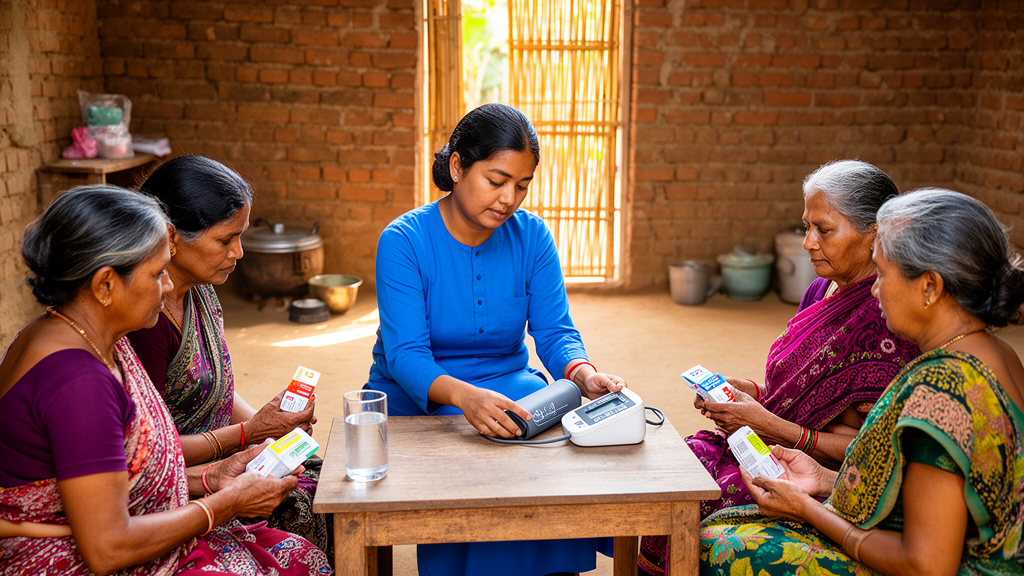
In a two-district longitudinal cohort study in Bangladesh, people living with lymphatic filariasis reported fewer acute attacks and less severe pain after training in an enhanced morbidity management and self-care protocol. Among 290 participants with mild, moderate or severe lymphoedema, the proportion reporting acute attacks fell to 25.2–35.2% after the intervention, while severe pain declined to 22.4–28.0%; both changes were reported with p-values below 0.001. The findings link the programme with improved self-reported outcomes, but the cohort design does not establish that the training alone produced the changes.
The research was conducted in Lalmonirhat and Thakurgaon districts during 2020–2021. Researchers assessed participants at baseline, trained them in enhanced self-care and then followed them after three months, with final assessments conducted at six months in Lalmonirhat and nine months in Thakurgaon. The measures included lymphoedema stage, acute attacks, pain, adherence and costs for self-care items such as soap, cream and pain relief. The baseline population covered the full severity range represented in the two districts, although the proportions with mild, moderate and severe disease varied: mild cases accounted for 11.2–54.7%, moderate cases 21.9–39.5% and severe cases 23.4–49.3%.
Before training, acute attacks and severe pain were widespread. Across the district and follow-up ranges, 62.8–79.6% of participants reported acute attacks and 40.6–54.6% reported severe pain. After the enhanced protocol, the corresponding ranges were 25.2–35.2% and 22.4–28.0%, respectively. These are reported longitudinal associations rather than proof of a causal effect. The study followed one cohort of people affected by filarial lymphoedema, used self-reported clinical outcomes and provided different final observation periods for the two districts, limiting how broadly the results can be generalized.
The study also found that self-care imposed a continuing out-of-pocket burden. Baseline monthly expenditure for participants’ self-care items ranged from 195.3 to 215.2 Bangladeshi taka, equivalent to US$2.29–2.53 in the source report. People with severe lymphoedema spent significantly more each month than those with mild disease in both districts: averages were 234.3 versus 159.2 BDT in Lalmonirhat and 234.2 versus 172.0 BDT in Thakurgaon, with both p-values below 0.05. Total monthly spending remained broadly stable over time, but its composition changed significantly, with spending shifting toward soap and cream and expenditure on pain relief decreasing, at p<0.001. Exploratory mixed-effects analyses found that higher expenditure was independently associated with follow-up time, district and greater baseline lymphoedema severity. Taken together, the results indicate that enhanced self-care training was associated with fewer reported acute attacks and less severe pain, while the financial burden of home care persisted, especially among participants with severe disease.
Subject of Research: Clinical outcomes and household costs of enhanced lymphoedema self-care in Bangladesh
Article Title: Evaluating the cost of self-care: Impact of enhanced morbidity management protocol on people living with lymphatic filariasis in Bangladesh
Article References: Williams, T., Karim, M. J., Siddiqui, S., Fazlur Rahman, A., Chowdhury, S., Jahan, S., AMS, S. M., Forbes, S. P., Betts, H., Taylor, M. J., & Kelly-Hope, L. A. (2026). Evaluating the cost of self-care: Impact of enhanced morbidity management protocol on people living with lymphatic filariasis in Bangladesh. PLOS Neglected Tropical Diseases, 20(10), e0014812. https://doi.org/10.1371/journal.pntd.0014812
Image Credits: AI Generated
DOI: 10.1371/journal.pntd.0014812
Keywords: lymphatic filariasis, lymphoedema, self-care training, Bangladesh, acute attacks, chronic pain, healthcare costs, out-of-pocket spending, longitudinal cohort, morbidity management, Evaluating, cost
Cite Scienmag News
Ophelia Keating. (October 22, 2026). Self-care training linked to fewer attacks, persistent costs in Bangladesh. Scienmag. https://scienmag.com/self-care-training-linked-to-fewer-attacks-persistent-costs-in-bangladesh/
Ophelia Keating. "Self-care training linked to fewer attacks, persistent costs in Bangladesh." Scienmag, 22 October 2026, https://scienmag.com/self-care-training-linked-to-fewer-attacks-persistent-costs-in-bangladesh/. Accessed 22 October 2026.
Ophelia Keating. "Self-care training linked to fewer attacks, persistent costs in Bangladesh." Scienmag. October 22, 2026. https://scienmag.com/self-care-training-linked-to-fewer-attacks-persistent-costs-in-bangladesh/


