


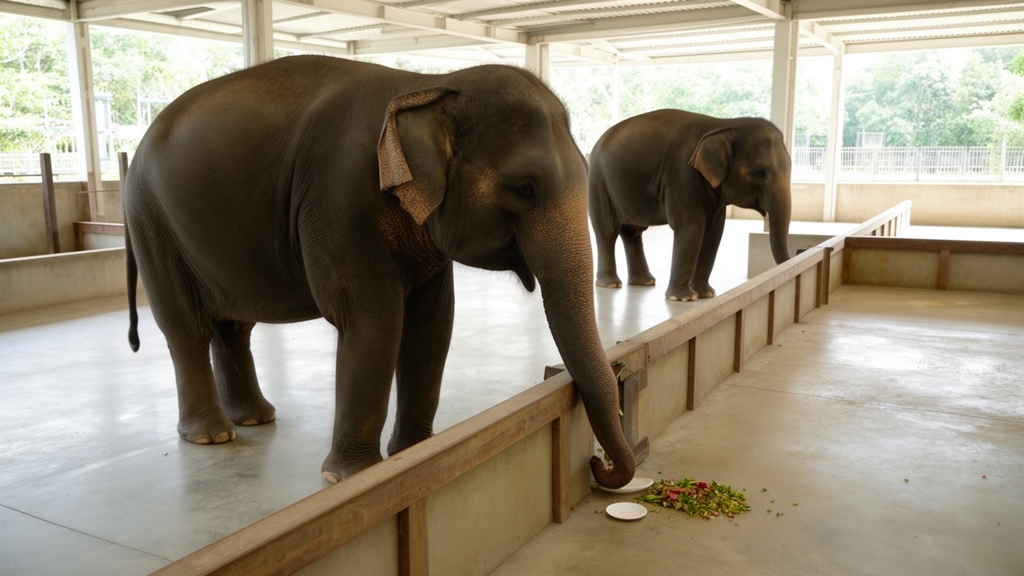
Sixteen Asian elephants tested at the National Elephant Institute in Thailand were generally able to suppress an immediate response to visible food and adjust their behavior when the route to a reward changed, providing the first evidence reported by the research team that the species demonstrates this form of inhibitory control. The peer-reviewed detour study, led by CUNY Graduate Center and Hunter College psychology professor Joshua Plotnik and postdoctoral researcher Sydney Hope, used a controlled task to examine whether the elephants could resist an automatic or previously learned response in favor of a more appropriate action. The finding suggests that elephant decision-making involves more than acting on a direct reward-seeking impulse, although the small sample, single testing site and restricted task limit how broadly the results can be generalized.
Each participating elephant was presented with a transparent box containing fruit. The animals could see and smell the food through small holes in the box, creating an opportunity to reach directly toward the reward. A separate opening on the side provided an indirect route. The elephants learned to inhibit the direct approach and use the side opening instead. In practical terms, the animals had to pass up the most immediate way of obtaining food in order to follow a less direct but effective strategy. Postdoctoral researcher Sydney Hope said the study showed that the elephants could suppress both the impulse to reach directly toward the food behind the transparent barrier and the impulse to continue using a previously effective technique when circumstances changed.
The researchers then rotated the box, relocating the opening. The elephants initially reached toward the position where the opening had been, demonstrating their initial reliance on the previously successful strategy. They were nevertheless able to withhold that response and quickly learn to use the opening in its new location. This stage tested behavioral flexibility: an animal had to recognize that its established response was no longer the appropriate one and alter course rather than continue applying the learned method. Together, the two stages of the detour task showed that the elephants could generally inhibit an immediate food-seeking response and revise an acquired behavior when the environment changed. The result was not presented as evidence that every elephant performed equally or that inhibitory control operates in the same way across every situation.
Age was associated with performance during the adaptation phase: older elephants took longer than younger elephants to adjust to the relocated opening. The researchers said the pattern could point to age-related changes in cognitive flexibility, but they cautioned that additional research is needed to determine whether the difference reflects cognitive decline. The study therefore does not establish that aging reduces inhibitory control. Its conclusions are also bounded by the number of participating animals, the use of one controlled detour task and the specific experimental setting at the National Elephant Institute. The supplied publication record classifies the work as an observational study of animals and reports its publication in PLOS ONE on September 9, 2026.
The experiment adds to a broader body of elephant-cognition research led by Plotnik and his collaborators, which has previously reported that elephants can recognize themselves in mirrors, console distressed companions, coordinate actions with partners and solve novel problems. The new result supplies a focused behavioral measure of the ability to withhold a response and adapt when conditions change. That capability could be relevant to how elephants respond to obstacles, decisions about risk and changing human-dominated environments, but the experiment did not directly test wild behavior or measure whether stronger inhibitory control reduces conflict with people. The authors said further understanding of how elephants make decisions and adapt to environmental change could eventually help researchers design better strategies for human-elephant coexistence. This is a potential conservation application rather than a demonstrated outcome of the study, and further work would be required to connect laboratory cognitive performance with behavior in shared landscapes.
Subject of Research: Inhibitory control and behavioral flexibility in 16 Asian elephants tested in Thailand
Article Title: Researchers find Asian elephants can resist impulsive behavior
Article References: Researchers find Asian elephants can resist impulsive behavior. Original publication (Bibliographic details unavailable.)
Image Credits: AI Generated
DOI: Not provided
Keywords: Asian elephants, inhibitory control, behavioral flexibility, detour task, elephant cognition, decision-making, animal psychology, Thailand, cognitive aging, conservation, Researchers, find
Cite Scienmag News
Glenn Wilkins. (October 22, 2026). Study of 16 Asian elephants links inhibitory control to flexible detour behavior. Scienmag. https://scienmag.com/study-of-16-asian-elephants-links-inhibitory-control-to-flexible-detour-behavior/
Glenn Wilkins. "Study of 16 Asian elephants links inhibitory control to flexible detour behavior." Scienmag, 22 October 2026, https://scienmag.com/study-of-16-asian-elephants-links-inhibitory-control-to-flexible-detour-behavior/. Accessed 22 October 2026.
Glenn Wilkins. "Study of 16 Asian elephants links inhibitory control to flexible detour behavior." Scienmag. October 22, 2026. https://scienmag.com/study-of-16-asian-elephants-links-inhibitory-control-to-flexible-detour-behavior/


