


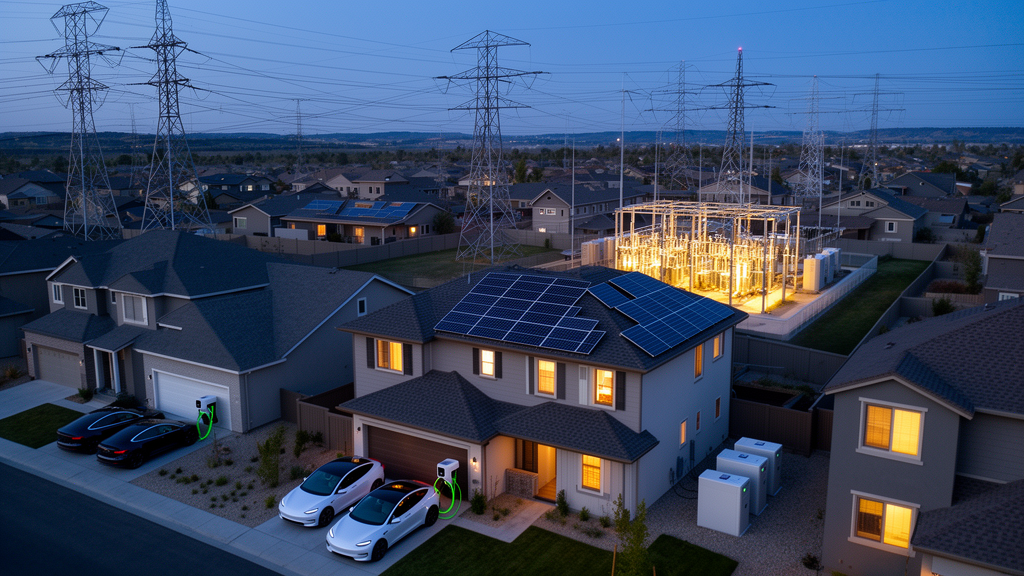
A University of Michigan-led study projects that broader adoption of building technologies, particularly heat pumps, could reshape extreme peak electricity demand across the United States by 2060, with technology diffusion producing larger changes than climate change in many regions. The researchers modeled heating- and cooling-related demand in 183 counties under four climate-change scenarios and 18 technology-diffusion pathways. Their results show that future peak demand will vary by regional climate and by the pace and type of technology adoption, rather than following one nationwide trajectory.
Senior author Michael Craig, an associate professor at the University of Michigan’s School for Environment and Sustainability and Department of Industrial and Operations Engineering, said the study is intended to help power systems remain reliable during unusually demanding periods. “We focused on the extreme peak demands because we want to keep our power systems reliable,” said postdoctoral research fellow Mai Shi. “If the system works for moderate conditions but fails in extremes, it doesn’t work.
That’s not how we build the power grid. We need to plan for extremes.” The analysis therefore concentrates on the most demanding peaks in electricity use rather than on average consumption across the year. Published in the Proceedings of the National Academy of Sciences, the study examined how two changes could affect building electricity demand between 2020 and 2060.
The first was climate change, which is associated with rising global temperatures and more intense and frequent heat waves. The second was the spread of technologies that can improve building heating and cooling, including insulation and heat pumps. The team used machine-learning algorithms to model demand, considering scenarios with technology diffusion alone, climate change alone and both forces acting together.
A scenario without technology diffusion and one without climate change helped the researchers distinguish their separate contributions and examine how their combined effects could evolve. When the model considered climate change alone, extreme peak demand was projected to increase by 3% to 9% over the four-decade period everywhere except the Northwest. In regions outside the Northwest, the modeled peaks were driven by cooling demand.
The Northwest was the exception because its extreme peaks were driven by heating, and the climate-change-only scenario produced a projected 3% decrease in those peak-demand extremes. This result is a projection from the model for the period studied, not a measured trend or a direct observation of how demand has already changed. Technology diffusion alone produced a markedly different pattern.
In the model without climate change, increasing heat-pump adoption raised extreme peak demand by 60% to 104% in cold regions such as the Northeast and Midwest, where the additional electricity demand was associated with heating requirements. In more temperate regions, including parts of the Southwest and Southeast, the increases were closer to 15%. In hot regions such as Texas and California, the model projected decreases in extreme peak demand as heat pumps became more common.
The contrast shows why the regional setting matters: the modeled effect of a technology transition can differ substantially depending on whether heating or cooling produces the local extreme and how the technology performs under those conditions. Heat pumps are electrified systems for heating and cooling that can offer substantial efficiency gains compared with air conditioners. However, their fully electric operation places a greater burden on the electricity system than conventional fossil-fuel systems such as gas furnaces.
Their efficiency also drops as outdoor temperatures become colder. As a result, wider heat-pump adoption can increase electricity demand for winter heating even though the equipment is more efficient than the systems it replaces. The modeled increases in cold regions reflect the combination of heating requirements, reduced heat-pump performance in cold conditions and the electrification of equipment previously able to use fossil fuels.
When climate change and technology diffusion were considered together, the combined result was more complicated than simply adding the two separate projections. Rising temperatures can improve heat-pump efficiency during winters in cold regions, reducing some of the demand effect associated with wider adoption. In hot regions, warming increases extreme peak demand through cooling requirements, but technology diffusion mitigates that increase compared with the climate-change-only scenario.
The two forces can therefore partly offset one another in some locations. A warming climate can simultaneously increase summer cooling loads, reduce winter heating requirements and alter the efficiency of equipment used to meet both needs. The researchers emphasized substantial uncertainty in the results.
The 18 technology pathways and four climate scenarios were intended to represent a range of possible futures, but the analysis does not identify one pathway as inevitable. The projections are model estimates rather than observations of future events, and they are limited to the study’s 2020–2060 period, county population and assumptions about heating, cooling, climate change and building-technology diffusion. Despite that uncertainty, the authors said the results may help utilities and policymakers consider how regional incentives and regulations could influence technology adoption.
Shi noted that an individual region can do little on its own to limit climate change, but studies of this kind can help regions consider which technology paths they want to encourage. The comparison does not mean climate change should be ignored. “Climate change still matters a lot,” Craig said, adding that it remains an important source of risk and uncertainty for power-system planning.
Overall, the study portrays future peak electricity demand as a regional and scenario-dependent challenge. Climate change alone is projected to amplify most modeled extreme peaks, with the Northwest behaving differently because its demand extremes are driven by heating. Technology diffusion alone produces much larger modeled increases in cold areas, more moderate increases in temperate areas and reductions in hot areas as heat pumps replace other systems.
The central planning implication is that projected changes in heating and cooling demand should be considered alongside the pace and regional pattern of building-technology adoption when preparing for future extremes in electricity use through 2060.
Subject of Research: Modeled effects of climate change and building-technology adoption on U.S. peak electricity demand
Article Title: How climate change, new technology are shaping the future of extremes in peak power demands
Article References: How climate change, new technology are shaping the future of extremes in peak power demands. Original publication (Bibliographic details unavailable.)
Image Credits: AI Generated
DOI: Not provided
Keywords: peak electricity demand, heat pumps, climate change, technology diffusion, power grid, building electrification, heating demand, cooling demand, energy efficiency, U.S. counties, machine learning, PNAS
Cite Scienmag News
Denise Maddox. (October 22, 2026). Technology adoption could reshape U.S. peak electricity demand by 2060. Scienmag. https://scienmag.com/technology-adoption-could-reshape-u-s-peak-electricity-demand-by-2060/
Denise Maddox. "Technology adoption could reshape U.S. peak electricity demand by 2060." Scienmag, 22 October 2026, https://scienmag.com/technology-adoption-could-reshape-u-s-peak-electricity-demand-by-2060/. Accessed 22 October 2026.
Denise Maddox. "Technology adoption could reshape U.S. peak electricity demand by 2060." Scienmag. October 22, 2026. https://scienmag.com/technology-adoption-could-reshape-u-s-peak-electricity-demand-by-2060/


