


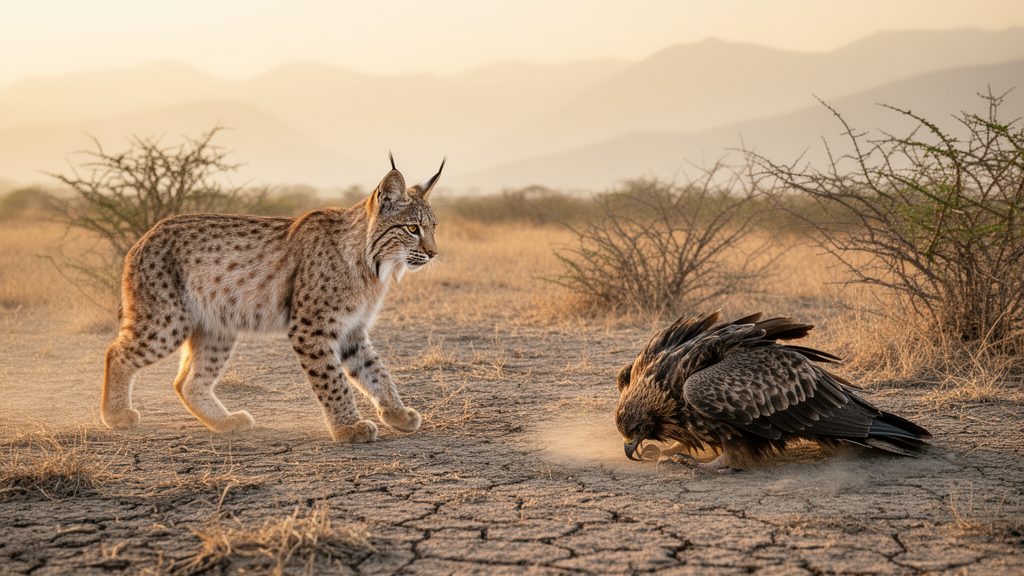
A three-decade field study in Doñana National Park found that Iberian lynx began killing black kite nestlings after rabbit haemorrhagic disease sharply reduced the rabbits that both predators eat, with the attacks occurring only during drought years. The study suggests that low rabbit availability and the drying of the marsh created conditions in which lynx increasingly targeted another top predator. The research focused on a 10-square-kilometre plot in the northern part of Doñana, a seasonally flooded wetland in southwestern Spain.
The area supported a relatively stable population of four to six adult Iberian lynx, including two to three males and two to three females, and 105 to 223 black kite breeding pairs. Black kites represented 82–90% of the local raptor assemblage. The two species shared an important food resource: European rabbits.
Before the rabbit population collapsed, rabbits made up as much as 80% of the black kite diet, with a mean of 58%, while previous work at Doñana found that rabbits accounted for 70–99% of the lynx diet. That shared food base began to deteriorate in 2013, when a new variant of rabbit haemorrhagic disease spread from commercial breeding facilities into wild rabbit populations across the Iberian Peninsula. The local rabbit population declined by more than 70%.
As rabbit scarcity increased, both predators could potentially broaden their diets. Black kites were already capable of taking birds, fish, reptiles and crayfish, while earlier research showed that lynx shifted toward ducks and other waterbirds when rabbits were scarce. The loss of rabbits therefore coincided with reduced access to alternative prey when droughts caused most of Doñana’s marshes to dry.
Investigators classified a year as a drought when the minimum inundated area in February and March was below 20% of the maximum flooding recorded since 1975, meaning that more than 80% of the wetlands were dry. The classification was based on Landsat-derived inundation maps covering 684 square kilometres of marshes, inland ponds and lagoons. Under this definition, droughts occurred in 1993, 1999, 2005, 2012, 2016, 2018, 2019, 2022 and 2023.
A broader category of climatic anomalies also included exceptionally high spring temperatures and late heavy rainfall; models using that category produced results equivalent to the drought analysis. The team monitored black kite nests throughout the breeding cycle, checking them every 10–15 days when possible and climbing nests when young were 40–45 days old. They recorded fledging success, prey remains inside nests and remains on the ground below them.
Lynx predation had a characteristic pattern: chicks were killed in the nest, carried to the ground, and plucked or partly plucked before being consumed. Mammalian-carnivore pluckings could be distinguished from raptor pluckings because carnivores cut and chewed feathers, whereas raptors generally extracted them without severing them. The researchers found no lynx attacks on younger nestlings in more than 13,000 hours of nest photography or in hundreds of nest checks.
The annual predation analysis included 1,624 nests across 25 years from 1993 to 2023. Only years in which at least 20 nests could be assessed were included, and nests that failed before reaching the well-feathered stage targeted by lynx were excluded from the predation denominator. Statistical models tested the effects of rabbit availability, drought and their interaction.
Rabbit density was measured directly from 2005 onward; earlier estimates were reconstructed from the proportion of rabbits in the diets of black kites in the study area. The clearest pattern was an interaction between drought and low rabbit abundance: lynx attacks were concentrated in dry years, whereas black kites and lynx continued to coexist without routine nest attacks in wetter years after the rabbit crash. An analysis of 108 lynx-predated nests offered further evidence that the circumstances surrounding individual territories mattered.
For each attacked nest, researchers selected a successful nest from the same year and compared nest height, brood size, distance to the marshes and distance to the nearest attacked nest. They also examined prey remains beneath nests. The pattern was consistent with lynx encountering rabbit remains beneath kite nests and, in drought years, killing the kite chicks.
The study did not establish whether nutritional gain, competitive effects or another factor determined the lynx’s decision, and it did not prove that lynx deliberately sought out competitors. For marked black kite adults, brood predation had consequences beyond the loss of an individual nesting attempt. Matched comparisons showed that adults whose broods were taken by lynx had lower lifetime reproductive success, and territory abandonment or dispersal was more frequent in the following breeding season.
These observations support the conclusion that lynx predation imposed a fitness cost and affected the movements of kites. The authors describe the situation as suggestive of a new arms race among predators, but the study did not demonstrate evolutionary change in either species or show that kites developed new defences. The interaction was also associated with a change lower in the food web.
Black kites prey on little owls: researchers found 26 little-owl individuals among kite nest remains and directly witnessed three attempts to capture little owls, one of which succeeded. Annual kite abundance was related to the previous year’s lynx predation rate, and little-owl abundance was associated with kite abundance and the predation interaction. A reduction in kite numbers was associated with an increase in the insectivorous little owl.
The study demonstrates how separate pressures can combine to expose an interaction that had not been apparent during long periods of neutral coexistence. Rabbit disease reduced the abundance of the principal prey shared by lynx and kites, while drought reduced the availability of alternative foods and changed the ecological setting in which the predators lived. The long-term nest records, monitoring of marked birds and comparisons among wet and dry years support the finding that lynx predation of black kite nestlings occurred specifically under drought conditions and was associated with rabbit remains below the nests.
The research was nevertheless limited to one Mediterranean wetland and one focal predator module.
Subject of Research: Drought- and disease-driven interactions between Iberian lynx and black kites in Doñana National Park
Article Title: Drought and disease trigger novel interactions among top predators
Article References: Sergio, F., Natsukawa, H., Tanferna, A., Chicano, J., Carro, F., Soriguer, R. C., Hiraldo, F., & Blas, J. (2026). Drought and disease trigger novel interactions among top predators. Nature. https://doi.org/10.1038/s41586-026-11194-z
Image Credits: AI Generated
DOI: 10.1038/s41586-026-11194-z
Keywords: Iberian lynx, black kite, Doñana National Park, drought, rabbit haemorrhagic disease, intraguild predation, wildlife ecology, climate change, food-web interactions, little owl, disease, trigger
Cite Scienmag News
Gavin Prescott. (October 22, 2026). Drought and disease drove lynx to prey on black kites. Scienmag. https://scienmag.com/drought-and-disease-drove-lynx-to-prey-on-black-kites/
Gavin Prescott. "Drought and disease drove lynx to prey on black kites." Scienmag, 22 October 2026, https://scienmag.com/drought-and-disease-drove-lynx-to-prey-on-black-kites/. Accessed 22 October 2026.
Gavin Prescott. "Drought and disease drove lynx to prey on black kites." Scienmag. October 22, 2026. https://scienmag.com/drought-and-disease-drove-lynx-to-prey-on-black-kites/


