


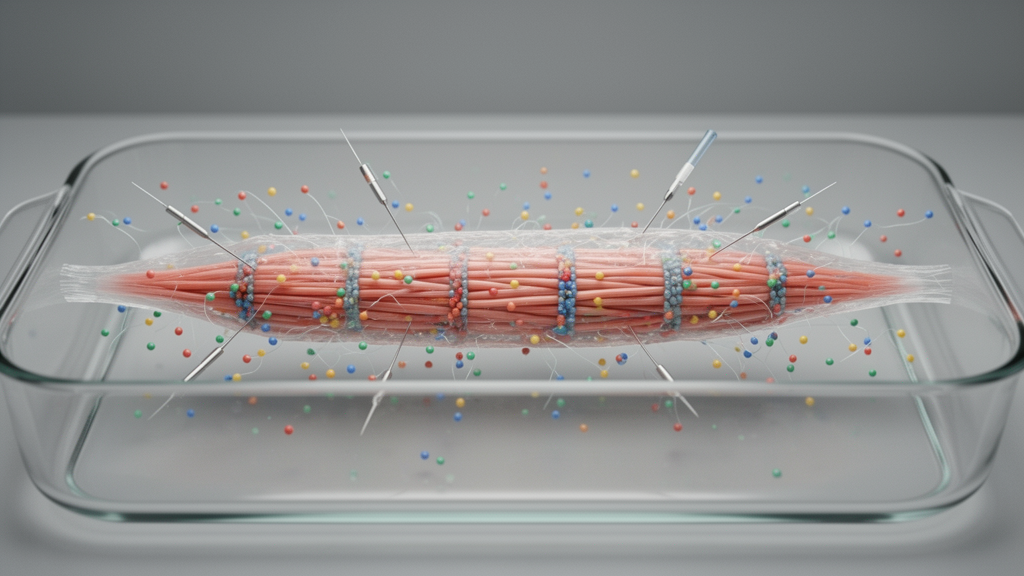
A proof-of-concept study of human skeletal muscle has identified a group of muscle fibres from critically ill patients that combine inflammatory gene activity, intracellular remodelling and altered myosin energy turnover. Researchers isolated individual fibres from quadriceps biopsies taken from eight patients with intensive-care-unit-acquired weakness and eight orthopaedic control donors, then measured gene expression, protein abundance and myosin ATP-turnover kinetics in the same cells. The combined analysis revealed an “Inflammatory” fibre state that was enriched among critically ill patients and associated with a prolonged ATP turnover time for myosin heads in the super-relaxed, or SRX, state.
The work addresses a central problem in critical-illness research: skeletal muscle can deteriorate rapidly, but the mechanisms linking whole-body inflammation to weakness in individual muscle cells remain incompletely defined. Patients may lose close to 2% of their muscle mass per day during the first week of intensive care, according to the study’s background. Such losses are associated with impaired mobility, metabolic dysfunction, longer hospital stays and higher mortality. Because a muscle biopsy contains a mixture of fibre types, proteins, RNA and other cells, conventional tissue-wide measurements can conceal biologically important variation between individual myofibres.
For the new analysis, the investigators divided each isolated fibre into segments. One segment was used in a Mant-ATP chase experiment, in which fluorescence decay after addition of ATP was used to estimate ATP turnover by myosin heads in two biochemical conformations. The disordered-relaxed state, designated DRX, is relatively active, whereas the SRX state has low basal ATPase activity. The other segment was processed for RNA sequencing and liquid chromatography-tandem mass spectrometry, and its spatial identity was linked to the functional measurements. Quality control retained 165 fibres for transcriptomics, 124 for proteomics and 117 with usable data from both molecular layers.
The sequencing data averaged 5.7 million reads per fibre and detected about 13,456 genes per sample, while mass spectrometry identified roughly 1,372 proteins per fibre with about 8% missing data. At the donor level, neither RNA nor protein abundance showed genome-wide differences between ICU-acquired weakness and control groups. Nevertheless, pathway-level transcript analysis indicated higher activity in ICU-associated fibres in processes including reactive oxygen species, cytokine signalling and protein secretion, alongside lower signals for metabolism, myogenesis and some immune-homeostasis pathways.
Hierarchical clustering then exposed a subset of fibres with consistently elevated expression of the most strongly differing genes. The resulting “Inflammatory” cluster contained 32 fibres from ICU-acquired weakness patients and one control fibre, and its members were distributed across all eight ICU donors. The cluster was not explained by the fibre’s myosin heavy-chain composition or by the number of genes detected. A donor-aware comparison identified 108 differentially expressed genes, 107 of which were increased in cluster fibres. Functional annotations included immune-cell activation, neutrophil degranulation, the respiratory burst, granulocyte chemotaxis and other immune or cytotoxic processes.
Protein measurements showed a partly different pattern. Relative to fibres outside the cluster, the inflammatory-state fibres had 277 differentially expressed proteins: 199 increased and 78 decreased. The increased proteins were enriched for mitochondrial functions, translation, ribosomal biogenesis and matrix remodelling, whereas the decreased proteins were associated with membrane-associated processes and surface-protein localisation. This difference between the RNA and protein annotations indicates that the inflammatory transcriptional state is accompanied by post-transcriptional or post-translational regulation, rather than a simple, uniform increase in stress-response molecules.
Intersecting the two molecular datasets identified 19 features significantly altered in both RNA and protein. Among the concordantly increased features were ACTN4 and MYL9, linked respectively to cytoskeletal anchoring and myosin ATPase regulation; H2AC4 and RPS9, associated with translation; and CTSG, TPSB2 and CDSN, which have immune-related functions. IDI1, involved in lipid metabolism and membrane biogenesis, was decreased in both layers. Other features changed in opposite directions at the RNA and protein levels, including AUH and NCK2, which had lower RNA but higher protein abundance. The investigators interpret the discordant patterns as consistent with selective protein stabilisation, degradation or secretion, although the study did not directly measure those processes.
The key functional difference was concentrated in the SRX myosin state. Fibres assigned to the Inflammatory cluster had a significantly longer SRX ATP-turnover time than non-cluster fibres, with p below 0.05, and their composite RNA-protein score differed significantly for this measurement, with p below 0.01. The disordered-relaxed turnover time, the proportions of myosin heads in the two states and calculated overall ATP consumption did not differ significantly. The result is a selective association with reduced basal ATPase activity in resting myosin, not a demonstrated change in the muscle’s maximum force-generating capacity.
Mechanistically, the findings are consistent with a stressed fibre prioritising intracellular maintenance and energy-preserving behaviour. Greater residence in the SRX state lowers the energetic cost of rest, which may help a fibre conserve resources during critical illness. It can also impede return to an active contractile state, potentially reducing available contractile power. The protein findings point toward mitochondrial and translational machinery, while changes involving ACTN4, MYL9 and other structural or energetic proteins are compatible with remodelling. These observations remain mechanistic associations: the small observational study did not test whether the molecular state causes weakness, whether lowering inflammation would restore myosin turnover, or whether the pattern predicts patient outcomes.
The authors describe the work as a proof of concept, and several limitations constrain how far it can be generalised. The sample included only 16 donors, with eight in each group, and its participants differed in age, sex, underlying conditions and geographic origin. Critical-illness fibres were sampled 6 to 13 days after ICU admission, while control fibres came from patients undergoing hip replacement for arthritis. No force measurements were included, so the practical effect of prolonged SRX turnover on contractile performance remains unknown, and the analysis did not examine post-translational modifications such as phosphorylation, acetylation or ubiquitination. Larger, more balanced cohorts, direct force testing and broader molecular measurements will be needed to determine whether the fibre state is reproducible, prevalent across different ICU populations and clinically useful for predicting weakness or guiding treatment.
Subject of Research: Single-fibre transcriptomic, proteomic and myosin-kinetic analysis of ICU-acquired muscle weakness
Article Title: Integrated Single‐Myofibre Multi‐Omics Correlates Inflammatory State to Myosin Energetics in ICU‐Acquired Weakness
Article References: Winant, A. M., Moreno‐Justicia, R., Paolini, L., Claassen, W. J., Ottenheijm, C. A. C., Deshmukh, A. S., Cattaneo, S., Piva, S., Latronico, N., Seaborne, R. A. E., & Ochala, J. (2026). Integrated Single‐Myofibre Multi‐Omics Correlates Inflammatory State to Myosin Energetics in ICU‐Acquired Weakness. Journal of Cachexia, Sarcopenia and Muscle, 17(5), Article e70407. https://doi.org/10.1002/jcsm.70407
Image Credits: AI Generated
DOI: 10.1002/jcsm.70407
Keywords: ICU-acquired weakness, skeletal muscle, single-fibre multi-omics, myosin, inflammation, critical illness, proteomics, RNA sequencing, bioenergetics, myofibres, Integrated, Single
Cite Scienmag News
Juliet Wilcox. (October 21, 2026). Single-fibre multi-omics links inflammation to altered myosin energetics in ICU weakness. Scienmag. https://scienmag.com/single-fibre-multi-omics-links-inflammation-to-altered-myosin-energetics-in-icu-weakness/
Juliet Wilcox. "Single-fibre multi-omics links inflammation to altered myosin energetics in ICU weakness." Scienmag, 21 October 2026, https://scienmag.com/single-fibre-multi-omics-links-inflammation-to-altered-myosin-energetics-in-icu-weakness/. Accessed 21 October 2026.
Juliet Wilcox. "Single-fibre multi-omics links inflammation to altered myosin energetics in ICU weakness." Scienmag. October 21, 2026. https://scienmag.com/single-fibre-multi-omics-links-inflammation-to-altered-myosin-energetics-in-icu-weakness/


