


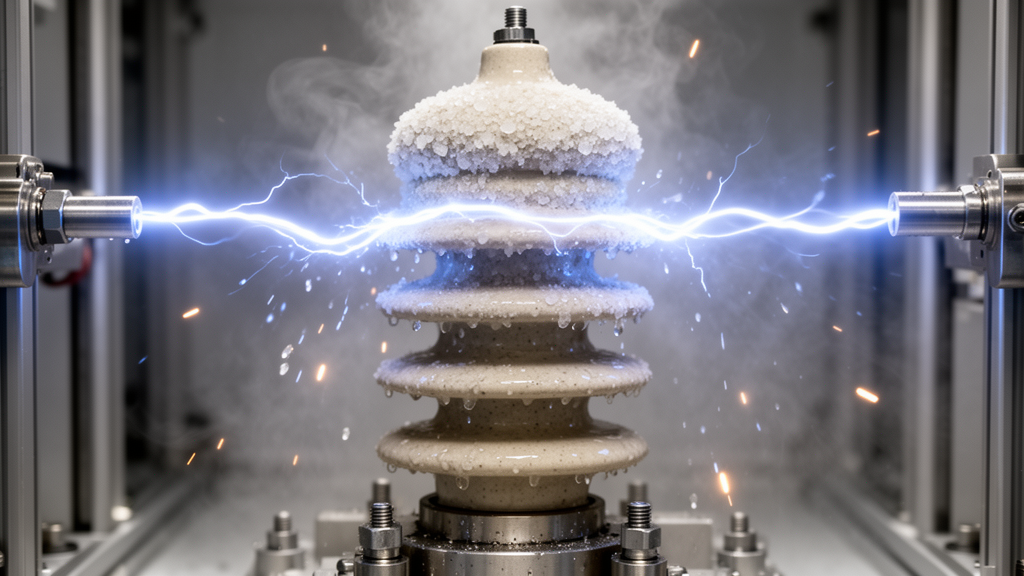
Researchers have developed a dynamic alternating-current discharge model for transmission-line insulators that explicitly accounts for the concentration-dependent conductivity of slightly soluble calcium sulfate, or CaSO4, in mixed salt pollution. The model combines laboratory conductivity measurements with simulations of moisture evaporation, dry-band formation, arc inception and arc propagation. In comparisons with artificial-pollution tests, its calculated flashover voltages differed from experimental values by no more than 10.0%, with an average relative error of 4.26%. The results indicate that treating all pollutants as equally soluble, as conventional pure-sodium-chloride equivalence methods do, can misrepresent an insulator’s behavior as its surface dries and an electrical arc develops.
The need for a more realistic model follows from the chemical complexity of outdoor contamination. Insulator surfaces collect soluble salts along with non-soluble deposits and are repeatedly wetted by fog, dew and drizzle. In a wet layer, dissolved salts ionize and provide conductive paths for leakage current. NaCl, a highly soluble salt commonly used in artificial pollution tests, behaves differently from CaSO4, whose limited dissolution causes conductivity to approach saturation as its concentration rises. Earlier work showed that flashover voltage can vary substantially with salt composition even at the same equivalent salt deposit density, but dynamic changes in pollution-layer conductivity during heating and evaporation had not been adequately represented.
To characterize that behavior, the team measured the electrical conductivity of analytically pure CaSO4 and NaCl solutions with purities above 99%, as well as mixtures containing different proportions of the two salts. Solutions were heated from 20 to 70 degrees Celsius in five-degree intervals under continuous stirring, with conductivity recorded by an instrument spanning 0.00 microsiemens per centimeter to 200 millisiemens per centimeter. The maximum water-bath temperature was limited to 70 degrees Celsius to limit evaporation-related changes in solution concentration. CaSO4 conductivity followed an exponential saturation curve with concentration, whereas NaCl conductivity increased approximately linearly. Global fits produced coefficients of determination, or R-squared values, of 0.995 for the CaSO4 relationship and 0.997 for the NaCl relationship.
The fitted equations separated the effects of temperature and concentration within the experimental range. For CaSO4, the limiting saturation conductivity was 2.285 millisiemens per centimeter, the dissolution-rate constant was 0.519 liters per gram and the temperature coefficient was 0.0199 per degree Celsius. For NaCl, the conductivity constant was 1.419 and the temperature coefficient was 0.0238 per degree Celsius. Mixed solutions conducted less electricity than a simple sum of their single-component conductivities, requiring a fitted suppression term for interactions among the ions. The mixed-solution interaction constant was 0.01941, with an equivalent temperature coefficient of 0.01891 per degree Celsius and an R-squared value of 0.993. The authors attribute the reduced mixed-solution conductivity to stronger electrostatic interactions involving multivalent calcium and sulfate ions, increased opportunities for oppositely charged ions to form neutral pairs or charged complexes, and the resulting loss of free conductive ions.
The equations were then embedded in a full-process discharge model for an XP-160 porcelain suspension insulator. Rather than using a simplified rectangle, the researchers used a true-form unfolding method that retained the insulator’s actual geometry and converted its creepage path into a planar equivalent. The model divided the surface into differential segments, each with a water-film thickness, temperature and conductivity that could change during the calculation. It coupled leakage-current heating to moisture loss using Dalton’s evaporation law and a balance between Joule heating and evaporative cooling. A dry band formed when a segment’s liquid layer reached zero thickness, concentrating the electric field. Arc inception was triggered when the local field exceeded the adopted surface-air breakdown threshold of 5 kilovolts per centimeter.
After inception, the calculation represented a single arc in series with the remaining pollution-layer resistance, following the Obenaus formulation for an alternating-current discharge. Nonlinear leakage current was solved with the Newton-Raphson method, while the Claverie condition was used to determine whether an arc could reignite. Hampton’s energy criterion and a local arc-propagation criterion assessed whether the discharge could continue. The numerical setup used a spatial increment of 0.1 centimeters, a time increment of 1 millisecond and a voltage increment of 10 volts. For validation, the researchers compared the model with artificial-pollution flashover results from seven-unit insulator strings, converting measured voltages to equivalent single-unit values because flashover voltage was reported to vary approximately linearly with string length for strings of up to seven units.
The validation covered salt deposit densities of 0.06, 0.10 and 0.25 milligrams per square centimeter and mixtures containing 0% to 100% NaCl, with the remainder CaSO4. Across the reported comparisons, calculated flashover voltage decreased as salt deposit density increased, and the calculated values followed a negative power relationship with an R-squared above 0.995. The maximum relative difference between model and test values was 10.0%, while the average was 4.26%. A separate comparison showed why the saturation effect matters: when CaSO4 concentration was modeled as approximately linear below 2 grams per liter, the model predicted lower flashover voltages and increasing divergence from experimental results as salt deposit density rose. Including saturation therefore produced the closer match within the studied range.
Simulations at an ambient temperature of 20 degrees Celsius, a non-soluble-deposit to salt-deposit ratio of 3.5 and an equal salt mixture revealed a sequence of events near the steel pin, where current density and Joule heating were greatest. Conductivity first increased because heating accelerated ion motion and evaporation increased concentration, but it then fell sharply as the aqueous network disappeared. The electric field remained nearly stable during early drying before surging as a dry band approached. It crossed the breakdown threshold, initiating a partial arc. Higher salt deposit density increased initial leakage current, accelerated evaporation and shortened dry-band formation and arc-inception times. After inception, the arc initially grew almost linearly in length and accelerated sharply just before full flashover; higher salt deposit density also reduced the time needed for propagation.
Composition affected the sequence in more complicated ways. At the same salt deposit density, mixtures with more CaSO4 began with lower conductivity but required a higher critical flashover voltage. Near the end of drying, the larger voltage produced a stronger late-stage electric field and more concentrated Joule heating, allowing arc inception earlier in some conditions. Once the arc existed, however, greater CaSO4 content made continuation more demanding because it disrupted conductive continuity in the residual layer, and the arc required longer to propagate. Immediately before complete flashover, the more severe field distortion in CaSO4-rich layers generated a stronger driving force and a higher instantaneous peak propagation velocity. The study therefore presents a modeling framework rather than a field trial: it is based on laboratory solution measurements, a specified porcelain insulator geometry and comparison with artificial-pollution tests, and its applicability to other designs, natural contaminants or operating environments would require further evaluation.
Subject of Research: Dynamic modeling of AC flashover on insulators polluted with calcium sulfate and sodium chloride
Article Title: An AC dynamic discharge model for insulators considering the conductivity concentration saturation characteristics of slightly soluble pollution
Article References: Yang, Z., Zhou, J., Zhang, F., Chen, C., & Zeng, X. (2026). An AC dynamic discharge model for insulators considering the conductivity concentration saturation characteristics of slightly soluble pollution. Results in Engineering, 32, Article 113485. https://doi.org/10.1016/j.rineng.2026.113485
Image Credits: AI Generated
DOI: 10.1016/j.rineng.2026.113485
Keywords: insulator flashover, calcium sulfate, sodium chloride, pollution conductivity, AC discharge, dry-band formation, arc propagation, leakage current, power transmission, dynamic modeling, dynamic, discharge
Cite Scienmag News
Denise Maddox. (October 21, 2026). Dynamic model captures salt-driven flashover on polluted insulators. Scienmag. https://scienmag.com/dynamic-model-captures-salt-driven-flashover-on-polluted-insulators/
Denise Maddox. "Dynamic model captures salt-driven flashover on polluted insulators." Scienmag, 21 October 2026, https://scienmag.com/dynamic-model-captures-salt-driven-flashover-on-polluted-insulators/. Accessed 21 October 2026.
Denise Maddox. "Dynamic model captures salt-driven flashover on polluted insulators." Scienmag. October 21, 2026. https://scienmag.com/dynamic-model-captures-salt-driven-flashover-on-polluted-insulators/


