


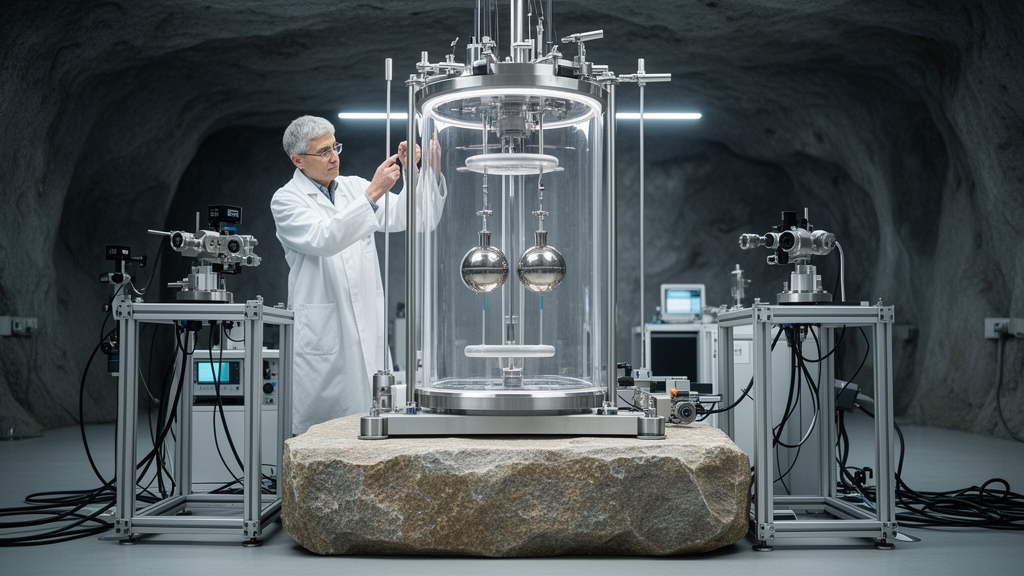
An underground experiment found no signal matching a generalized model in which tiny fluctuations of spacetime cause quantum superpositions to erode. The null result, reported by researchers from Italy’s Gran Sasso National Laboratory, excludes the tested version of the Károlyházy gravity-induced decoherence model within the experiment’s sensitivity. It does not establish that gravity has no role in quantum decoherence, nor does it rule out other theories connecting gravitation and quantum mechanics.
The peer-reviewed study collected data for 62 days and was published in the New Journal of Physics in June 2026. The investigation targeted a theoretical proposal developed in the 1960s by Hungarian physicist Frigyes Károlyházy. His model suggests that spacetime is continually rippling with tiny fluctuations.
These fluctuations could progressively disturb quantum superpositions and prevent macroscopic objects from remaining in the combinations of distinct states imagined in Schrödinger’s cat thought experiment. The idea has since been revived, refined and reformulated by researchers seeking to understand the relationship between general relativity and quantum physics. The experiment tested a generalized version of that model rather than every gravity-induced decoherence proposal.
Although the predicted spacetime fluctuations cannot be observed directly, the model links them to a possible electromagnetic signature. If the fluctuations exist, they should cause charged particles to jiggle and accelerate randomly, leaving trails of electromagnetic radiation. The signal expected from this process is extremely faint and can be hidden by electromagnetic background from sources such as cosmic rays.
The researchers therefore searched for radiation with the signature predicted by the generalized Károlyházy model, rather than attempting to measure spacetime fluctuations directly. The Gran Sasso National Laboratory, operated by Italy’s National Institute for Nuclear Physics beneath 1.4 kilometers of rock, provided the setting for the search. The underground site is described as one of the quietest environments on Earth for detecting extremely rare physical phenomena.
Its natural shielding suppresses environmental electromagnetic radiation that could obscure the effect sought by the team. The location made it possible to collect data in a low-background setting, although the absence of a detected signal applies specifically to the model and experimental conditions tested. The detector was built around a coffee-mug-sized piece of high-purity germanium crystal, enclosed by layers of copper and lead shielding.
Over the 62-day measurement period, the team collected data, subtracted the expected background radiation and searched the remaining measurements for a signal matching the model’s prediction. No such signal was detected. In this setting, the absence of the predicted radiation is the experimental finding itself: it constrains the generalized Károlyházy model rather than supporting the existence of the proposed gravitational mechanism.
The study is an experimental test of a specific theoretical hypothesis, not an observation of decoherence in a macroscopic object and not a direct measurement of gravity’s role in the transition from quantum behavior to classical reality. Its scope is also limited to the generalized model, the predicted radiation signature and the sensitivity achieved by the germanium detector, shielding and analysis. A null result cannot exclude models that predict different observable effects or signals outside those conditions.
The result therefore narrows the experimental search while leaving the broader question of a gravitational link with decoherence unresolved. “This absence of a signal is itself a major scientific result,” said Catalina Curceanu, a member of the Foundational Questions Institute and director of research and spokesperson for the VIP Collaboration at the National Laboratory of Frascati of the National Institute for Nuclear Physics. She said the experiment rules out one of the oldest and most natural gravity-induced decoherence models, bringing researchers one step closer to understanding the interplay between gravity and quantum mechanics.
In that sense, the study changes a speculative possibility into an experimentally constrained proposal. The theoretical context extends beyond the particular model that was excluded. Károlyházy’s proposal rests on the idea that there is a fundamental limit to the precision with which an object’s position can be specified and length can be measured.
According to Kristian Piscicchia, a quantum physicist at the Enrico Fermi Research Center/INFN/VIP and the experimental lead on the study, this feature has become a common thread in many contemporary approaches to uniting quantum physics and gravity, including string theory and loop quantum gravity. The Gran Sasso experiment illustrates how a specific consequence of such a theory can be tested without directly observing the complete theory. Curceanu described the broader experimental development in similarly measured terms.
“Precision experiments are now reaching a level of sensitivity where they can test ideas that, until recently, belonged almost exclusively to the realm of theoretical speculation,” she said. “As sensitivity improves, the boundary between theory and measurement continues to move, opening new possibilities for discovering the fundamental principles that govern our universe.” The result therefore extends the reach of laboratory inquiry into a question often treated as belonging entirely to theory, while retaining the specific limits imposed by the search for a predicted radiation signal. The paper, “Experimental exclusion of a generalized Károlyházy gravity-induced decoherence model,” was authored by Nicola Bortolotti, Kristian Piscicchia, Alessio Porcelli, Matthias Laubenstein, Simone Manti, Antonino Marcianò, Federico Nola and Catalina Curceanu.
It appeared in New Journal of Physics, volume 28, article 064511, on 19 June 2026. The research was supported by the Foundational Questions Institute through its Consciousness in the Physical World program.
Subject of Research: Experimental testing of gravity-induced quantum decoherence
Article Title: What kills Schrödinger’s cat?
Article References: What kills Schrödinger’s cat?. Original publication (Bibliographic details unavailable.)
Image Credits: AI Generated
DOI: Not provided
Keywords: quantum decoherence, gravity-induced decoherence, Károlyházy model, quantum gravity, Gran Sasso, underground experiment, germanium detector, spacetime fluctuations, general relativity, kills, Schr, dinger
Cite Scienmag News
Katie Riggs. (October 21, 2026). Underground Test Excludes a Leading Gravity-Based Decoherence Model. Scienmag. https://scienmag.com/underground-test-excludes-a-leading-gravity-based-decoherence-model/
Katie Riggs. "Underground Test Excludes a Leading Gravity-Based Decoherence Model." Scienmag, 21 October 2026, https://scienmag.com/underground-test-excludes-a-leading-gravity-based-decoherence-model/. Accessed 21 October 2026.
Katie Riggs. "Underground Test Excludes a Leading Gravity-Based Decoherence Model." Scienmag. October 21, 2026. https://scienmag.com/underground-test-excludes-a-leading-gravity-based-decoherence-model/


