


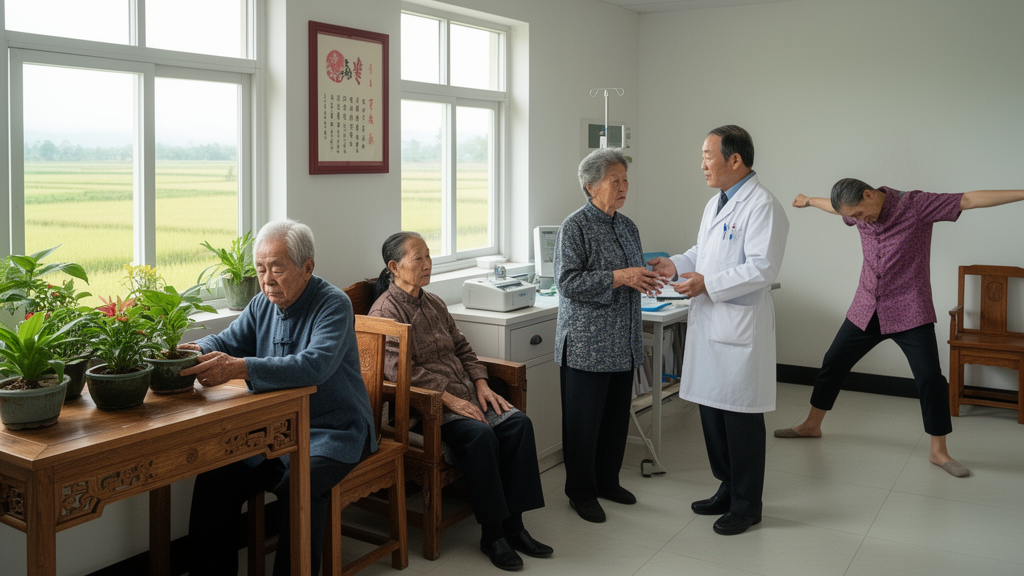
Older adults with chronic diseases in rural Guizhou, China, showed four distinct patterns of depressive and anxiety symptoms in a cross-sectional study of 3,200 people aged 60 or older. The most common profile, observed in 34.31% of participants, combined severe depressive and anxiety symptoms, while other groups had moderate combined symptoms, moderate depression with low anxiety, or minimal symptoms. The findings show substantial variation in mental health experiences within the same population.
Researchers collected data between May and October 2024. Depressive symptoms were assessed with the PHQ-9 and anxiety symptoms with the GAD-7. They applied latent class analysis to the symptom responses, identifying four classes that best represented the patterns in the sample. These classes describe differences in symptom severity and combination; they are not groups defined by formal diagnoses of depression or anxiety.
The prevalence estimates depended on how symptoms were counted. Using any symptom endorsement, defined as PHQ-9 scores of at least 5 or GAD-7 scores of at least 5, 66.7% of participants had depressive symptoms and 56.0% had anxiety symptoms. At the standard clinical cutoffs of PHQ-9 scores of at least 10 and GAD-7 scores of at least 10, the corresponding proportions were 30.5% and 20.8%.
The severe class represented 34.31% of the sample, the moderate depressive-anxious class 27.03%, the class with moderate depressive symptoms and low anxiety 22.31%, and the minimal-symptom class 16.34%. The separate depression-predominant profile indicates that anxiety and depressive symptoms did not move together uniformly. More than one in five participants belonged to a class with moderate depressive symptoms but comparatively low anxiety.
Multinomial logistic regression was used to examine factors associated with class membership. Loneliness, impaired activities of daily living and poor sleep quality were associated with symptomatic classes across the severity range, with the reported effect sizes decreasing as symptom severity declined. Lower income and being underweight were associated with elevated risk primarily among participants in the moderate and severe groups.
Social support showed different associations across the classes. It was associated with lower risk of membership in the severe and moderate groups, but participants in the mild-symptom group with higher odds of belonging to that class. Self-efficacy was associated with lower risk only in the mild-symptom class. The study therefore did not find one pattern of association for every group, although the supplied results do not establish why the relationships differed.
These findings support differentiated public health planning for older adults with chronic diseases in rural and resource-limited settings. The authors proposed combining attention to factors shared across symptomatic classes, including loneliness, sleep quality and functional impairment, with approaches tailored to distinct symptom profiles. The work did not test an intervention, so it cannot show whether a class-specific strategy would improve symptoms or clinical outcomes.
The evidence should also be interpreted within the study’s design and geographic scope. The analysis was cross-sectional, meaning that the observed relationships do not show whether loneliness, sleep quality, impaired daily functioning, income, weight, social support or self-efficacy caused the reported symptoms. The sample came from rural Guizhou in Southwest China, so the results do not by themselves establish patterns in other regions. Within those limits, the study identifies four symptom profiles and their associated factors, offering a more differentiated view of mental health among older adults managing chronic disease.
Subject of Research: Latent symptom profiles and associated factors among rural Chinese older adults with chronic diseases
Article Title: Latent classes and determinants of depressive and anxiety symptoms among older adults with chronic diseases in rural China
Article References: Wu, Q., Liu, Y., Liu, L., Wang, X., Wang, L., & Wang, L. (2026). Latent classes and determinants of depressive and anxiety symptoms among older adults with chronic diseases in rural China. BMC Psychology. https://doi.org/10.1186/s40359-026-05301-y
Image Credits: AI Generated
DOI: 10.1186/s40359-026-05301-y
Keywords: older adults, chronic diseases, depressive symptoms, anxiety symptoms, rural China, latent class analysis, loneliness, sleep quality, social support, public health, Latent, classes
Cite Scienmag News
Glenn Wilkins. (October 21, 2026). Four mental health profiles found among rural Chinese older adults with chronic diseases. Scienmag. https://scienmag.com/four-mental-health-profiles-found-among-rural-chinese-older-adults-with-chronic-diseases/
Glenn Wilkins. "Four mental health profiles found among rural Chinese older adults with chronic diseases." Scienmag, 21 October 2026, https://scienmag.com/four-mental-health-profiles-found-among-rural-chinese-older-adults-with-chronic-diseases/. Accessed 21 October 2026.
Glenn Wilkins. "Four mental health profiles found among rural Chinese older adults with chronic diseases." Scienmag. October 21, 2026. https://scienmag.com/four-mental-health-profiles-found-among-rural-chinese-older-adults-with-chronic-diseases/


