


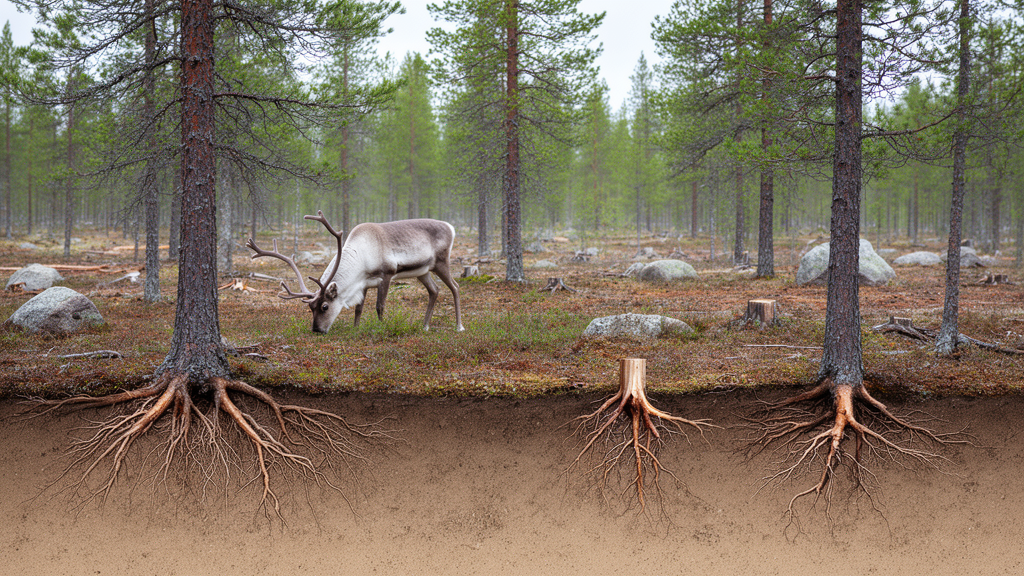
A comparative field study in three dry pine forests in northern Finland found nearly 30% less shallow-root biomass in areas grazed by reindeer than in areas where the animals had been excluded for 50 to 100 years. The difference was greatest in the uppermost 5 centimetres of soil, where most roots were found. Root architecture also differed: plants in grazed forests had roots that were generally shorter, thicker and less branched, a pattern interpreted as less extensive exploration of the soil for water and nutrients. The study provides evidence that reindeer grazing changes below-ground plant structure as well as visible vegetation, but its comparison was limited to three dry pine-forest sites in Finland.
Researchers collected soil from grazed and fenced dry pine forests at Angeli, Raja-Jooseppi and Kätkäsuvantoin in Finland. The fenced areas had been excluded from reindeer grazing for between 50 and 100 years. Samples were separated into five-centimetre sections extending to a depth of 25 centimetres. Fine and coarse roots were recovered by washing and weighed, and fine roots were further classified according to length, diameter and branching. The researchers also measured lichen-layer thickness, dwarf-shrub abundance, soil temperature and soil moisture. This observational design compared forests with long-term differences in grazing exposure, allowing the researchers to examine relationships among grazing, vegetation, soil conditions and root systems rather than directly manipulating every potential influence.
Several measured differences accompanied the lower root biomass in grazed areas. Reindeer reduced the abundance of crowberry and lingonberry, which have thin, highly branched roots, and grazing also thinned the insulating lichen cover. With less lichen, soils in the grazed forests experienced greater temperature fluctuations. Winter soil temperatures in these areas fell as low as −10°C, whereas minimum temperatures in the ungrazed forests only rarely reached −5°C. Maria Väisänen, a postdoctoral researcher at the University of Oulu’s Water, Energy and Environmental Engineering Research Unit, said winter cold and frost damage may help explain the reduced quantity of roots in grazed areas. Mechanical disturbance, including trampling, may also have contributed.
The change in root form may have implications for how plants obtain resources. Shorter, thicker and less-branched roots indicate reduced structural exploration of the soil. The researchers identified two possible explanations: root plasticity, in which individual plants alter root growth, and shifts in plant-species composition, in which grazing changes the balance of species with different root architectures. The study did not distinguish between those mechanisms, and the reduced abundance of crowberry and lingonberry indicates that both processes could contribute. The three-site comparison also does not establish how widely the measured changes occur among other boreal forests or under different grazing, climate or soil conditions.
Roots take up water and nutrients and contribute carbon-rich litter and exudates to soil. Their abundance, structure and location play a central role in soil nutrient and carbon cycling. In northern coniferous forests, roots are estimated to account for 50–70% of the carbon entering soil. Living roots release carbon compounds that can stimulate microbial decomposition and the release of carbon into the atmosphere, while dead roots form litter in which carbon can remain stored for extended periods. The study linked its measured root changes to these broader processes, but it did not quantify the resulting effects on carbon storage or nutrient cycling at forest-wide scale. Its direct finding is that, at the sampled Finnish sites, long-term reindeer grazing was associated with less shallow-root biomass and altered root architecture, together with thinner lichen cover, colder winter soil conditions and changes in dwarf-shrub composition.
Subject of Research: Effects of long-term reindeer grazing on root biomass and architecture in three Finnish dry pine forests
Article Title: Reindeer grazing changes plant roots in pine forests
Article References: Reindeer grazing changes plant roots in pine forests. Original publication (Bibliographic details unavailable.)
Image Credits: AI Generated
DOI: Not provided
Keywords: reindeer grazing, boreal pine forests, root biomass, root architecture, Finland, soil temperatures, lichen cover, dwarf shrubs, nutrient uptake, forest carbon cycling, Reindeer, grazing
Cite Scienmag News
Alan Morgan. (October 21, 2026). Reindeer grazing reduces roots in three Finnish pine forests. Scienmag. https://scienmag.com/reindeer-grazing-reduces-roots-in-three-finnish-pine-forests/
Alan Morgan. "Reindeer grazing reduces roots in three Finnish pine forests." Scienmag, 21 October 2026, https://scienmag.com/reindeer-grazing-reduces-roots-in-three-finnish-pine-forests/. Accessed 21 October 2026.
Alan Morgan. "Reindeer grazing reduces roots in three Finnish pine forests." Scienmag. October 21, 2026. https://scienmag.com/reindeer-grazing-reduces-roots-in-three-finnish-pine-forests/


