


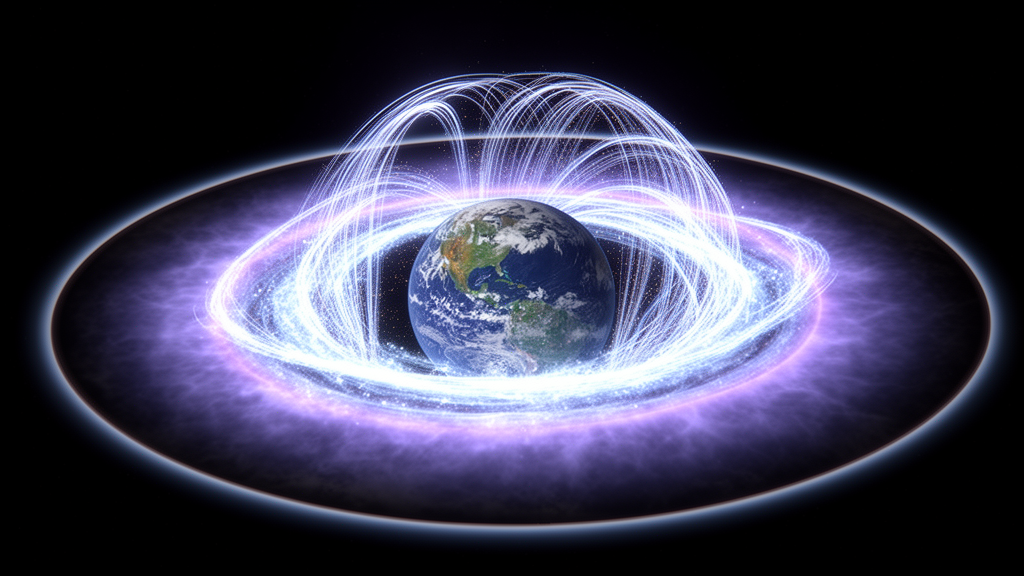
A geomagnetic storm does more than intensify the familiar westward flow of charged particles around Earth. A 2026 review of inner-magnetospheric current systems concludes that the stormtime ring current can reshape the radiation belts, reorganize ionospheric convection, structure the plasmapause and restrict the delivery of later particle injections from the magnetotail. The review focuses on the electric currents and their magnetic and electric coupling, rather than on the hot ions and electrons that carry those currents. Its authors describe the ring current as a defining feature of intense space storms because it can increase in intensity by several orders of magnitude and influence multiple linked regions of geospace.
The term “ring current” originally referred to the population of approximately 1–100 keV ions and electrons in the inner magnetosphere, generally within about 10 Earth radii, although this population has never literally formed a geometrically perfect ring. Hot ions dominate the plasma pressure and therefore the electric currents there. Their activity produces characteristic magnetic-field disturbances that can be recorded by ground magnetometers, especially at middle and low latitudes. These disturbances have a recognizable time profile during magnetic storms and underpin the Dst index, which is often used as a key measure of storm intensity. Although other currents contribute to the low-latitude signal, the review says those contributions are generally brief and relatively small.
Under the slowly varying conditions assumed in the review’s current-pressure relationship, the current perpendicular to the magnetic field scales with plasma pressure and inversely with magnetic-field strength. During the main phase of a storm, pressure generally peaks on the nightside, making the current configuration strongly asymmetric. The dominant system is the partial ring current, which carries charge westward in a limited local-time sector just outside the pressure maximum. It closes through field-aligned currents into and out of the ionosphere, with a horizontal Pedersen current completing the circuit. Inside the pressure peak, an eastward current partially closes the westward flow in a configuration called the banana current loop, while symmetric eastward and westward currents can also exist even when the hot-ion population is broadly distributed.
The review groups these systems, together with the inner portion of the cross-tail current, under the stormtime ring current. They can be difficult to separate in spacecraft observations because their three-dimensional closure paths overlap in space and evolve on different timescales. Early in a storm’s main phase, before the nightside pressure maximum is fully developed, the tail current can be the largest component. Near storm peak, the partial ring current and banana currents usually dominate where plasma pressure is most asymmetric. During recovery, when the pressure peak becomes smoother in local time, the symmetric ring currents tend to be strongest. New plasma-sheet injections, nonlinear electric and magnetic feedback, and particle-loss processes continually reshape this configuration.
One of the ring current’s most consequential effects occurs at the outer radiation belt. The currents depress the magnetic-field strength near the plasma-pressure maximum and stretch magnetic-field lines. Because relativistic electrons gradient-curvature drift around Earth more rapidly than most other geospace particles, this stretching changes their paths. Their outward displacement is often called the Dst effect and can reduce observed energetic-electron fluxes. More importantly, the stretched geometry can make the electrons more likely to encounter the magnetopause, where they can escape to deep space. This process, called magnetopause shadowing, represents a genuine loss of particles rather than only an adiabatic redistribution of their energies, and the review cites it as a dominant outer-belt loss mechanism during the storm main phase.
The ring current also reaches downward into the ionosphere. The imbalance between the current outside and inside the pressure peak produces field-aligned currents that close through the ionosphere and modify the electric-potential pattern. A characteristic result is a large potential minimum on the nightside inner magnetosphere, often near the equatorward edge of the auroral zone. This feature can distort the Harang discontinuity and is incorporated into empirical convection models even under moderate driving conditions. During strong storms, the ring-current-associated electric fields can overwhelm other electric-field signatures in the middle-latitude nightside ionosphere, demonstrating that the current system is not merely an indicator of storm strength but an active driver of ionospheric electrodynamics.
Changes in the ionospheric electric potential feed back into the plasmasphere, the cold plasma region that dominates mass and particle number density in much of the inner magnetosphere and helps regulate plasma-wave activity there. Small potential wells and peaks created by partial-ring-current closure can appear near the plasmapause, the outer boundary of the plasmasphere. One documented response is enhancement of the subauroral polarization stream, which can sharpen the plasmapause edge in the evening sector. Another is electric-field overshielding: if the interplanetary magnetic field suddenly turns northward, the large-scale convection pattern weakens relatively quickly, but hot-ion pressure and its associated electric fields remain temporarily elevated. The resulting pattern has been observed as outward motion in the predawn sector and inward motion in the evening sector, sometimes producing localized plasmapause notches.
Electric and magnetic feedback also act on future magnetotail injections. Strong small-scale electric fields alter the drift of all particles in the inner magnetosphere, including the hot ions that dominate pressure and drive the current. Flow vortices around the two field-aligned-current regions bordering the partial ring current can produce outward drift at the center of the pressure maximum, where the weakened magnetic field enhances the effect. If the vortex drift is small relative to the background sunward flow, it has little effect; if sufficiently strong, it may break apart the nightside pressure peak or skew it toward the predawn sector. Observations summarized in the review also show hysteresis between auroral-oval size and the SYM-H storm index, including a large, relatively stable oval through much of the main phase and peak.
Not every fast flow from the magnetotail reaches the ring current region. Bursty bulk flows often stall between 12 and 7 Earth radii downtail and rarely penetrate to geosynchronous altitude at 6.6 Earth radii. Modeling and test-particle studies cited in the review indicate that reaching roughly 9–10 Earth radii generally requires a specific entropy characteristic, while exceptional simulations have carried some particles inside geosynchronous orbit. Observations also reveal a gap containing strongly fluctuating electric fields between the mesoscale fast-flow region of the near magnetotail and the inner magnetosphere. The pre-existing ring-current population may inhibit further injections, although some numerical studies allow penetration and one alternative analysis found no strong correlation between symmetric ring current and magnetotail stabilization. The review therefore presents this aspect as unresolved rather than settled.
Accurate prediction remains the central practical challenge. Numerous models can forecast the Dst time series, but the review notes that they often do not predict the location of the plasma-pressure peak. That location, together with the peak’s intensity and timing, is dynamically coupled to the rest of the geospace system through linear and nonlinear processes. Forecasting those properties could improve space-weather operations beyond a simple storm-strength index. Continued examination is also needed to determine how magnetotail fast-flow structures change with storm phase and interact with a ring current already building in the inner magnetosphere. The overall picture is of a storm-driven current system that both records the developing disturbance and reorganizes the magnetic and electric environment in ways that shape later geospace activity.
Subject of Research: Stormtime ring-current dynamics in Earth’s inner magnetosphere
Article Title: The importance of the stormtime ring current
Article References: Liemohn, M. W., & Fok, M.-C. (2026). The importance of the stormtime ring current. Frontiers in Astronomy and Space Sciences, 13, Article 1949106. https://doi.org/10.3389/fspas.2026.1949106
Image Credits: AI Generated
DOI: 10.3389/fspas.2026.1949106
Keywords: stormtime ring current, geomagnetic storms, inner magnetosphere, radiation belts, magnetopause shadowing, ionospheric convection, plasmapause, magnetotail injections, electric currents, space weather, importance, stormtime
Cite Scienmag News
Cameron Wolfe. (October 21, 2026). Stormtime ring current reshapes Earth’s inner magnetosphere. Scienmag. https://scienmag.com/stormtime-ring-current-reshapes-earths-inner-magnetosphere/
Cameron Wolfe. "Stormtime ring current reshapes Earth’s inner magnetosphere." Scienmag, 21 October 2026, https://scienmag.com/stormtime-ring-current-reshapes-earths-inner-magnetosphere/. Accessed 21 October 2026.
Cameron Wolfe. "Stormtime ring current reshapes Earth’s inner magnetosphere." Scienmag. October 21, 2026. https://scienmag.com/stormtime-ring-current-reshapes-earths-inner-magnetosphere/


