


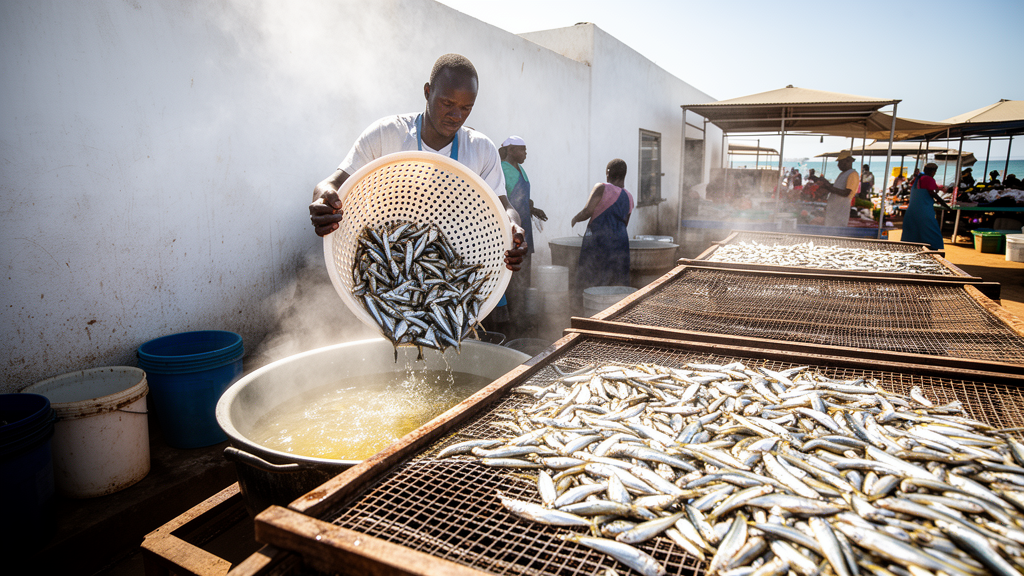
Boiling small pelagic fish in brine before sun-drying reduced the time needed to dry Kenya’s Dagaa by 75% and produced lower total plate counts than drying salted fish without an initial boil, according to a field-scale experiment conducted at the Kibuyuni landing site in Kwale County in August 2025. The study compared fresh Dagaa with fish boiled for 12 or 15 minutes in brine and then salted and dried, or salted with dry salt and dried without boiling. Each treatment was prepared in triplicate using 40-kilogram batches. After drying, the products were evaluated for microbial counts, proximate composition, iron, zinc, calcium and magnesium, dimensions, bulk density, fragmentation and sensory characteristics. The 12-minute treatment offered the strongest balance in the tested conditions: it produced total plate counts of 3.2 colony-forming units per gram, preserved more protein and minerals than the 15-minute treatment, and dried in 5 hours rather than 20.
The experiment was designed to represent processing practices used by small-scale fishers and processors rather than a standardized laboratory comparison. Fresh Dagaa, Rastrineobola argentea, was boiled in perforated aluminium pots over a firewood fire for either 12 or 15 minutes. The mean cooking-medium temperature was 88°C, and the brine contained 1.77 grams of salt per litre. Fish in the unboiled treatment instead received dry salt at approximately 143 grams per kilogram of fresh fish before being spread to dry. Because salt was applied by different methods and at rates expressed on different bases, the experiment cannot isolate the independent effect of boiling. The results instead describe the combined effects of locally practiced boiling, salting and drying procedures, a limitation that researchers say should be addressed in future trials by standardizing salt-to-fish ratios or measuring comparable salt concentrations in the fish tissue.
Microbiological results showed that pre-boiling had a measurable advantage. Fresh Dagaa had a total plate count of 10.4 colony-forming units per gram, whereas the 12- and 15-minute boiled, salted and dried products registered 3.2 and 3.0 colony-forming units per gram, respectively. Both boiled treatments were below the study’s cited maximum permissible limit of 5 colony-forming units per gram. The unboiled dry-salted product had 6.4 colony-forming units per gram, lower than the fresh baseline but still above that limit. Yeast and mold counts fell from 4.5 colony-forming units per gram in fresh fish to undetectable levels in all three dried treatments. The authors interpret the reduction as the combined result of heat, salt, dehydration and reduced water activity rather than as evidence that boiling alone caused every difference. Counts of viable microorganisms in fresh fish are also indicators of handling and storage conditions, not direct measurements of pathogen risk to consumers.
The clearest operational gain was the reduction in drying time. Boiled fish reached the processor-determined drying endpoint after 5 hours, compared with 20 hours for unboiled dry-salted fish. Mean temperature and relative humidity during drying were similar between the methods—34.38°C and 47.55% for the boiled treatment, and 32.08°C and 48.30% for the unboiled treatment—so the shorter period was associated with the prior brine-boiling step rather than markedly different weather conditions. Residual moisture averaged 14.04% in the boiled products and 16.91% in the unboiled products, a statistically significant difference. Both values exceeded the 12% safety limit cited by the study. Shorter drying may reduce exposure to flies, dust and other environmental contaminants and can be particularly useful during rainy seasons, when open-air drying windows are restricted, but the experiment did not test those seasonal effects directly.
Processing also changed the measured nutrient profile. Fresh Dagaa contained an average of 20.68% crude protein, 5.43% fat, 5.21% ash and 2.23% dietary fiber. After the combined salting, boiling and drying processes, protein, fat, fiber and ash values generally rose on the analyzed basis, and the 12-minute boiled treatment had the highest protein and fat values. Extending boiling to 15 minutes significantly reduced protein by about 11% relative to the 12-minute treatment, while the unboiled dry-salted product had approximately 20% less protein than its boiled counterparts. The researchers attributed part of the higher fat and fiber readings to moisture loss and restructuring of the fish matrix, rather than treating them as evidence that processing created new fat or fiber. The 12-minute treatment also had significantly higher concentrations of iron, zinc, calcium and magnesium than the 15-minute and unboiled products, indicating that additional heating produced no corresponding nutritional gain.
Micronutrient values should be interpreted carefully because concentration per unit weight can rise when water is removed, and minerals can also leach into cooking liquid. The authors note that brine boiling, salt uptake and subsequent dehydration may jointly produce higher apparent mineral concentrations on a dry-weight basis. They also point out that Dagaa are commonly sold without nutritional labels or standardized serving information, making those measured changes difficult for consumers to interpret. The study did not measure bioavailability, mineral retention during storage or the nutritional effect of discarding cooking water, nor did it test outcomes in human consumers. Its micronutrient findings therefore describe the laboratory composition of the processed fish, not demonstrated improvements in health or dietary adequacy. The clearest evidence of nutrient loss with extended boiling came from the reduction in protein and the lower mineral concentrations in the 15-minute treatment.
Physical changes revealed a trade-off between faster drying and product integrity. Fresh Dagaa measured 6.41 millimeters long and 0.94 millimeters wide. The 12- and 15-minute boiled products were shorter and narrower, at 3.92 by 0.37 millimeters and 3.90 by 0.34 millimeters, respectively, while the unboiled dried fish remained similar in length and width to fresh fish. Boiled fish became bent and lost their heads and tails, acquired a golden-to-dark-brown color and detached easily from drying surfaces. The unboiled fish retained straighter, intact bodies but adhered to the rack and to neighboring fish. Bulk density fell after drying, from 1,075 kilograms per cubic meter in fresh fish to 357.5 and 351.5 kilograms per cubic meter in the boiled treatments and 217.5 kilograms per cubic meter in the unboiled product. These physical differences could affect handling, packaging and transport efficiency as well as consumer acceptance.
Fragments and meal lost during winnowing also carried an economic cost. The 12-minute boiled treatment produced 2.5% fragments, the 15-minute treatment 3.0% and the unboiled dry-salted treatment 1.0%. The study reports that such fragments are commonly sold as animal feed at about US$0.39 per kilogram, compared with approximately US$3.33 for whole dried Dagaa. Boiling appeared to make the fish more fragile, while the unboiled material adhered to the drying surface and may have been lost during removal. The sensory assessment was qualitative rather than a standardized scoring exercise: fishers, traders, researchers and processors described color, shape, body integrity and ease of removal in open-ended comments, which were then grouped into recurring themes. Because the panel was untrained, the results document stakeholder perceptions at one landing site rather than establish consumer preference or market demand.
Boiling also carried a measurable firewood cost. Processors used approximately 0.17 kilogram of firewood for each kilogram of fresh Dagaa boiled for 12 minutes and 0.20 kilogram for the 15-minute treatment. Applied to the site’s reported annual throughput of 250,000 kilograms, the researchers estimated annual firewood requirements of 42.5 and 50 tonnes, with respective costs of US$2,125 and US$2,500. The 12-minute treatment therefore saved both fuel and processing time without sacrificing the measured microbial safety achieved by the longer boil. The authors also estimate that the annual demand could require roughly 923 to 1,086 trees when a yield of 46 kilograms of dry wood per tree is assumed, highlighting the pressure that traditional boiling can place on local forests and mangroves. The energy calculation combines measured treatment ratios with reported production figures rather than directly monitoring an entire year of fuel use.
Overall, the field experiment identifies a 12-minute brine boil followed by drying as the most favorable of the three locally practiced processed-fish treatments examined. It shortened drying from 20 to 5 hours, kept total plate counts below the cited limit, retained more protein and minerals than a 15-minute boil, and produced only modestly more fragmentation than the unboiled method. The findings are strongest as a comparison of complete processing routes at Kibuyuni, not as proof that boiling independently caused the measured benefits or that the same performance will occur across seasons, landing sites or fish batches. The researchers also note the absence of pH, titratable acidity and instrumental texture measurements. Future work should standardize salting, include storage and sensory testing, and evaluate renewable-energy boilers and dryers under real operating conditions. As it stands, the study supplies field evidence that precise control of boiling time could improve the speed, safety and nutritional consistency of Dagaa processing while limiting unnecessary fuel use and product fragmentation.
Subject of Research: Effects of brine boiling and sun-drying methods on the microbial, nutritional, physical and energy performance of Dagaa in Kenyan small-scale fisheries.
Article Title: Effects of Processing Practices (Boiling and Drying) on the Nutritional, Microbial, and Physical Quality Attributes of Small Fish (Dagaa) in Small‐Scale Fishery Systems
Article References: Ngwenyama, P., Kitabi, P., Tunje, D., Masoud, E., Odhiambo, P., Parmar, A., & Kimani, P. (2026). Effects of Processing Practices (Boiling and Drying) on the Nutritional, Microbial, and Physical Quality Attributes of Small Fish ( Dagaa ) in Small‐Scale Fishery Systems. Food Science & Nutrition, 14(10), Article e72504. https://doi.org/10.1002/fsn3.72504
Image Credits: AI Generated
DOI: 10.1002/fsn3.72504
Keywords: Dagaa fish, brine boiling, sun drying, small pelagic fish, food safety, nutrient retention, Kenya, firewood energy, post-harvest processing, Effects, Processing, Practices
Cite Scienmag News
Alan Morgan. (October 21, 2026). Brine boiling cuts drying time for Kenya’s nutrient-dense Dagaa fish. Scienmag. https://scienmag.com/brine-boiling-cuts-drying-time-for-kenyas-nutrient-dense-dagaa-fish/
Alan Morgan. "Brine boiling cuts drying time for Kenya’s nutrient-dense Dagaa fish." Scienmag, 21 October 2026, https://scienmag.com/brine-boiling-cuts-drying-time-for-kenyas-nutrient-dense-dagaa-fish/. Accessed 21 October 2026.
Alan Morgan. "Brine boiling cuts drying time for Kenya’s nutrient-dense Dagaa fish." Scienmag. October 21, 2026. https://scienmag.com/brine-boiling-cuts-drying-time-for-kenyas-nutrient-dense-dagaa-fish/


