


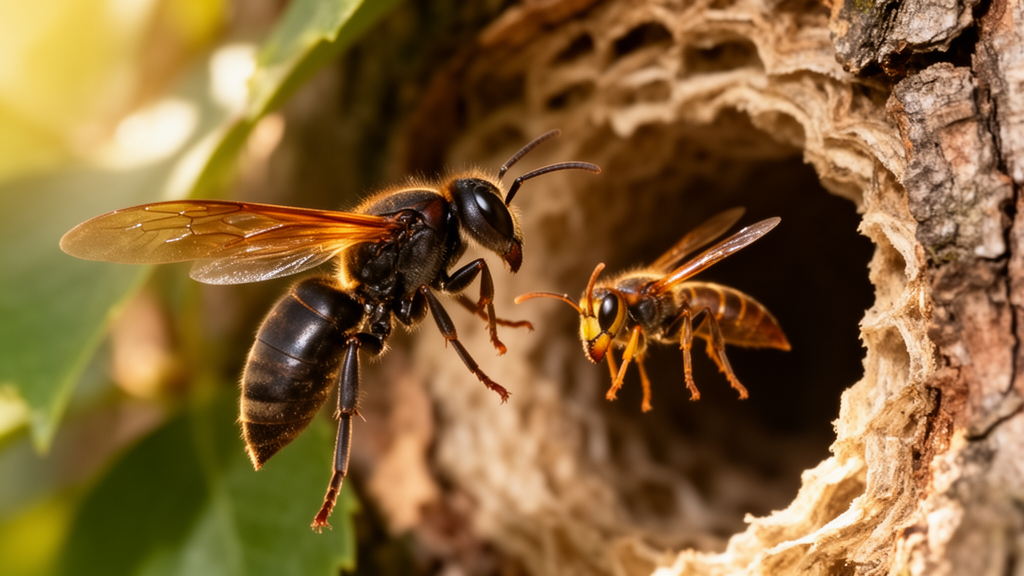
Wing shape in the Eastern yellowjacket wasp, Vespula maculifrons, differs substantially among workers, gynes and males, even though the three castes retain wings and share much of their genetic background. A geometric morphometric study of 965 wasps from 10 colonies found that caste accounted for 31.08% of the measured variation in forewing shape. Colony identity and paternal family also contributed significant variation, with patriline explaining 22.20% of shape variation among gynes and 17.45% among workers after colony differences were accounted for. The study also detected a heritable family signature across female castes, but genetic coupling between the principal shape axes of workers and gynes was weak and imprecise.
The research focused on the Eastern yellowjacket, a common North American social wasp that acts as an important arthropod predator in natural and disturbed environments. Colonies are founded by a single queen and can contain thousands of workers, along with hundreds of new queens, or gynes, and males, by the end of the reproductive season. Queens typically mate with an average of six males, producing multiple paternal lineages, or patrilines, within each nest. This polyandrous mating system provided the basis for testing whether genetic differences among a queen’s mates influenced the wing shape of her female offspring. The researchers collected 10 colonies in Atlanta, Georgia, in November 2021 and November 2022, when the reproductive cycle made workers, gynes and males available in each colony.
To measure wing geometry, the team removed the right forewing from each wasp and imaged it with a dissection microscope. A single researcher manually placed 19 anatomical landmarks, primarily at vein intersections and other venation features, and 12 curves tracing corresponding wing regions. The choices were designed to be consistently identifiable across castes, allowing comparisons among individuals and castes. Wings damaged in ways that obscured the landmarks or curves were excluded, leaving a final dataset of 965 measured wings, with approximately 100 individuals from each colony. A Generalized Procrustes Alignment removed differences in position, orientation and scale, while each individual’s centroid size was retained separately for allometric analyses. Principal component analysis summarized the resulting shape space, and Procrustes ANOVAs with 1,000 permutations tested differences associated with caste, colony and patriline. Here, “wing shape” means the multivariate geometry of the selected landmarks and curves after alignment; it does not refer to the presence or absence of veins, their branching patterns or changes in vein identity.
The clearest result was a separation among the three castes in the forewing shape space. The first principal component accounted for 29.16% of total shape variation and the second for 18.47%. Caste was statistically associated with wing shape, and all pairwise caste comparisons showed significant divergence. The study also found significant differences among colonies nested within caste, with colony effects accounting for 19.15% of total shape variation. That colony-level pattern cannot be assigned to one mechanism from these data. Individuals in a colony share nutrition, brood care, nest microclimate and other developmental conditions, while separate colonies can differ in maternal genotype, patriline composition and socially mediated developmental effects. The colony result is therefore consistent with a mixture of environmental and genetic contributions, rather than evidence that either category alone produced the differences.
The team extracted DNA from the posterior legs of female wasps and genotyped them at six highly variable microsatellite markers. These markers were used to infer relatedness and paternal-family membership, not assumed to be causal loci for wing shape. Within a colony, females with compatible multilocus genotypes were assigned to the same patriline and treated as full-sib subfamilies; females assigned to different patrilines shared the same mother and were treated as maternal half-sibs. Patriline had a significant effect on wing shape in both female castes after colony differences were accounted for. Bayesian mixed-effects models estimated narrow-sense heritability along the primary shape axis at 0.275 for workers, with a 95% highest posterior density interval of 0.091 to 0.489, and 0.264 for gynes, with an interval of 0.103 to 0.494. Both intervals excluded zero. These estimates indicate that additive genetic differences contributed to within-colony variation in the measured primary shape axis, although they do not identify the particular genes or regulatory mechanisms responsible.
Body size was not strongly coupled to wing shape within colonies. A pooled multivariate model detected a significant caste-by-size interaction, but preliminary analyses showed that between-colony differences in body size, particularly among gynes, dominated the pooled allometric signal. Separate within-colony analyses were therefore used to examine individual-level size–shape relationships. None of the ten colonies showed a significant relationship among gynes, and their slopes varied in direction. Workers generally had negative or near-zero slopes, but only one colony reached significance, at p = 0.012; the weak and inconsistent pattern does not establish systematic negative allometry. No colony showed significant allometry among males, although that analysis had limited statistical power because each colony contributed only 10 males. Across the castes, the results do not support a strong developmental link between body size and forewing shape within nests.
Cross-caste comparisons showed that paternal relatedness leaves a measurable but small imprint on morphology. The analysis included 16,403 possible worker–gyne pairs from the 10 colonies. Pairs sharing a patriline were closer in overall multivariate shape space than maternal half-sister pairs assigned to different patrilines within the same colony. In a mixed-effects model with colony as a random effect, half-sister pairs were estimated to be 0.00109 shape-space units farther apart than full-sister pairs, with a standard error of 0.00011. The difference was highly significant, with t = 10.22, 16,390 degrees of freedom and p < 0.0001. Colony identity accounted for approximately 19% of the variation in worker–gyne distance, while the remainder was associated with the individual-pair level. The mean difference amounted to only about 2% of the within-colony range of pairwise distances, but it was estimated with high precision and was consistent across colonies. No single principal component dominated the resemblance; it emerged from many small differences distributed across multiple shape axes.
Genetic correlation models showed that this family resemblance did not amount to tight genetic constraint between the female castes. Patrilines explained substantial variation within each caste, but correlations between matching principal components in workers and gynes were centered near zero. The correlation between worker PC1 and gyne PC1 was −0.0010, with a 95% highest posterior density interval from −0.37 to 0.37. The estimate for worker PC2 and gyne PC2 was 0.0001, with an interval from −0.39 to 0.37. Other cross-component and cross-caste correlations were similarly weak, and their intervals overlapped zero. These results mean that full-sister workers and gynes were more similar overall, while the particular directions in which paternal family influenced their major shape axes were largely decoupled. The analysis is compatible with a modular genetic architecture, but it did not directly test genetic modularity or identify loci responsible for the effects.
The observed patterns are consistent with the different flight demands of the castes. Workers rely heavily on flight for foraging and nest defense, whereas gynes use it for dispersal and colony founding, and males fly mainly during mating periods. Worker wings were tightly clustered in shape space, while male wings showed greater shape variability. Those patterns are compatible with differences in the strength or direction of selection, although the study did not directly measure aerodynamic performance or test the underlying selective mechanisms. It likewise cannot establish that flight requirements caused the observed shape differences. The researchers did not quantify how a particular wing geometry affects survival, reproduction or colony performance, and the six-marker panel was not designed to detect genotype-by-environment interactions or causal genetic variants. The result is instead an observational separation of measured shape differences among castes, colonies and patrilines.
Overall, the study shows that Eastern yellowjacket wing morphology reflects several overlapping influences rather than a single cause. Caste differences were strong, colonies retained distinct shape signatures, and paternal family identity accounted for a meaningful portion of female wing-shape variation within nests. At the same time, the genetic effects of family membership were expressed differently across workers and gynes, with weak correlations along the main shape axes. The findings support the possibility that selection associated with the social division of labor can be associated with distinct wing forms in wasps that share much of their genetic architecture. They also illustrate how multiple mating can preserve heritable variation within colonies while leaving room for caste-specific divergence, without showing that any particular wing shape causes a fitness advantage.
Subject of Research: Genetic and colony-level determinants of caste-specific forewing shape in the Eastern yellowjacket wasp.
Article Title: Same Genes, Different Wings: Wing Shape Divergence Among Castes in a Social Wasp
Article References: Murray, K. A., Orr, S. E., Goodisman, M. A. D., Gosse, E. L., Hill, R., & Kovacs, J. L. (2026). Same Genes, Different Wings: Wing Shape Divergence Among Castes in a Social Wasp. Ecology and Evolution, 16(10), Article e74478. https://doi.org/10.1002/ece3.74478
Image Credits: AI Generated
DOI: 10.1002/ece3.74478
Keywords: Eastern yellowjacket, social wasps, wing morphology, geometric morphometrics, caste divergence, quantitative genetics, patrilines, polyandry, colony variation, insect flight, Same, Genes
Cite Scienmag News
Juliet Wilcox. (October 21, 2026). Same Genes, Different Wings: Wing Shape Divergence Among Castes in a Social Wasp. Scienmag. https://scienmag.com/same-genes-different-wings-wing-shape-divergence-among-castes-in-a-social-wasp/
Juliet Wilcox. "Same Genes, Different Wings: Wing Shape Divergence Among Castes in a Social Wasp." Scienmag, 21 October 2026, https://scienmag.com/same-genes-different-wings-wing-shape-divergence-among-castes-in-a-social-wasp/. Accessed 21 October 2026.
Juliet Wilcox. "Same Genes, Different Wings: Wing Shape Divergence Among Castes in a Social Wasp." Scienmag. October 21, 2026. https://scienmag.com/same-genes-different-wings-wing-shape-divergence-among-castes-in-a-social-wasp/


