


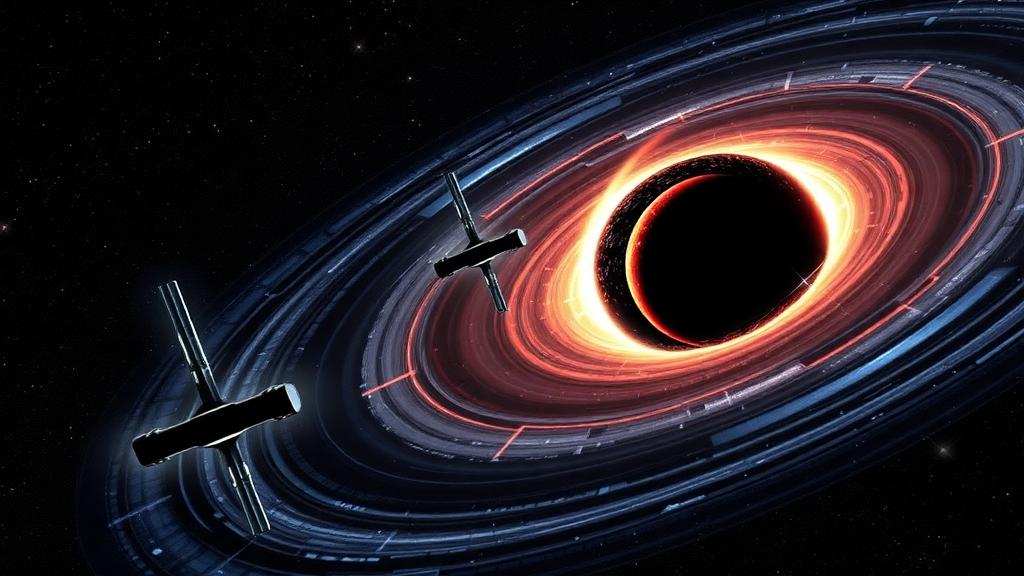
A preliminary theoretical study concludes that lightweight probes orbiting a nearby stellar-mass black hole could test Einstein’s theory of general relativity with exceptional precision, provided at least one probe can operate close to the compact object’s innermost stable orbit. The authors calculate that an orbit passing near that boundary and lasting only hours might reveal deviations from the Schwarzschild metric corresponding to a deformation parameter as small as 10⁻⁵. The result is a proposed measurement strategy rather than a demonstrated capability: it assumes a non-rotating black hole, an empty surrounding environment, instruments capable of extraordinary timing precision and, most importantly, a craft able to brake and enter a scientifically useful orbit.
The investigation is the first part of a two-paper study of hypothetical interstellar missions to the closest black hole. The underlying scenario imagines a gram-scale nanocraft accelerated by ground- or space-based lasers to a substantial fraction of the speed of light. A few stellar-mass black holes may exist within 50 light-years of the Solar System, although no candidate is currently known.
If one were found 20 to 25 light-years away and a probe traveled at one-third the speed of light, it could arrive in roughly 60 to 75 years, with returned data taking another 20 to 25 years to reach Earth. The present analysis does not solve propulsion, target discovery or reliable deceleration, all of which remain major obstacles. For the calculations, the researchers use natural units in which the gravitational constant and speed of light are unity and consider a non-rotating black hole in vacuum described by the Schwarzschild solution.
Circular orbits inside 3M are physically impossible, while those from 3M to 6M are unstable; stable circular motion begins at 6M, the innermost stable circular orbit. The authors also examine eccentric trajectories and photon paths near the unstable photon orbit at 3M. A rotating black hole would introduce a spin parameter and make probe motion depend on the angle between the spin axis and orbital angular momentum.
Accretion and the interstellar medium could additionally perturb trajectories and measurements, although the density of that medium is low except near the compact object. One probe could extract several useful quantities from a circular orbit. An electromagnetic signal arriving from Earth would identify the direction of the home planet, allowing the probe to count completed orbits, while an onboard clock would measure the probe’s proper time.
Combining the clock reading with Earth-based timing gives the ratio between the probe’s elapsed time and the black hole’s coordinate time. The probe’s angular velocity, measured in its own time, then permits simultaneous inference of the black hole mass parameter and the probe’s areal radius under the Schwarzschild assumptions. Repeated periods in Earth’s signal also reveal whether the orbit is aligned with the Earth–black-hole axis, because an otherwise fixed incoming signal becomes periodically redshifted and blueshifted when the orientation is inclined.
The projected precision depends on timing errors averaging down as the probe accumulates observations. With a clock sensitivity of one microsecond, the relative uncertainty in the measured angular velocity is about 4 × 10⁻¹² after three days, 4 × 10⁻¹³ after one month and 4 × 10⁻¹⁴ after ten months, according to the study. The estimate is independent of orbital radius because more complete orbits improve the period measurement in proportion to the longer observing time.
In the simplified model, the corresponding precision in the inferred mass and radius can be comparable. Such performance would demand more than a nominal clock specification: temperature changes, magnetic fields, power-supply ripple, oscillator aging and accumulated frequency drift could dominate the measurements, while intermittent communication with Earth might be needed to correct long-term drift. A two-probe configuration provides a direct consistency test.
A larger mothership would carry the light sail, which could also function as an antenna for transmitting data to Earth, but tidal forces would prevent it from approaching the black hole closely. A smaller probe could communicate with the mothership and therefore need no large antenna, allowing it to orbit at a much smaller radius. Each probe could independently infer the black hole mass.
Under general relativity, the two estimates should agree; if the central object had a metric different from the Schwarzschild solution, the estimates could differ. The test becomes more sensitive when the smaller probe operates near 6M, but only if it can be maneuvered into that orbit without being destroyed. The authors quantify this idea with the Johannsen spacetime, a model in which a parameter called α₁₃ measures a departure from the Schwarzschild geometry and recovers general relativity when set to zero.
It is not a complete representation of every possible deviation from Einstein’s theory, making the analysis explicitly model-dependent. The probe measurements—two angular velocities and two redshift factors—can be fitted numerically for the mass, orbital radii and deformation parameter. For eccentric orbits, the researchers compare physically matched periapsis and apoapsis, then calculate apsidal precession, the excess azimuthal angle accumulated between successive radial turning points.
Closer periapsis shortens the time needed to detect a difference, but greater eccentricity at fixed periapsis can have the opposite effect by moving the orbit’s average distance outward. For a fixed orbit, the required observing time scales approximately linearly with α₁₃. Photon echoes provide another possible test of the spacetime.
A probe can emit a narrowly directed electromagnetic beam that loops around the black hole and returns either to itself or to a second probe. Because the photon orbit is unstable, a small alteration in spacetime geometry can change the emission angle and travel time substantially. In an example with a 10-solar-mass black hole, one probe orbiting at 50M and another at 20M, the authors examine photons that make no more than two complete circuits around the photon sphere.
Measuring the energy, arrival direction and timing of several orders, together with the intervals between adjacent arrivals, would constrain the deformation parameter. Backward ray-tracing turns the multiple photon paths into an overdetermined geometric system whose common emission event can be used to fit the black hole’s properties. The most extreme configuration involves a small probe plunging toward the horizon while continuously signalling a mothership on a 50M orbit.
Numerical simulations show that the final detectable transmission in the illustrated 10-solar-mass case comes from roughly 2.012M, close to the Schwarzschild horizon at 2M. Near that boundary, however, the required emission direction becomes exceptionally sensitive to small changes in position because the photon trajectory winds around the unstable photon sphere. The practical reach of this test would depend on whether the beam can still be directed toward the receiving probe, the detector’s frequency range and the probe’s survival in the strong tidal field.
The simulation therefore demonstrates a possible observable, not a guarantee that a horizon probe could communicate from every trajectory. The study’s central result is that deceleration alone would not give an interstellar black-hole mission its most sensitive test of general relativity. At least one probe would need to achieve an orbit close to the innermost stable circular orbit, and the mission would need instruments capable of preserving timing and positional information over long periods and across a substantial communications delay.
A companion paper separately considers non-decelerating flyby probes, while the present study focuses on probes that can brake and orbit. The analysis also identifies unresolved requirements involving beam control, clock stability, orbit insertion, materials, power, target identification and data transmission.
Subject of Research: Theoretical design of interstellar orbiting probes for testing black-hole spacetime and general relativity
Article Title: Testing black holes with interstellar missions: I. Orbiting probes
Article References: Gao, L., Bambi, C., Fan, Y., Mirzaev, T., Nosirov, A., & Santangelo, A. (2026). Testing black holes with interstellar missions: I. Orbiting probes. The European Physical Journal C, 86(10), Article 1192. https://doi.org/10.1140/epjc/s10052-026-16371-y
Image Credits: AI Generated
DOI: 10.1140/epjc/s10052-026-16371-y
Keywords: black holes, general relativity, interstellar probes, nanocrafts, strong gravity, Schwarzschild metric, photon orbits, event horizon, astrophysics, space missions, Testing, black
Cite Scienmag News
Grant Pearson. (October 21, 2026). Orbiting probes could test general relativity near stellar-mass black holes. Scienmag. https://scienmag.com/orbiting-probes-could-test-general-relativity-near-stellar-mass-black-holes/
Grant Pearson. "Orbiting probes could test general relativity near stellar-mass black holes." Scienmag, 21 October 2026, https://scienmag.com/orbiting-probes-could-test-general-relativity-near-stellar-mass-black-holes/. Accessed 21 October 2026.
Grant Pearson. "Orbiting probes could test general relativity near stellar-mass black holes." Scienmag. October 21, 2026. https://scienmag.com/orbiting-probes-could-test-general-relativity-near-stellar-mass-black-holes/


