


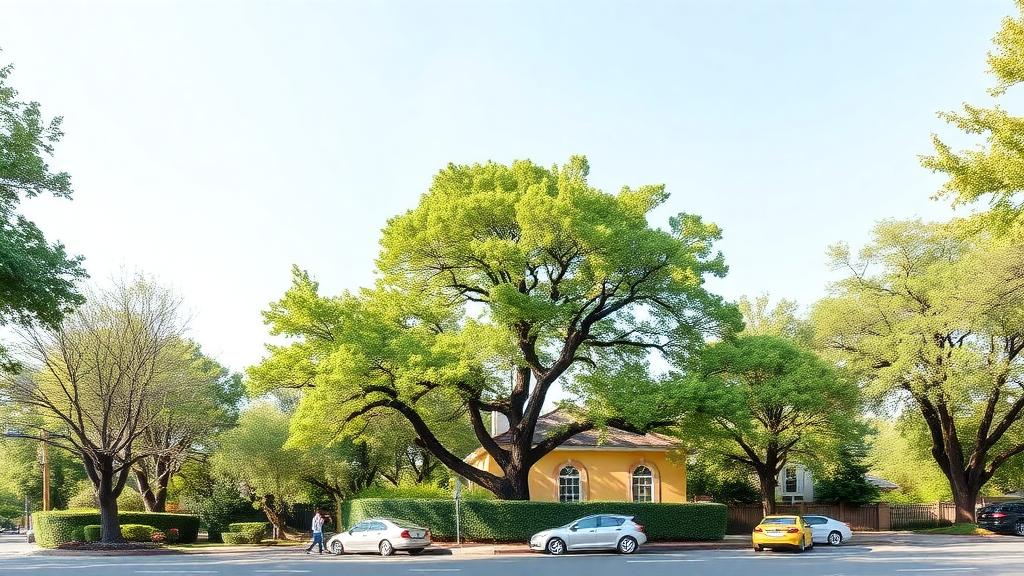
A new preprint introduces StreetTree, a publicly available benchmark for identifying street-tree species from images. The dataset contains more than 12 million street-level images covering over 8,300 common tree species, gathered from urban streetscapes in 133 countries across five continents. It also incorporates expert-verified observational data and a taxonomic hierarchy spanning order, family, genus and species.
The authors, Jiapeng Li and colleagues, describe the collection as the first large-scale benchmark designed specifically for fine-grained street-tree classification. Their experiments with pretrained vision models establish baselines, but also show that current systems remain challenged by the visual and statistical complexity of urban tree imagery. StreetTree addresses a data gap that has restricted progress in computer-assisted street-tree identification.
The authors identify this capability as important for urban planning, streetscape management and the assessment of urban ecosystem services. Yet the field has lacked a benchmark that is simultaneously large, geographically diverse and publicly available. The dataset includes more than 8,300 common street-tree species, creating a fine-grained classification problem with thousands of categories.
The authors supplement the image collection with expert-verified observational data. The supplied study record does not provide a single overall accuracy value for the entire dataset, nor does it identify one model as universally successful. Instead, the contribution is framed as a benchmark and baseline study: a shared body of data, a taxonomic organizing structure and experiments that reveal where current pretrained vision models remain limited.
Fine-grained tree recognition is difficult because different species can look similar in street images. The study specifically identifies high inter-species visual similarity as a challenge for pretrained models. StreetTree also contains a long-tailed natural distribution, meaning that some species are represented by many more examples than others.
Variation within a single species creates an additional test. The authors report substantial intra-class variation linked to seasonal changes, and the benchmark was assembled in real urban environments where illumination, occlusion from buildings and differing camera angles produce varied imaging conditions. A tree photographed at different times or from different positions may therefore present a markedly different image from another example of the same species.
To organize this difficult label space, StreetTree provides a hierarchical taxonomy that extends from order to family, genus and species. The hierarchy supports two related research directions: fine-grained classification and representation learning. Researchers can use the taxonomic structure to examine predictions at multiple levels, rather than treating every species as an unrelated class.
The authors also intend the taxonomy to support hierarchical classification research, in which relationships among categories can be represented explicitly and assessed as part of the learning problem. Experiments with a range of pretrained vision models establish the benchmark’s baselines and expose the limitations of existing methods under the real-world conditions represented in the data. According to the authors, the models continue to struggle with the combined effects of inter-species similarity, long-tailed class distributions, seasonal intra-class variation and diverse image capture.
The reported finding is therefore not that street-tree identification has been solved. Rather, the experiments show that current pretrained approaches do not automatically overcome the complexities of street-level imagery when the task requires species-level discrimination. StreetTree is presented as a resource at the intersection of computer vision and urban science.
Its scale, species coverage and international scope allow researchers to work with the same data when comparing classification methods, studying hierarchical representations and investigating performance under varied urban conditions. The public collection may support work related to tree mapping, planning and greener city management, as stated by the authors, but the supplied evidence does not claim that any one released model has already delivered those applications at city scale. It instead provides a foundation on which more capable and reliable methods can be evaluated.
The manuscript, titled “ArborVerse: Scaling Fine-Grained Urban Tree Species Classification to Millions of Trees Worldwide,” was posted on 21 October 2026 and is currently under review in Earth System Science Data. The StreetTree dataset is publicly available through Figshare. Because this is a preprint under discussion rather than a final journal article, its results and wording remain subject to the review process.
Even so, the project makes three core contributions immediately clear: a public benchmark containing more than 12 million images, coverage of over 8,300 street-tree species across 133 countries and five continents, and experimental evidence that today’s pretrained vision models still face substantial difficulty in recognizing street trees from unconstrained urban photographs.
Subject of Research: A global image benchmark for fine-grained street-tree species classification with pretrained vision models
Article Title: ArborVerse: Scaling Fine-Grained Urban Tree Species Classification to Millions of Trees Worldwide
Article References: Li, J., Huang, Y., Zhang, F., Tao, S., Dong, Z., Yang, J., & Liu, Y. (2026). ArborVerse: Scaling Fine-Grained Urban Tree Species Classification to Millions of Trees Worldwide. https://doi.org/10.5194/essd-2026-380
Image Credits: AI Generated
Keywords: StreetTree dataset, street trees, tree species, computer vision, urban ecology, image classification, machine learning, taxonomic hierarchy, urban planning, global cities, pretrained models, ArborVerse
Cite Scienmag News
Gavin Prescott. (October 21, 2026). StreetTree Preprint Tests Vision Models on 12 Million Tree Images. Scienmag. https://scienmag.com/streettree-preprint-tests-vision-models-on-12-million-tree-images/
Gavin Prescott. "StreetTree Preprint Tests Vision Models on 12 Million Tree Images." Scienmag, 21 October 2026, https://scienmag.com/streettree-preprint-tests-vision-models-on-12-million-tree-images/. Accessed 21 October 2026.
Gavin Prescott. "StreetTree Preprint Tests Vision Models on 12 Million Tree Images." Scienmag. October 21, 2026. https://scienmag.com/streettree-preprint-tests-vision-models-on-12-million-tree-images/


