


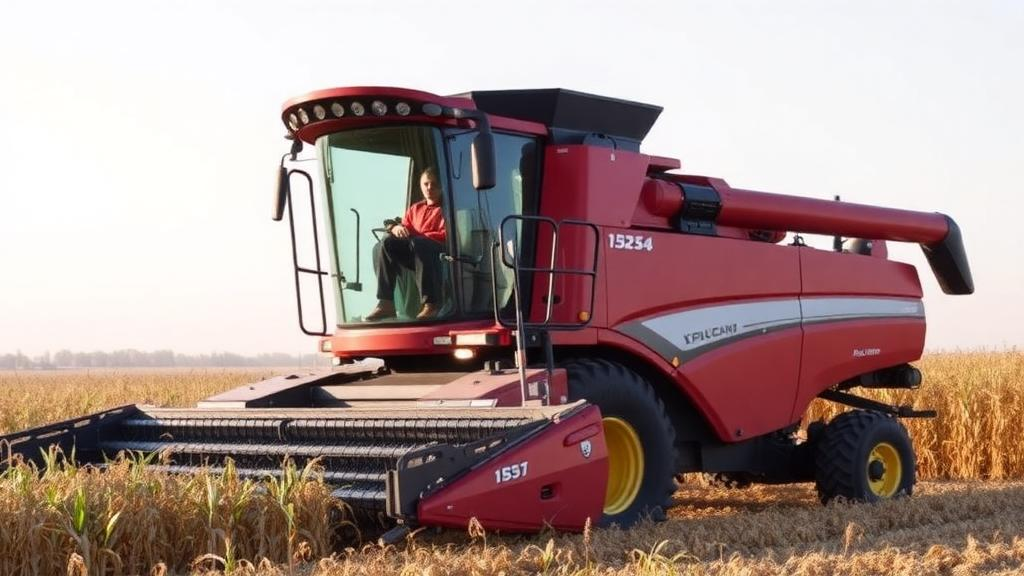
A material-flow grey-box model coupled to model predictive control reduced soybean cleaning loss, grain impurity and grain breakage in field tests of one GK-150 combine harvester. The controller adjusted seven machine settings together and produced mean reductions of 45.93%, 54.08% and 34.35%, respectively, relative to a static response-surface baseline, while retaining 100.62% of baseline clean-grain throughput. The comparison included three independent soybean field repetitions. It demonstrates feasibility under the tested conditions rather than universal performance across harvesters, crops or sites.
The research focused on a central engineering problem in combine harvesting: maintaining grain quality and output while crop material moves through coupled threshing, separation and cleaning stages. Feed rate, grain moisture, straw-to-grain ratio and crop density can alter the distribution of material inside the machine. The operating variables available to the controller—forward speed, cylinder speed, fan speed, upper- and lower-sieve openings, threshing gap and separation gap—also interact with those disturbances. Excessive load can raise quality losses, whereas conservative settings may leave usable capacity unused. Rather than regulating the cleaning subsystem in isolation, the study represented the whole machine with internal states that describe material load, capacity limitation and impurity accumulation.
Field data were collected through a CAN-bus acquisition system and an edge computer installed on the GK-150. Piezoelectric sensors at the cleaning outlet measured cleaning loss, a vision module at the clean-grain outlet assessed breakage and impurity, and a through-beam sensor measured clean-grain throughput. Before the performance experiments, each online channel was calibrated against manual reference measurements from 36 stable 20-second operating windows, including 18 for wheat and 18 for soybean. A separate set of 18 windows, excluded from calibration, yielded mean measurement accuracies of 92.03% for cleaning loss, 89.94% for impurity, 91.97% for breakage and 93.72% for throughput. These calibration relationships were fixed before the solver comparison and closed-loop tests, while manual samples were used to verify the field-control results.
The identification and validation design separated model fitting from evaluation across field runs. For each crop, the researchers used five 1,500-second runs for identification and reserved five independent 300-second runs from other plots for cross-plot validation. Asynchronous machine, sensor and actuator streams were timestamped and resampled on a common one-second grid. Gaps no longer than three seconds within otherwise continuous and stable periods were interpolated for sensor variables, while actuator commands were synchronized with zero-order hold. After processing, each crop’s identification dataset contained 7,505 samples and its cross-plot validation set contained 1,505. The researchers also performed five-fold leave-one-run-out validation, re-identifying the model on four runs and testing it on the excluded run. Wheat feed rates ranged from 3.5 to 9.0 kilograms per second and moisture from 11.5% to 15.2%; soybean ranged from 4.5 to 10.5 kilograms per second and 12.0% to 15.6% moisture.
The grey-box state-space model prescribed three evolving internal states: threshing-separation load, cleaning load and impurity accumulation. Effective feed rate was compared with the processing capacity of the threshing-separation and cleaning subsystems, with capacity varying in response to actuator settings and grain moisture. A smooth overload function activated as demand approached or exceeded capacity, and first-order load dynamics represented the finite time required for material to move through each path. Cleaning loss combined threshing-separation and cleaning components; breakage depended on cylinder speed, threshing gap and load; and impurity followed a storage-and-release formulation, with accumulation related to feed load, moisture and cleaning overload and removal related to fan, sieve and separation settings. These states are control-oriented lumped variables rather than direct material-mass measurements or a complete first-principles mass balance.
The model structure was fixed before numerical identification. The outer optimization estimated 15 bounded nonlinear process parameters, while ridge regression estimated the conditionally linear observation coefficients, with non-negativity imposed on coefficients associated with the principal physical proxies. Each run began with an eight-step warm-up before the objective was evaluated. An outer differential-evolution search was followed by bounded refinement of the four leading candidates. On the complete independent soybean cross-plot dataset, the model achieved R² values of 0.9598 for cleaning loss, 0.9150 for impurity and 0.9312 for breakage, with root-mean-square errors of 0.0218, 0.0089 and 0.1005 percentage points, respectively. A reproduced PSO-WNN state-space baseline using the same data and inputs produced lower corresponding R² values of 0.8022, 0.8255 and 0.8621. Leave-one-run-out results remained positive across all five wheat folds and were generally consistent across the soybean folds, though performance varied moderately among runs.
To reduce the computational burden of repeatedly solving the nonlinear model online, the researchers constructed a local affine approximation around the current operating point. Finite differences for the seven actuators produced a local input-output sensitivity matrix, allowing a bounded continuous optimizer to consider their joint effects. The objective penalized cleaning loss, impurity and breakage above target values, reduced clean-grain output, abrupt actuator movement, departure from a safe operating point and operation near actuator boundaries. A horizon-sensitivity replay held future measurable disturbances at their current values and optimized only the current actuator vector. Increasing the prediction horizon from one to ten steps did not improve the quality–throughput balance, while mean solution time rose from 0.53 seconds at one step to 1.29, 1.94, 2.61 and 4.18 seconds at horizons of three, five, seven and ten steps. The researchers selected a one-step prediction and control horizon, explicitly limiting that conclusion to the tested configuration with one control move and persistence-based disturbance assumptions.
Four solver strategies were then compared in soybean field passes using the same model, objective, actuator constraints, throughput requirement and one-step horizon. Full candidate enumeration required 7.14 ± 0.18 seconds per optimization call, coordinate greedy search required 2.20 ± 0.09 seconds, and every call from both methods exceeded the one-second control interval. Fast enumeration averaged 0.47 ± 0.04 seconds, with a maximum of 0.58 seconds, but yielded smaller quality improvements. The local-affine bounded L-BFGS-B method averaged 0.60 ± 0.01 seconds, had a 95th-percentile time of 0.62 seconds and a maximum of 0.63 seconds; no call exceeded the deadline. Relative to the static baseline, this method reduced cleaning loss, impurity and breakage by 45.93%, 54.08% and 34.35%, respectively, with throughput retention of 100.62%. Its manual measurements were 0.68% cleaning loss, 0.42% impurity and 0.91% breakage, compared with 1.29%, 0.90% and 1.40% for the static reference.
Closed-loop validation also used soybean variety Zhengdou 1307, with average grain moisture of 12.6% and feed rates of 4.5–8.5 kilograms per second. Targets were 1.20% for cleaning loss and breakage and 0.90% for impurity, while trigger limits were 1.50%, 1.50% and 1.20%, respectively. Control was activated only when at least one indicator exceeded its trigger for two consecutive one-second samples, reducing responses to isolated noise or transient impacts. In a representative trial, the system activated after 20 seconds, increased fan speed, slightly reduced forward and cylinder speeds, and adjusted sieve openings and processing gaps. Cleaning loss and breakage moved toward approximately 1.2–1.5%, while impurity fell below 1.0% within about 10 seconds. Subsequent corrections were intermittent once the indicators entered their target ranges.
The findings carry several boundaries. The modelling framework was evaluated for both soybean and wheat, but physical closed-loop control was tested only for soybean. The field results came from one GK-150 harvester, one experimental site and one harvesting season, with three independent repetitions in the solver comparison. The local affine approximation is reliable only near its current operating point, and errors in the online quality measurements can affect state updating, threshold comparisons and the timing of actuator adjustments. The controller’s two-sample trigger was intended to reduce sensitivity to isolated noise, but the study did not include an explicit measurement-noise model in the predictive-control formulation. The results therefore show a tested quality–throughput and computational trade-off within a defined operating domain; performance across other machines, crops, sites, seasons, feed rates and moisture conditions remains unverified.
Subject of Research: Grey-box modeling and predictive control for coordinating combine-harvester grain quality and throughput
Article Title: Material-flow grey-box modeling and predictive control method for combine harvesters
Article References: Chen, Z., Qian, Z., Jin, C., Yang, T., & Gao, J. (2026). Material-flow grey-box modeling and predictive control method for combine harvesters. Smart Agricultural Technology, 15, Article 102645. https://doi.org/10.1016/j.atech.2026.102645
Image Credits: AI Generated
DOI: 10.1016/j.atech.2026.102645
Keywords: combine harvesters, agricultural automation, model predictive control, grey-box modeling, grain quality, cleaning loss, grain breakage, grain impurity, material flow, soybean harvesting, Material-flow, grey-box
Cite Scienmag News
Alan Morgan. (October 21, 2026). Grey-box controller reduces soybean harvest losses in single-machine field trials. Scienmag. https://scienmag.com/grey-box-controller-reduces-soybean-harvest-losses-in-single-machine-field-trials/
Alan Morgan. "Grey-box controller reduces soybean harvest losses in single-machine field trials." Scienmag, 21 October 2026, https://scienmag.com/grey-box-controller-reduces-soybean-harvest-losses-in-single-machine-field-trials/. Accessed 21 October 2026.
Alan Morgan. "Grey-box controller reduces soybean harvest losses in single-machine field trials." Scienmag. October 21, 2026. https://scienmag.com/grey-box-controller-reduces-soybean-harvest-losses-in-single-machine-field-trials/


