


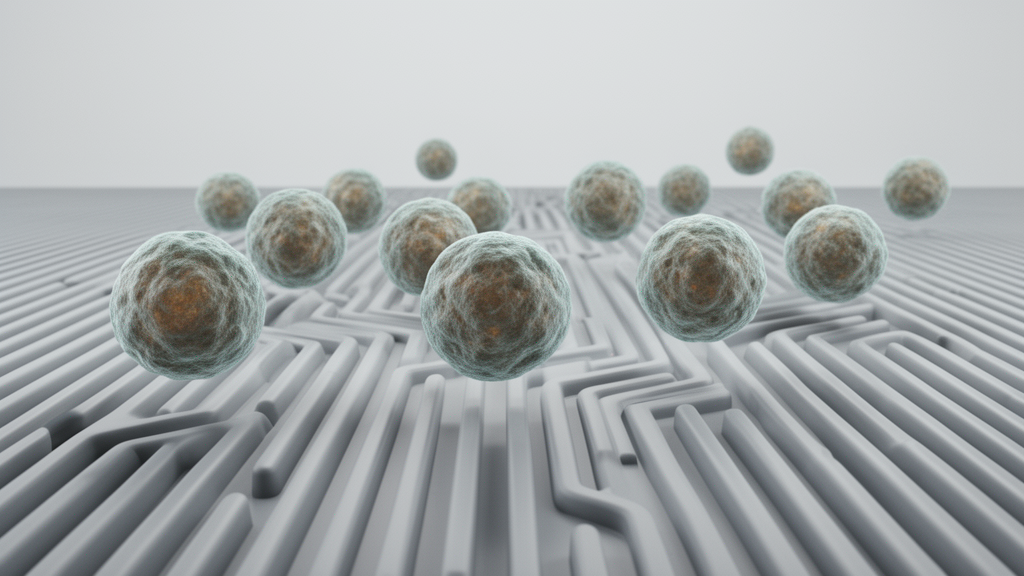
A critical review concludes that the most promising feature of biologically produced antimicrobial nanoparticles is not an automatic environmental advantage, but their biomolecular capping layer: a chemically diverse shell acquired during particle formation that can influence stability, dissolution, protein-corona formation and biological interactions. The analysis finds that this interface is often poorly measured even as the field generates rapid growth in reports of plant-, bacteria-, fungus- and algae-mediated particles. It argues that progress toward manufacturable products depends less on documenting another organism–metal combination than on controlling synthesis and post-synthesis processing as a bioprocess. The review is a critical narrative assessment rather than a systematic meta-analysis, drawing on literature identified from Scopus, Web of Science, PubMed and reference lists, with emphasis on primary research published from 2005 through 31 July 2026.
The underlying chemistry of biological nanoparticle production is not exceptional in itself. NAD(P)H-dependent enzymes, quinones, thiols, reducing sugars, ascorbate and phenolic compounds can reduce dissolved metal cations to zero-valent particles, while biological hydrolysis and condensation can produce oxides and chalcogenides. These routes are mechanistically distinct despite sharing near-ambient conditions, and the review groups them by their production context rather than assuming a common mechanism. Organisms can also template nucleation, restrict growth and influence crystal structure through biomolecular interfaces. What generally distinguishes biological production from conventional chemical reduction is that reducing agents often become capping agents at the same time, leaving proteins, polysaccharides, polyphenols, extracellular polymeric substances, lipopolysaccharide, pigments and other biomolecular constituents adsorbed on the growing particle in a heterogeneous shell assembled during synthesis.
That shell creates both a distinctive opportunity and a major source of variability. Plant extracts commonly supply polyphenols, flavonoids and terpenoids, with protein and polysaccharide content depending on the tissue and extraction solvent. Extracellular bacterial systems can deposit secreted proteins and extracellular polymeric substances, while Gram-negative organisms introduce potentially immunogenic lipopolysaccharide. Fungal systems often contain extracellular reductases and proteins; algae can contribute sulfated polysaccharides, pigments and proteins; and magnetotactic bacteria produce magnetosomes with a genetically defined membrane-protein complement. The shell may stabilize a colloid, alter the rate of active-ion release and provide the foundation on which a protein corona later assembles. Yet the review stresses that these effects are system-specific and that the claimed links among composition, dissolution and antimicrobial performance remain hypotheses requiring direct validation rather than established quantitative relationships.
Downstream handling is a particularly important but underreported source of lost control. Centrifugation and repeated washing may remove loosely attached capping molecules, lyophilisation without a cryoprotectant can aggregate a shell designed to remain hydrated, and autoclaving or other sterilisation methods can denature proteins or alter surface chemistry. A particle characterised immediately after synthesis may therefore differ substantially from the material eventually applied. The review recommends treating core size distribution, crystalline phase, capping-layer mass and composition, stability in the intended medium, ion-release profile and endotoxin burden as candidate critical quality attributes. Feedstock composition, pH, temperature, reaction time, harvest stage, washing, drying, storage and sterilisation are correspondingly candidate critical process parameters, but validated acceptance limits remain application-specific and largely unavailable.
The review also finds that biological production is not intrinsically cheaper or greener. Economic analyses of bacterial magnetite indicate that yield and downstream separation, rather than the avoidance of a chemical reductant, can dominate cost. Life-cycle studies similarly find that metal precursors and process energy often impose the greatest environmental burden, allowing low-yield biological routes with energy-intensive separation to perform worse than optimised chemical routes. However, a recent comparison of three plant-based silver-synthesis routes with sodium-borohydride reduction found that the strongest green route was cheaper and had lower global-warming potential per kilogram, demonstrating that sustainability is route-specific. Any comparison therefore requires a declared functional unit, system boundary and measured process performance rather than a general presumption that “biological” means “sustainable.”
Antimicrobial testing must also distinguish three possible contributors: released metal ions, residual biological material and particle-specific effects. Silver, copper and zinc activity is substantially ion-mediated in many systems, with the particle acting as a localized reservoir of active species; silver nanoparticles that cannot oxidise under anoxic conditions have shown negligible activity. Nevertheless, direct contact, surface-generated reactive species and intracellular delivery may add to killing, depending on composition and conditions. The proposed control hierarchy therefore calls for a dissolved-metal control at the concentration actually measured in the assay, a processed particle-free extract or supernatant control, and a chemically synthesized comparator matched as closely as possible for core properties, aggregation, surface chemistry, dissolution and delivered dose. Claims about the capping layer itself additionally require controlled removal or denaturation, alongside reassessment of aggregation and ion release.
Biofilms expose the limitations of common assays more sharply because planktonic minimum inhibitory concentrations do not predict activity inside an attached microbial community. Extracellular polymers can slow particle penetration, while anionic matrix components and extracellular DNA can bind cationic particles and released ions. Nutrient and oxygen gradients create slow-growing cells and persisters, and the anoxic interior of a mature biofilm may further suppress ion-mediated activity through reduced oxidative dissolution. Crystal-violet biomass measurements alone are therefore uninformative because they confound killing, dispersal and inhibition of attachment and may be distorted by particle adsorption or dye binding. The review identifies depth-resolved viability, viable counts from disrupted biofilms and post-treatment regrowth kinetics as a more defensible minimum, supported by standardized biofilm protocols.
Safety and resistance considerations place additional constraints on translation. A 24-hour tetrazolium assay in one immortalized cell line cannot establish biocompatibility, especially when nanoparticles can reduce the assay dye independently of cells. More relevant mammalian cells, matched exposure conditions and a selectivity index are needed, although the narrow separation between silver’s antimicrobial and mammalian-cell toxicity concentrations illustrates why particle potency alone is insufficient. Microbially derived materials also require endotoxin measurement, with assay-interference controls where conventional methods are unreliable. Resistance to silver nanoparticles has been selected in laboratory serial-exposure experiments, and shared efflux or stress-response mechanisms can contribute to co-selection with antibiotic resistance, although direct field-scale evidence remains limited. Formats delivering a high local dose over a short, defined window are therefore more defensible than products that maintain prolonged sub-inhibitory concentrations in open environments.
Several routes could improve the field’s prospects, including recombinant hosts engineered to secrete a defined capping protein, continuous-flow synthesis with in-line characterization, omics-guided identification of reductases and capping molecules, and stricter reporting across multiple independent batches. The most consequential application is likely to be wound dressings, where conventional silver products provide regulatory and clinical precedent, topical exposure can constrain systemic toxicity and sustained local release is functionally useful; this precedent does not itself establish clinical benefit for biogenic preparations. Implant and device coatings face a more demanding burden, requiring retention of activity after sterilization, controlled release, adhesion and acceptable host-cell responses. By reframing biological nanoparticle synthesis around a measurable surface specification, the review argues that researchers could connect feedstock and process conditions to dissolution, exposure, efficacy and safety. The immediate gains would come from better controls and reporting rather than new organisms, instruments or unsupported claims of universal sustainability.
Subject of Research: Bioprocess control and antimicrobial performance of biologically synthesized metal nanoparticles
Article Title: Biogenic nanoparticles from laboratory curiosity to manufacturable antimicrobial technology: Bioprocess control, the capping-layer interface, and the evidence required for translation
Article References: Shukla, S. K. (2026). Biogenic nanoparticles from laboratory curiosity to manufacturable antimicrobial technology: Bioprocess control, the capping-layer interface, and the evidence required for translation. Current Research in Biotechnology, Article 100431. https://doi.org/10.1016/j.crbiot.2026.100431
Image Credits: AI Generated
DOI: 10.1016/j.crbiot.2026.100431
Keywords: biogenic nanoparticles, antimicrobial materials, bioprocess engineering, capping layers, metal-ion release, nanomanufacturing, biofilm control, quality by design, antimicrobial resistance, life-cycle assessment, Biogenic, nanoparticles
Cite Scienmag News
Drew Townsend. (October 21, 2026). Biogenic nanoparticles advance through controllable surfaces, not green labels. Scienmag. https://scienmag.com/biogenic-nanoparticles-advance-through-controllable-surfaces-not-green-labels/
Drew Townsend. "Biogenic nanoparticles advance through controllable surfaces, not green labels." Scienmag, 21 October 2026, https://scienmag.com/biogenic-nanoparticles-advance-through-controllable-surfaces-not-green-labels/. Accessed 21 October 2026.
Drew Townsend. "Biogenic nanoparticles advance through controllable surfaces, not green labels." Scienmag. October 21, 2026. https://scienmag.com/biogenic-nanoparticles-advance-through-controllable-surfaces-not-green-labels/


