


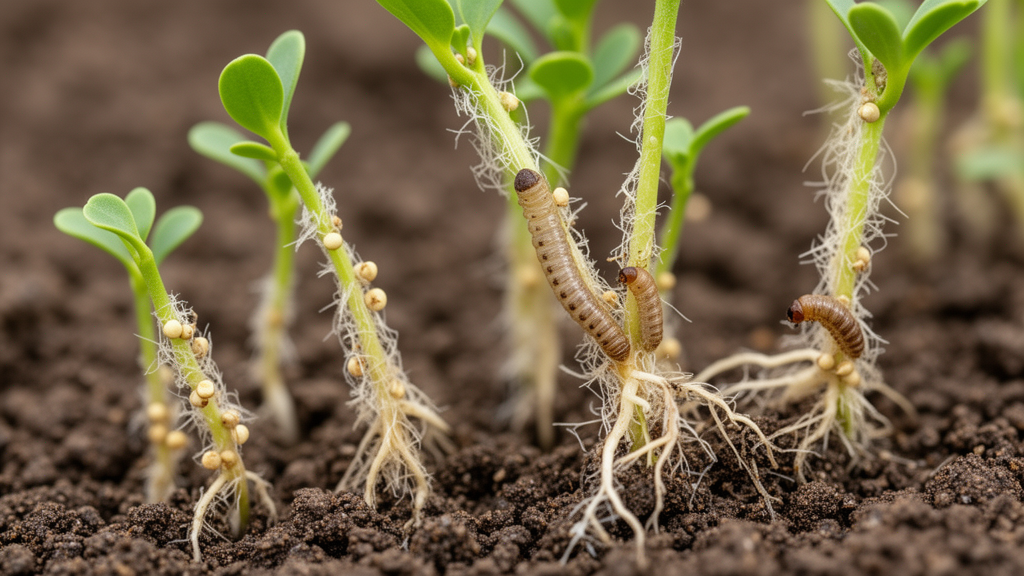
Seed treatment with the entomopathogenic fungus Beauveria bassiana reduced exit holes left by the quinoa stem-boring fly Amauromyza karli in a directly sown Colorado field experiment, but it did not significantly reduce the number of larvae inside stems. Colorado State University researchers also found that the fungus could establish inside quinoa roots, stems and leaves after seed inoculation, although recovery declined as plants grew. The study, published in Frontiers in Fungal Biology on October 21, 2026, provides the first evaluation of endophytic B. bassiana against this emerging quinoa pest while showing that the biological-control effect varied among experimental settings.
The directly sown field trial used quinoa grown from inoculated seed in a commercial field in Colorado’s San Luis Valley. At the sampling date with observable pest damage, plants from inoculated plots had an exit-hole density of 0.066 ± 0.022 holes per cubic centimetre of stem, compared with 0.165 ± 0.023 holes per cubic centimetre in control plots. That represented an approximately 59.7% reduction and was statistically significant at a P value of 0.019. Larval density did not differ between the treatments, however. The fungus was recovered from 26.7% ± 8.4% of treated plants at the first sampling, 14 days after sowing, and from 16.7% ± 6.1% of roots, 20.0% ± 7.3% of stems and 10.0% ± 4.5% of leaves. It could no longer be isolated from treated or control plants at the second sampling on June 30, 2026. The experiment used six replicate plots per treatment, with each plot comprising six rows, each 20 feet long, and adjacent plots separated by a 2-foot space.
Exit holes are openings made by mature A. karli larvae as they leave the stem to pupate in soil, so their density indicates larvae that completed development and emerged. The reduction in exit holes without a corresponding reduction in larval density suggests that the seed treatment did not prevent larvae from entering or feeding within quinoa stems. Instead, the fungal treatment may have slowed larval development, altered the plant’s response to feeding, or interfered with the larvae’s ability to complete development and exit. The researchers did not directly test those mechanisms. They also recovered no mycosed larvae, making direct fungal killing an unlikely explanation for the lower exit-hole count. The absence of external mycosis does not completely exclude an internal infection, but the study provided no direct evidence that B. bassiana killed the larvae.
Because colonization and infestation were assessed on different plants in the directly sown experiment, the investigators could not establish that individual plants containing the fungus were the same plants with fewer exit holes. The results therefore demonstrate an association between the seed formulation and reduced emergence rather than proving a mechanism. The authors suggest that future experiments should measure colonization and pest damage on the same plants. Testing specific fungal strains, inoculation methods and later supplementary treatments could also clarify whether the approach can be made more reliable. Yield was not measured, so the lower exit-hole density cannot yet be translated into an economic benefit for growers. The study also did not establish an economic injury level for A. karli in quinoa.
The greenhouse experiments showed that seed inoculation can introduce viable B. bassiana into several quinoa tissues. Researchers compared seed soaked for 24 hours in a suspension containing 1 × 10⁷ conidia per millilitre, either with 0.05% Silwet L-77 or 0.05% Tween 20, against a sterile-water control. The fungal suspensions had mean germination above 90% before use. Plants were sampled at 7, 14, 21 and 28 days after germination, and surface-sterilized roots, stems and leaves were cultured on potato dextrose agar or Sabouraud dextrose agar supplemented with 1% yeast extract. Across recovery media and sampling times, B. bassiana was recovered from 40% of plants treated with Silwet L-77, 26.3% of plants treated with Tween 20 and none of the controls. Both fungal treatments differed significantly from the control, but recovery did not differ significantly between the two fungal treatments.
The highest colonization frequency was 70% seven days after germination among plants whose seeds had been treated with B. bassiana and Silwet L-77 and whose tissues were cultured on the yeast-supplemented Sabouraud medium. Colonization then fell with time: average recovery across seed treatments and media was 38.3% at seven days, 31.7% at 14 days, 16.7% at 21 days and 1.7% at 28 days. Recovery at seven days was significantly higher than at 21 and 28 days. By day 28, the fungus was recovered only from the Silwet L-77 treatment on the yeast-supplemented medium, at 10%. Recovery across seed treatments and sampling times was 27.5% on the yeast-supplemented medium and 16.7% on potato dextrose agar, a statistically significant difference. Because culture methods detect viable but sometimes sparse fungi imperfectly, some of this difference may reflect medium-specific culturability and detection sensitivity rather than a true difference in fungal abundance inside the plants.
Detection also depended on which quinoa tissue was examined. Seven days after germination, recovery from stems reached 60% in both the Silwet L-77 and Tween 20 treatments when the yeast-supplemented medium was used. Recovery from leaves reached 60% with Tween 20 and 40% with Silwet L-77 on that medium, while root recovery reached 50% in both fungal treatments. The fungus was therefore not confined to roots, unlike the pattern reported after soil inoculation in earlier quinoa work. Other fungal morphotypes emerged from the surface-sterilized tissues, indicating that competition within the plant microbiome may have contributed to the decline in B. bassiana recovery. Dilution of established fungal colonies as quinoa tissue expanded during growth is another possible factor, but neither explanation was tested directly in this experiment. The observed pattern was transient, with detectable colonization lasting up to four weeks after germination.
Potted-plant trials produced weaker and statistically non-significant evidence of suppression. In 2024, infestation incidence was 4.2% among treated plants and 12.0% among controls, while larval density did not differ significantly between treatments. No exit holes were observed in either treatment that year. In 2025, infestation incidence was 20.0% in treated plants and 41.7% in controls, and mean exit-hole density was approximately 49% lower after treatment, at 0.075 ± 0.050 compared with 0.145 ± 0.067 holes per cubic centimetre, but neither difference was statistically significant. The potted plants were exposed to natural field infestations for 14 days in 2024 and eight days in 2025, compared with continuous exposure from emergence for the directly sown crop. By the time the potted plants entered the fields, a substantial portion of the season’s adult A. karli activity had already occurred. Wind-related stem breakage also killed some plants, leaving 15 of 64 plants in 2024 and 18 of 40 plants in 2025 out of the infestation assessment.
Several design limitations complicate comparison among the experiments. Colonization was not assessed in the potted trials, so those results measured the effect of a seed formulation containing the fungus rather than the effect of confirmed endophytic colonization. The directly sown trial was conducted in 2026, whereas the potted experiments took place in 2024 and 2025, with different exposure periods and arrangements. Natural pest pressure varied among years and locations and was not standardized. Moreover, the efficacy experiments included water controls but no surfactant-only controls. Any effect therefore cannot be assigned specifically to the fungus rather than to the combined B. bassiana-and-surfactant formulation. The transient colonization pattern also limits how long a single seed treatment could remain active as the crop develops. Although the period of greatest fungal recovery coincided with the early onset of A. karli activity, the single inoculation did not maintain detectable colonization through the whole crop-development period.
The biological motivation is the difficulty of reaching insects that feed concealed inside plant stems with a conventional foliar spray. B. bassiana generally infects susceptible insects after spores contact and penetrate the cuticle, making internally feeding pests less accessible to externally applied inoculum. Establishing the fungus endophytically could expose larvae to the pathogen from within the plant or change plant traits that affect their development. The strategy is particularly relevant to quinoa, a crop for which the newly reported A. karli fly has caused severe losses, including nearly complete loss in some observations. The pest’s larvae feed within quinoa stems, disrupting the vascular system and causing lodging and plant death. Yet the present study offers a measured result rather than a ready-made solution: B. bassiana can colonize quinoa from inoculated seed, and one directly sown field trial found fewer exit holes, but the effect was not reproduced consistently across all settings. The findings support further controlled testing of fungal strains, application timing and mechanisms before seed treatment can be considered a dependable field-management strategy.
Subject of Research: Greenhouse and field evaluation of endophytic Beauveria bassiana for suppressing the quinoa stem-boring fly Amauromyza karli.
Article Title: Suppressive effects of endophytic Beauveria bassiana on a stem boring pest of quinoa
Article References: Panwar, N., Stewart, J. E., Ibarra Caballero, J. R., Davis, T. S., & Szczepaniec, A. (2026). Suppressive effects of endophytic Beauveria bassiana on a stem boring pest of quinoa. Frontiers in Fungal Biology, 7, 1995993. https://doi.org/10.3389/ffunb.2026.1995993
Image Credits: AI Generated
DOI: 10.3389/ffunb.2026.1995993
Keywords: Beauveria bassiana, quinoa, Amauromyza karli, endophytic fungi, biological control, seed inoculation, stem borer, field experiment, agriculture, insect pest management, Suppressive, effects
Cite Scienmag News
Alan Morgan. (October 21, 2026). Seed-inoculated fungus shows mixed suppression of quinoa stem borer. Scienmag. https://scienmag.com/seed-inoculated-fungus-shows-mixed-suppression-of-quinoa-stem-borer/
Alan Morgan. "Seed-inoculated fungus shows mixed suppression of quinoa stem borer." Scienmag, 21 October 2026, https://scienmag.com/seed-inoculated-fungus-shows-mixed-suppression-of-quinoa-stem-borer/. Accessed 21 October 2026.
Alan Morgan. "Seed-inoculated fungus shows mixed suppression of quinoa stem borer." Scienmag. October 21, 2026. https://scienmag.com/seed-inoculated-fungus-shows-mixed-suppression-of-quinoa-stem-borer/


