


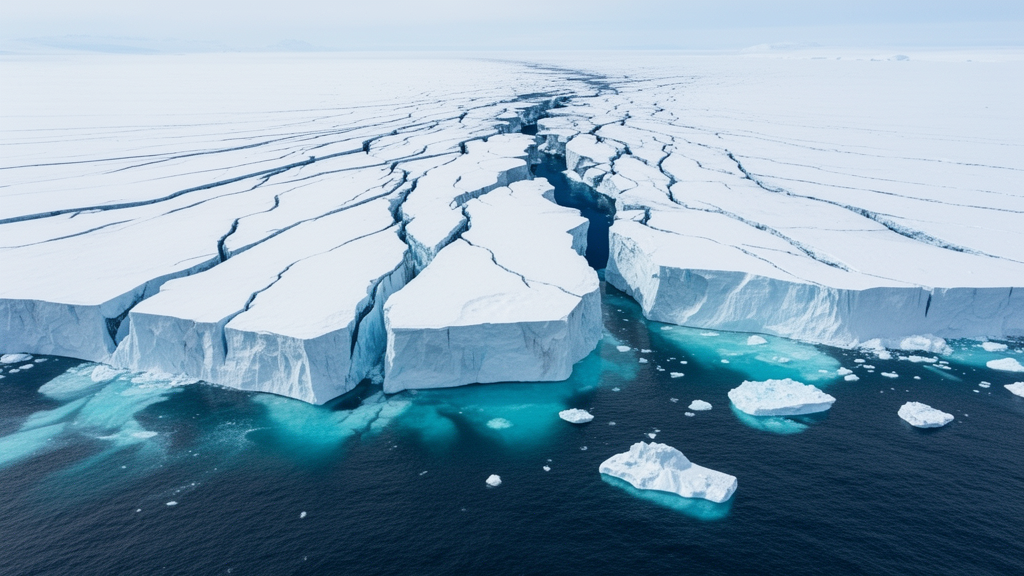
Satellite observations show that the northern sector of the Pine Island Ice Shelf in West Antarctica has retreated, thinned, lost contact with several pinning points and developed propagating rifts since 1973. Its area has decreased, while ice speeds have increased at most of nine monitored locations, including grounded glaciers and floating ice. Calving events also followed the breakup of landfast sea ice in several parts of the shelf.
The observational study documents these linked changes but does not isolate a single cause or demonstrate that the ice shelf is approaching large-scale collapse. The Pine Island Ice Shelf regulates ice discharge from the Pine Island Glacier basin and is commonly divided into northern, central and southern sectors that differ in flow speed, basal melt rate and buttressing strength. Compared with the rapidly thinning and fast-flowing central and southern sectors, the northern ice shelf, designated N-PIIS, has received less attention.
It is primarily fed by the Larter, Lucchitta and Velasco glaciers. Earlier mapping showed that its area had fallen by 13.3% relative to 1966 by 1992, by 16.7% by 1996 and by 27.2% by 2000. A major calving event in 2015 disconnected it from the central ice shelf, although grounding lines at the Lucchitta and Larter glaciers have remained comparatively stable over mountainous, prograde bed topography.
The new analysis combines Landsat optical images, Sentinel-1 synthetic aperture radar, Sentinel-2 imagery, annual ice-velocity products, ICESat-2 laser-altimetry data, sea-ice observations and double-differential interferometry. Ice-front positions were mapped from 1973 through 2026, with extraction uncertainties ranging from about 10 metres for recent Sentinel-1 observations to 60 metres for early Landsat-1 imagery. Annual velocities from 2014 to 2026 were extracted at nine sites, including the grounded Larter and Lucchitta glaciers, floating parts of the northern shelf and several locations on the Velasco Glacier.
Pinning-point evolution was assessed from optical imagery acquired in 1997, 2003, 2007 and 2026, while interferograms generated from Sentinel-1 acquisitions tracked grounding-zone changes from 2017 through 2025. Surface elevation along one repeating ICESat-2 track was analysed from 2019 to 2025. Three mapped subregions experienced marked area loss.
N-PIIS1 lost about 600 square kilometres between 1973 and 2026, including roughly 200 square kilometres during 2014–2015 when it separated from the central shelf. N-PIIS2 decreased by about 120 square kilometres over the same period, with pronounced retreat after 1986. N-PIIS3 lost around 40 square kilometres, with most of that loss occurring after 2007.
An ice front previously connected to pinning point P7 retreated to P8 after calving between 23 January and 27 December 2011. More calving followed in the N-PIIS2 and N-PIIS3 regions during periods when SMOS thin-sea-ice measurements approached zero, indicating little or no landfast ice immediately offshore. By contrast, the N-PIIS1 front, where several pinning points remain and Pine Island Bay provides shelter, did not undergo comparable calving during open-water periods.
The most closely documented sequence unfolded at the Velasco Glacier. A rift was first observed on 14 September 2021, coinciding with the formation of a polynya. The polynya expanded, new fractures formed within the fast ice on 10 November, breakup progressed toward the ice tongue by 28 November, and complete disintegration was observed by 20 December as the polynya continued to expand.
The event ultimately detached an iceberg of approximately 3.50 square kilometres. Another sequence began after landfast sea ice near N-PIIS2 and N-PIIS3 almost completely broke up following 28 November 2025. Several calving events occurred between December 2025 and March 2026, producing further ice-shelf area loss and additional calving at the Velasco Glacier.
The area near pinning point P8 changed less, suggesting that local pinning continued to restrain part of the ice front. Annual velocity records show that ice movement generally accelerated between 2014 and 2026. Sites N1 and N2, on the grounded Larter and Lucchitta glaciers, and sites N3 and N4 on the floating N-PIIS1 shelf increased by approximately 50–100 metres per year.
Velocities at N5 and N6 remained relatively stable at about 50–70 metres per year. At the grounded Velasco Glacier, velocity rose from 2014 to 2022, declined from 2022 to 2024 and increased again after 2024. Floating sites N8 and N9 followed a similar pattern, accelerating through 2021, decelerating through 2024 and accelerating again afterward.
The loss of contact between the Velasco Glacier and N-PIIS3 after 2024 coincided with faster glacier flow. This temporal correspondence suggests that reduced buttressing may have contributed to the velocity increase, although the authors stress that other factors may also have affected the glacier’s response. Interferometric observations reveal a parallel decline in the ice shelf’s attachment to bedrock.
Pinning points P1, P2 and P3 remained visible in optical imagery from 1997 to 2026, although P4 was no longer detectable by 2026 after nearby calving, and P5 disappeared after 2007. Between 2017 and 2025, P1 persisted throughout the record. P2 showed the greatest variability: it was clearly detectable from 2017 to November 2020, appeared intermittently from January 2021 onward, and its centre gradually migrated southward.
P3 was no longer detectable after October 2022, while P5 began disappearing in December 2023 following calving that removed its contact with the ice shelf. Interferograms also showed deformation associated with basal channels. Together with lower surface elevations and the appearance of polynyas, the redistribution of pinning points indicates continued thinning and episodic loss of grounding.
Measurements of the two rifts document continued fracture growth and a change in the propagation rate of the older feature. The rift that developed in 2022 grew from 4.5 kilometres on 14 December 2022 to 8.5 kilometres on 21 December 2023 and 11.3 kilometres on 27 December 2024, an average rate of about 4 kilometres per year. From 27 December 2024 to 28 December 2025, it lengthened from 11.3 to 19.5 kilometres, corresponding to about 8 kilometres per year, nearly twice the earlier rate.
A second rift initiated north of pinning point P2 between June and August 2025. It expanded from approximately 4.1 kilometres on 26 June 2025 to 12.5 kilometres on 29 March 2026, an elongation of 8.4 kilometres in less than one year. Both rifts were close to areas where pinning points were changing, consistent with thinning-driven ephemeral grounding and altered internal stresses influencing fracture propagation.
The observations point to several interacting processes rather than a single demonstrated mechanism. Loss of pinning points can reduce local buttressing and redistribute stresses within the shelf. Breakup of landfast sea ice can also expose the ice front to ocean swell and associated flexural stresses.
ICESat-2 measurements indicated surface elevations near 50 metres in N-PIIS1 but below 15 metres in N-PIIS2 and N-PIIS3. After allowing for approximately 20 metres of firn air content, the researchers estimated ice thickness at about 300 metres in N-PIIS1 and less than 150 metres in the two thinner regions. They note that ocean swell may produce stronger flexural effects in ice shelves below 150 metres thick, although the observations do not quantify its contribution to individual calving events.
Overall, the analysis documents a northern ice shelf that is smaller, thinner and less securely pinned than it was decades ago, with faster ice flow, repeated frontal retreat and rifts that continue to propagate. Polynyas were not detected in the Landsat scenes examined for 1986, 1989 or 1997, although those images showed surface changes, including supraglacial lakes in 1997. Polynyas were clearly visible in imagery from 2003, 2005, 2007, 2019, 2020, 2021, 2022 and 2026, with marked expansion in 2021 and 2026.
Satellite radar also recorded areas of reduced backscatter during the austral winter of 2024, while ICESat-2 data showed a continuous elevation decrease in those areas. The study did not report a large-scale collapse of the N-PIIS and cannot determine the relative influence of basal melting, ocean swell, sea-ice loss, pinning-point change and other factors. The authors instead call for sustained satellite observations, in situ measurements and numerical modelling to quantify those contributions and assess the potential for further rift propagation and structural change.
Subject of Research: Satellite analysis of retreat, thinning, calving and rift propagation in West Antarctica’s northern Pine Island Ice Shelf
Article Title: Progressive changes in geometry and dynamics of the Northern Pine Island Ice Shelf, West Antarctica
Article References: Chien, Y., Zhou, C., & Zhang, B. (2026). Progressive changes in geometry and dynamics of the Northern Pine Island Ice Shelf, West Antarctica. The Cryosphere, 20(10), 6071-6086. https://doi.org/10.5194/tc-20-6071-2026
Image Credits: AI Generated
Keywords: Pine Island Ice Shelf, West Antarctica, ice-shelf retreat, ice-shelf thinning, pinning points, rift propagation, polynyas, sea-ice breakup, satellite observations, glacier dynamics, Progressive, changes
Cite Scienmag News
Sloane Callahan. (October 21, 2026). Northern Pine Island Ice Shelf Retreats, Thins and Develops Propagating Rifts. Scienmag. https://scienmag.com/northern-pine-island-ice-shelf-retreats-thins-and-develops-propagating-rifts/
Sloane Callahan. "Northern Pine Island Ice Shelf Retreats, Thins and Develops Propagating Rifts." Scienmag, 21 October 2026, https://scienmag.com/northern-pine-island-ice-shelf-retreats-thins-and-develops-propagating-rifts/. Accessed 21 October 2026.
Sloane Callahan. "Northern Pine Island Ice Shelf Retreats, Thins and Develops Propagating Rifts." Scienmag. October 21, 2026. https://scienmag.com/northern-pine-island-ice-shelf-retreats-thins-and-develops-propagating-rifts/


