

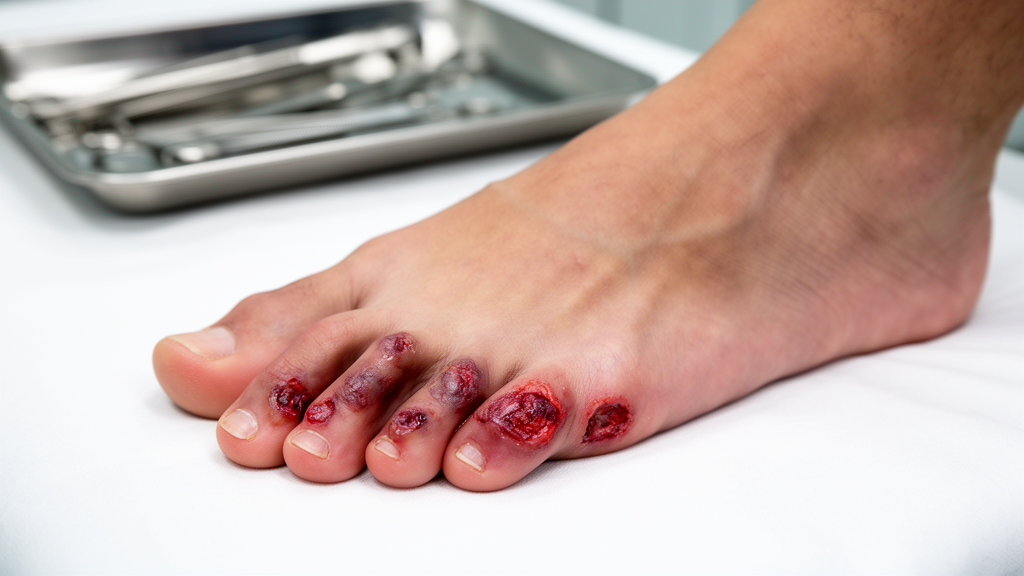
Diabetic foot ulcers in a Chinese hospital survey most often began between the toes, on the top of a toe or at the toe tip, according to researchers who mapped 7,813 recorded lesion locations in 2,892 patients. The analysis also found that accidental trauma and footwear-related injuries were the most frequently reported triggers, while peripheral neuropathy and arterial disease were associated with different patterns of ulcer involvement. Because the study was cross-sectional and hospital-based, its results describe associations in the recruited clinical population rather than proving that neuropathy, vascular disease or particular behaviors caused ulcers to form at specific sites.
The multicentre study, conducted from October 2020 through April 2022, drew records from 77 hospitals in 14 provincial-level regions through a WeChat-based survey platform. Investigators used the earliest dated entry for each patient, producing an analytical cohort of 2,892 people from 3,105 submitted records. Their mean age was 63.4 years, and 66.6% of participants with known sex were male.
Mean diabetes duration was 12.9 years, while the average reported duration of diabetic foot ulceration was 94.2 days. Participating hospitals were recruited through provincial diabetic-foot alliances using non-probability convenience sampling, an approach that limits how closely the sample represents people with diabetic foot ulcers across China as a whole. To standardize the assessment, physicians divided the foot into 56 anatomical regions and recorded every site at which ulceration was present in the index record.
These detailed positions were then summarized into eight prespecified groups—sole, dorsum of toe, dorsum of foot, heel, between toes, subungual toe, toe tip and ankle—plus an “other” category. Because a patient could have more than one affected region, the categories were non-mutually exclusive and did not total 100%. Overall, 46.8% of patients had multiple recorded sites, while 0.7% had bilateral involvement.
Within the broad “other” group, plantar toe pads were the largest component, followed by plantar interphalangeal-joint regions and lateral or medial metatarsal and midfoot regions. Between-toe involvement was recorded in 1,102 of 2,892 patients, or 38.1%, making it the leading category. The dorsum of a toe was involved in 883 patients, or 30.5%, and the toe tip in 770, or 26.6%.
Other recorded sites included the subungual area in 21.3%, the dorsum of the foot in 11.6%, the heel in 10.5%, the sole in 10.2% and the ankle in 5.6%. When the finer 56-region data were considered, the first-toe dorsum and first-toe tip were the most frequent individual points, each appearing in roughly 4.8% of the 7,813 location entries. The concentration around toes, nail margins and interdigital surfaces is compatible with the kinds of pressure, shear and compression that can arise during walking or from footwear, although the survey itself did not directly measure those mechanisms.
The recorded precipitating factors likewise pointed to everyday hazards. Accidental injury was the largest category, accounting for 32.2% of patients, and footwear-related injury followed at 25.4%. Sixteen percent had an unidentified cause, 15.3% were classified as personal behaviors and 11.1% as skin lesions and infections.
The behavioral category included events such as walking barefoot, cutting toenails, removing calluses and other self-care practices, while footwear injury included abrasion from shoes. The unidentified group combined causes recorded as unknown with cases lacking a specified external trigger. Trigger category was associated with eight of the nine grouped anatomical sites after false-discovery-rate correction; the heel was the only site without a significant global association.
Paired analyses revealed two modest differences between feet. Sole involvement was more frequent on the right, appearing in 5.91% of patients compared with 4.32% on the left, a difference of 1.59 percentage points. Toe-tip involvement showed the opposite pattern: it was recorded on the right in 11.89% of patients and on the left in 14.80%, a 2.90-percentage-point difference.
Both comparisons remained significant after correction for multiple testing, while no other grouped site differed significantly by side after that correction. The researchers described the findings as site-specific patterns worth attention during examination rather than evidence for a particular biomechanical mechanism, which was not established by the cross-sectional data. Compared with patients with neither diabetic peripheral neuropathy nor lower-extremity arterial disease, patients with lower-extremity arterial disease alone had greater odds of dorsal-toe involvement, with an odds ratio of 1.71 and a 95% confidence interval of 1.30 to 2.24.
Neuropathy alone was associated with heel involvement, with an odds ratio of 1.83 and a 95% confidence interval of 1.22 to 2.76, but not with sole involvement. Patients with both neuropathy and arterial disease had higher odds of toe-tip involvement, at 2.14, and subungual involvement, at 2.19, as well as lower odds of dorsum-of-foot involvement, at 0.47. These estimates were adjusted for age and sex and used hospital-cluster-robust standard errors.
The neurovascular models were secondary cross-sectional analyses and carried important interpretive limits. The reference group consisted of patients with neither diabetic peripheral neuropathy nor lower-extremity arterial disease, and the analysis tested 24 neurovascular coefficients with false-discovery-rate correction. A sensitivity analysis that additionally adjusted for smoking and diabetes duration produced similar results.
Even so, the data cannot establish that arterial disease or neuropathy caused ulcers at particular anatomical sites. Assessments were made during routine clinical care rather than by central adjudication, and potential differences among hospitals could have affected the classification of both disease status and ulcer location. Several further limitations constrain the findings.
Multiple lesions recorded for one patient may have developed concurrently or within a short period, yet all were treated as initial sites because the available records could not determine their exact sequence. The study did not impute missing data, and the convenience sample of hospitals limits generalization to the broader Chinese population. Residual confounding from unmeasured factors is also possible.
The authors call for prospective validation with standardized adjudication of ulcer sites.
Subject of Research: Distribution of initial diabetic foot ulcer sites and precipitating factors in a Chinese multicenter hospital sample
Article Title: Distribution characteristics of initial lesion sites for diabetic foot ulcers in China: a national multicenter survey
Article References: Shi, Y., Xue, T., Ma, L., Zou, L., Li, K., Wu, Y., Zhou, Q., Yu, Y., Jiang, X., Li, L., Zhang, J., Zhang, H., Wang, P., Yang, B., Zhu, H., Wang, A., Jiang, Y., Xu, Z., Ran, X., & Li, Q. (2026). Distribution characteristics of initial lesion sites for diabetic foot ulcers in China: a national multicenter survey. Frontiers in Endocrinology, 17, 1983798. https://doi.org/10.3389/fendo.2026.1983798
Image Credits: AI Generated
DOI: 10.3389/fendo.2026.1983798
Keywords: diabetic foot ulcers, anatomical distribution, diabetic peripheral neuropathy, lower-extremity arterial disease, footwear injury, accidental trauma, cross-sectional study, China, Distribution, characteristics, initial, lesion
Cite Scienmag News
Scienmag. (October 21, 2026). Chinese diabetic foot ulcers cluster around toes, survey reveals. https://scienmag.com/chinese-diabetic-foot-ulcers-cluster-around-toes-survey-reveals/
Scienmag. "Chinese diabetic foot ulcers cluster around toes, survey reveals." Scienmag, 21 October 2026, https://scienmag.com/chinese-diabetic-foot-ulcers-cluster-around-toes-survey-reveals/. Accessed 21 October 2026.
Scienmag. "Chinese diabetic foot ulcers cluster around toes, survey reveals." Scienmag. October 21, 2026. https://scienmag.com/chinese-diabetic-foot-ulcers-cluster-around-toes-survey-reveals/


