


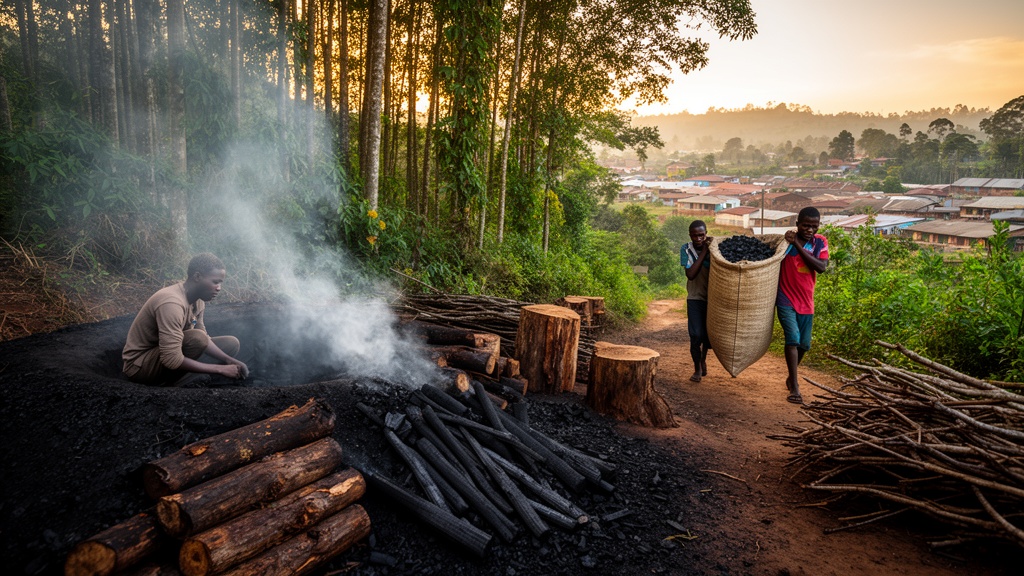
A field study conducted in 2020 estimated that charcoal entering Bonga Town through five entry points in Ethiopia’s Kafa Biosphere Reserve amounted to about 15 tonnes per day and 5,449 tonnes per year. Supplying that charcoal required an estimated 27,244 tonnes of dry wood, involved the felling of 355,354 trees and disturbed 895 hectares of forest. The researchers also estimated associated annual greenhouse gas emissions of 68,110 tonnes of carbon dioxide equivalents.
These results were derived from a preliminary field survey, household and informant interviews, focus-group discussions and daily monitoring rather than from a continuous, long-term census of forest change. The study combined quantitative and qualitative methods to examine charcoal production and supply around Bonga Town. Researchers randomly selected 108 households for the household survey and assessed charcoal arriving through the town’s five major entry points.
They used descriptive and numerical statistics in R to compare daily and annual charcoal supply, dry-wood extraction, estimated numbers of felled trees, forest area disturbed and emissions among those locations. The design combined physical measurements of supply with information about production practices and tree preferences, although its findings describe one year in one study area and cannot establish long-term trends in demand, forest loss or emissions. Millettia ferruginea, Ehretia cymosa and Vepris dainellii were the three tree species most preferred for charcoal production.
The researchers reported that two of these species are endemic to Ethiopia. The estimated felling of 355,354 trees therefore included pressure on native species, including endemic trees, within the reserve. Its figures for tree loss, disturbed forest area and associated impacts are estimates connected to the monitored charcoal flows and surveyed production areas.
The five entry points differed significantly in daily and annual charcoal supply, the amount of dry wood extracted, the estimated number of trees felled, the forest area disturbed and carbon dioxide emissions. Kaya Kela and Keja Araba had the highest values among the five locations studied. This spatial variation shows that the forest and emissions burden associated with Bonga’s charcoal supply was unevenly distributed across the reserve.
The findings support interventions tailored to the differing conditions of individual areas while the researchers also call for sustainable energy solutions that can protect the ecosystem while supporting rural livelihoods and urban energy demand. The annual estimate of 68,110 tonnes of carbon dioxide equivalents represents emissions associated with charcoal production and supply, as assessed by the study, rather than a direct measurement of carbon dioxide released at every stage of the chain. The scale of the estimate reflects the large inferred demand for wood: the 27,244 tonnes of dry wood used to make 5,449 tonnes of charcoal was slightly less than five times the mass of charcoal delivered.
Taken together, the measurements document a substantial energy-driven connection between urban charcoal consumption, woodland extraction and greenhouse gas emissions in an ecologically important reserve.
Subject of Research: Environmental impacts of charcoal production and supply in Ethiopia’s Kafa Biosphere Reserve
Article Title: Forest loss and greenhouse gas emissions associated with charcoal production and supply to Bonga town in the Kafa Biosphere Reserve southwestern Ethiopia
Article References: Gebremeskel, T., Kassa, H., Mulatu, K., Chekole, E., Mengistu, A., Taye, G., & Pavlů, V. (2026). Forest loss and greenhouse gas emissions associated with charcoal production and supply to Bonga town in the Kafa Biosphere Reserve southwestern Ethiopia. Discover Sustainability. https://doi.org/10.1007/s43621-026-04410-3
Image Credits: AI Generated
DOI: 10.1007/s43621-026-04410-3
Keywords: charcoal production, Kafa Biosphere Reserve, Bonga Town, forest loss, greenhouse gas emissions, deforestation, endemic trees, Ethiopia, wood harvesting, field study, Forest, loss
Cite Scienmag News
Violet Maxwell. (October 21, 2026). Research report: Forest loss and greenhouse gas emissions associated with charcoal production and supply to Bonga town in the Kafa Biosphere Reserve southwestern Ethiopia. Scienmag. https://scienmag.com/research-report-forest-loss-and-greenhouse-gas-emissions-associated-with-charcoal-production-and-supply-to-bonga-town-in-the-kafa-biosphere-reserve-southwestern-ethiopia/
Violet Maxwell. "Research report: Forest loss and greenhouse gas emissions associated with charcoal production and supply to Bonga town in the Kafa Biosphere Reserve southwestern Ethiopia." Scienmag, 21 October 2026, https://scienmag.com/research-report-forest-loss-and-greenhouse-gas-emissions-associated-with-charcoal-production-and-supply-to-bonga-town-in-the-kafa-biosphere-reserve-southwestern-ethiopia/. Accessed 21 October 2026.
Violet Maxwell. "Research report: Forest loss and greenhouse gas emissions associated with charcoal production and supply to Bonga town in the Kafa Biosphere Reserve southwestern Ethiopia." Scienmag. October 21, 2026. https://scienmag.com/research-report-forest-loss-and-greenhouse-gas-emissions-associated-with-charcoal-production-and-supply-to-bonga-town-in-the-kafa-biosphere-reserve-southwestern-ethiopia/


