


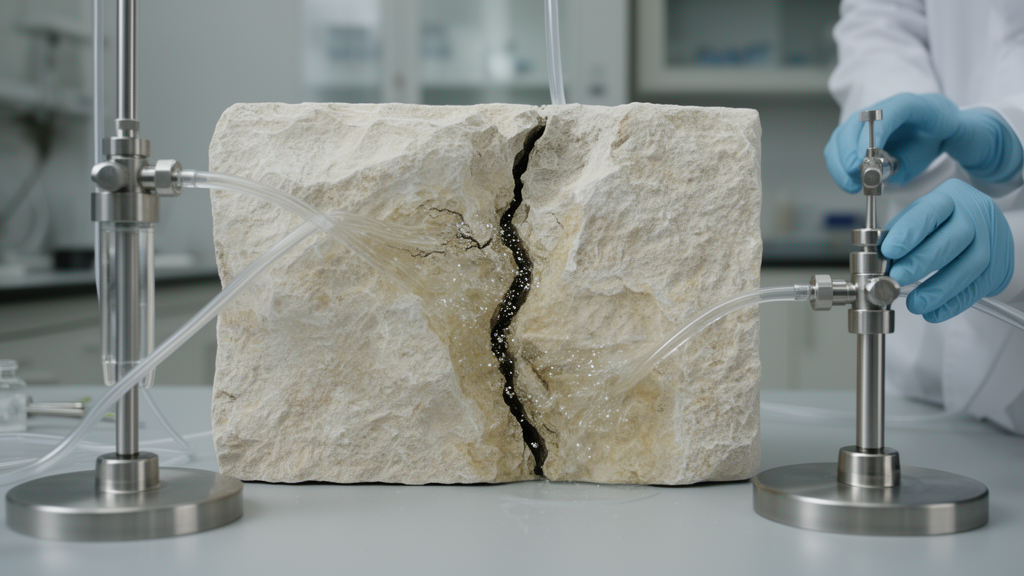
A coupled flow-and-chemistry model successfully reproduced limestone dissolution in a laboratory fracture under controlled carbon dioxide levels, flow rates and fracture openings. The experiments used a vertical karst-fracture analog with an area of 1 square metre, while the numerical simulations tracked the movement and reaction of dissolved carbon species and calcium between a reactive limestone wall and an inert cover. Agreement between measured and simulated calcium concentrations showed that the model can capture the feedback between transport, evolving flow and carbonate reaction at fracture scale. It also identified diffusive transport to the water–limestone interface, rather than reaction kinetics alone, as the principal constraint on dissolution in the tested scenarios.
p>The study was a laboratory validation exercise, not a field test or a demonstration of underground carbon storage performance. Researchers tested polished Dietfurter limestone in an apparatus measuring 1 metre by 1 metre by 2 centimetres. Spacers created adjustable apertures of 2 or 6 millimetres between the limestone and a polycarbonate plate, producing a simplified vertical fracture with one reactive surface and one inert surface. Carbon dioxide-enriched deionized water entered through two openings at the top and left through a uniformly draining outlet, where dissolved calcium was measured. The setup was designed to provide controlled flow conditions for testing a numerical model before it is applied to more complicated density-driven behavior.
p>Before running the comparison, the investigators used simulations to identify informative experimental conditions. They examined apertures from 1 to 10 millimetres, flow rates from 0.1 to 1.3 litres per minute and carbon dioxide partial pressures of 1, 0.5 and 0.02 bar. Predicted calcium concentrations remained above the 0.01 milligram-per-litre measurement threshold across the explored range, but varied substantially with aperture, residence time and carbon dioxide loading. Higher carbon dioxide pressure increased dissolution, while longer residence time allowed more contact with the reactive wall. The 0.02-bar condition, selected as representative of karst settings, produced concentrations too small for reliable measurement and was therefore excluded from the validation experiments.
p>The numerical system was newly implemented in the DuMu^x simulator and combined the Stokes equations for low-speed fluid flow with mass balances for water, total inorganic carbon and dissolved calcium. Unlike many Darcy-scale descriptions, the Stokes formulation accounts for density changes caused by dissolved species. Water properties followed IAPWS specifications, carbon dioxide properties used established equations, and calcium diffusion was calculated from its temperature-dependent molar conductivity. A two-dimensional cross-section was used because the dominant flow was expected to run perpendicular to the plates, while lateral velocities parallel to the limestone were expected to be much smaller. This approximation reduced computational cost but did not represent all possible three-dimensional instabilities.
p>Chemical speciation was solved from total inorganic carbon, electroneutrality and carbonate equilibrium relationships, allowing the model to recover pH and the relative proportions of dissolved carbon dioxide, carbonic acid, bicarbonate and carbonate. Calcite dissolution was represented through acid, neutral and carbonate mechanisms, including a backward carbonate reaction and suppression of dissolution as the mineral saturation ratio approached one. The reaction rates were temperature dependent, and their implementation was first checked against published fully mixed experiments. The simulated pH trajectories agreed closely with those literature measurements, providing a separate check on the kinetic formulation before fracture-scale transport effects were introduced.
p>The equations were discretized with a staggered-grid method that reduces pressure oscillations while retaining mass conservation. Square cells were used in the principal flow direction, with additional refinement across the narrow aperture to resolve concentration gradients beside the limestone. All equations were solved fully implicitly in time, using a Newton scheme with a maximum time step of 10 seconds. A grid-convergence analysis showed that further refinement changed the simulated concentration curves only modestly. Boundary conditions included no-slip walls, a prescribed inlet velocity during flow-through, an outlet condition and an initial one-hour closed period that reproduced the laboratory resting phase. That initialization allowed dissolution products to accumulate before circulation began.
p>Measurements and simulations followed the same qualitative pattern. After the one-hour resting phase, the outflow calcium concentration changed as accumulated material was flushed from the fracture and the system moved toward a dynamic steady state. The effect was sharper in the 2-millimetre opening, where the initial concentration formed a brief plateau before dropping toward its long-term value; the 6-millimetre case showed a weaker breakthrough. Both measurement and simulation produced higher normalized steady-state concentrations at lower flow velocities, corresponding to longer residence times. The influence of carbon dioxide pressure was comparatively small in the selected experiments. Simulations and observations generally agreed well in both transient and asymptotic portions of the curves, although measured data were somewhat scattered in several cases.
p>The agreement was somewhat better for the 6-millimetre aperture than for the 2-millimetre opening, and some discrepancies remained during the earliest transient, particularly in the narrow fracture. The investigators attributed some of this difference to measurement variability, noting that the laboratory curves showed less pronounced plug-flow-like behavior than the simulations. These deviations did not change the reproduced trends. The tests also revealed a technical limit: the maximum estimated cumulative denudation was about 13.1 micrometres, smaller than the vertical cell dimension of the finest grid, so the model treated the moving limestone boundary as effectively fixed. It also assumed a uniform, unchanged surface and did not include possible inhibitors associated with other ions.
p>The simulations further showed that dissolution was strongly transport-limited in every tested case. Researchers calculated Sherwood numbers to compare effective mass transfer with diffusion, and efficiency factors to distinguish transport control from reaction control. For the 6-millimetre fractures, the efficiency factors ranged from roughly 2 × 10⁻⁵ to 5 × 10⁻³. In the 2-millimetre fractures, they rose to about 10⁻², indicating somewhat less severe transport limitation while still showing that diffusion strongly influenced the result. The narrower gap allowed mass-transfer profiles to become nearly developed over the 1-metre path, whereas some wider-fracture cases had not reached the expected fully developed condition. These findings identify delivery of dissolved reaction products away from the reactive wall as the central bottleneck.
p>Both measurements and simulations reached a quasi-steady outflow calcium concentration after roughly one to two fracture volumes had passed through the apparatus. Normalized calcium concentration increased approximately linearly with the Damköhler number at low to moderate values before approaching a saturation limit, linking the observed behavior to the balance between reaction and residence time. The validated model provides a foundation for future work on stagnant water disturbed by density-driven carbon dioxide dissolution and calcite reaction. Its present evidence remains bounded by laboratory scale, a simplified two-dimensional geometry, selected carbon dioxide pressures and a nearly pure calcite surface; translating it directly to heterogeneous, three-dimensional carbonate aquifers will require additional validation.
Subject of Research: Validation of a coupled reactive-transport model for carbonic-acid dissolution of limestone in a laboratory fracture analog
Article Title: Validating a numerical model for calco-carbonic reactive transport in a laboratory-scale fracture analog
Article References: Wendel, K., Keim, L., Strauch, B., Zimmer, M., & Class, H. (2026). Validating a numerical model for calco-carbonic reactive transport in a laboratory-scale fracture analog. Hydrogeology Journal. https://doi.org/10.1007/s10040-026-03153-9
Image Credits: AI Generated
DOI: 10.1007/s10040-026-03153-9
Keywords: reactive transport, limestone dissolution, karst fracture, carbonate chemistry, carbon dioxide, numerical modelling, mass-transfer limitation, laboratory experiment, Stokes flow, calcium concentration, Validating, numerical
Cite Scienmag News
Violet Maxwell. (October 21, 2026). Lab fracture model reproduces limestone dissolution under variable flow. Scienmag. https://scienmag.com/lab-fracture-model-reproduces-limestone-dissolution-under-variable-flow/
Violet Maxwell. "Lab fracture model reproduces limestone dissolution under variable flow." Scienmag, 21 October 2026, https://scienmag.com/lab-fracture-model-reproduces-limestone-dissolution-under-variable-flow/. Accessed 21 October 2026.
Violet Maxwell. "Lab fracture model reproduces limestone dissolution under variable flow." Scienmag. October 21, 2026. https://scienmag.com/lab-fracture-model-reproduces-limestone-dissolution-under-variable-flow/


