


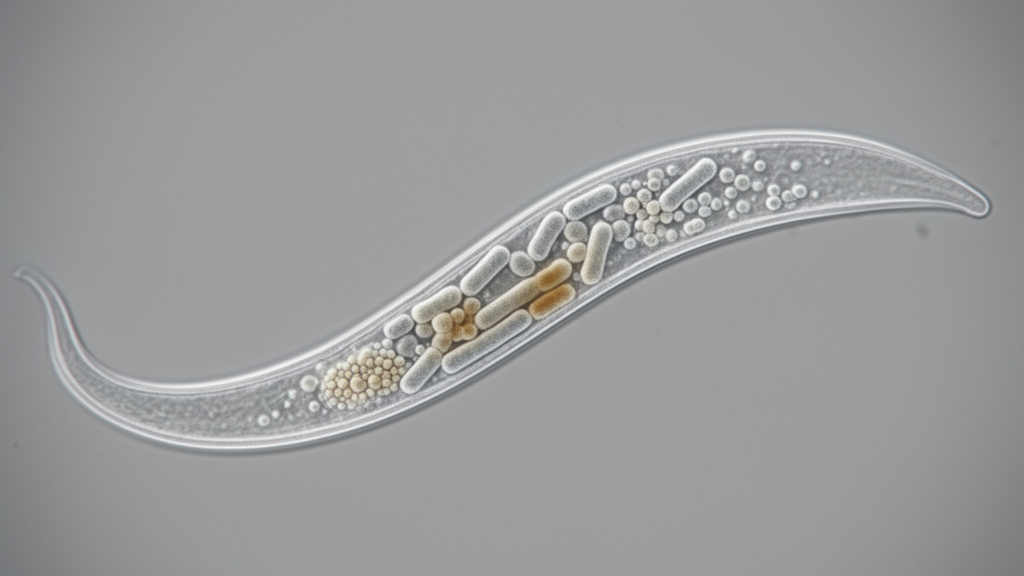
RNA sequencing of Pseudomonas aeruginosa colonizing the nematode Caenorhabditis elegans identified a partial reproduction of the transcriptional changes associated with chronic lung infection, according to a study in Frontiers in Microbiology. In the agar-based Slow Killing model, bacteria recovered from the worm intestine showed increased expression of genes linked to biofilm formation, lipid A synthesis and host adaptation, while genes associated with several acute virulence programs were reduced. The results support the nematode system as an accessible experimental model for studying bacterial responses inside a whole organism, but they do not establish that it reproduces every feature of chronic infection in people with cystic fibrosis.
P. aeruginosa is a Gram-negative opportunistic pathogen associated with hospital-acquired pneumonia, bloodstream infections and chronic respiratory infection, particularly in people with cystic fibrosis. Acute infections are characterized by production of proteases, cytotoxins, exotoxin A, rhamnolipids and other secreted factors that can disrupt host proteins or interfere with immune responses. Chronic infection is associated with a shift toward colonization, biofilm formation and persistence.
The study asked how bacterial gene expression changes as P. aeruginosa becomes established within a host and whether those changes overlap with the transcriptional profile of bacteria recovered from cystic fibrosis sputum and an ex vivo porcine lung biofilm model. The researchers used the laboratory strain P. aeruginosa PA14 and the established agar-based Slow Killing assay. In this system, worms feed on a bacterial lawn, and the pathogen produces disease by colonizing the intestinal epithelium.
Colonization-deficient mutants show attenuated virulence in the model, while the host resists infection through the p38 MAPK/PMK-1 innate immune pathway. The investigators also examined Liquid Killing conditions, in which virulence is associated mainly with pyoverdine and secreted toxins and colonization is strongly impeded. Too little bacterial colonization occurred in the liquid host condition to recover enough bacterial RNA for robust analysis, so the in vivo Liquid Killing samples were excluded.
Bacteria grown in liquid without worms remained available as an in vitro comparison. RNA sequencing covered P. aeruginosa grown on agar, grown in liquid and recovered during Slow Killing, with host-free controls used to distinguish the effect of the worm from growth medium alone. Principal-component analysis separated the biological signals among conditions.
Genes differing between bacteria grown on agar alone and bacteria colonizing worms were associated with several cellular processes, including transcription, fatty acid and phospholipid metabolism, protein synthesis, energy metabolism, the cell envelope, and transport and binding functions. Differentially expressed genes were identified at a false-discovery rate below 0.05 and a minimum log2 fold change of 1.5, equivalent to approximately 2.83-fold in ordinary fold change. The separated profiles indicated that host colonization was associated with a distinct bacterial state rather than simply reflecting growth on agar.
The team benchmarked the model against two external infection datasets: P. aeruginosa transcriptomes from cystic fibrosis sputum and an ex vivo porcine lung infection experiment involving PA14. Its Accuracy Score 2 metric measured the proportion of genes whose expression fell within two standard deviations of a reference profile, with higher values indicating greater similarity. Combined profiles from the nonhuman conditions scored above 80% against the sputum data, while bacteria recovered specifically from colonized worms scored above 75%.
For pathogenesis-associated genes, each tested condition exceeded 70% similarity with sputum. These quantitative results support substantial overlap, although the investigators characterized the agreement as partial rather than complete and noted that the clinical reference included 24 unique samples that were compared with a single experimental condition. Genes shared between the worm-associated profile and the sputum reference were enriched for functions involving energy metabolism, protein fate, and transport and binding.
Pathogen-specific analysis showed that bacteria colonizing C. elegans downregulated multiple programs associated with acute virulence. Relative to growth on agar alone, genes for pyoverdine and pyochelin biosynthesis and uptake declined, as did genes for type II and type III toxin secretion, phenazine production, quorum sensing, rhamnolipid production and motility. The affected quorum-sensing genes included lasR, rhlR, rhlI, pqsA and pqsB.
Downregulation of flagellar and type IV pilus genes was consistent with a shift away from a motile state. Fourteen pathogenesis-associated genes were unique to the Slow Killing condition and significantly downregulated relative to in vitro growth on agar. Several pathways associated with chronic adaptation moved in the opposite direction during nematode colonization.
The lipid A biosynthetic locus was upregulated, along with the phoPQ and pmrAB two-component regulatory systems. These systems regulate metal-related responses and lipopolysaccharide modification. Genes encoding PagP and several Arn proteins, which contribute to lipopolysaccharide modification, also increased, while the ferrous iron uptake system feoAB was elevated.
Exopolysaccharide biosynthetic genes for Pel and alginate, both required for biofilm formation, were upregulated. Genes involved in hydrogen cyanide production were among the other increased functions. Together, the coordinated changes were consistent with a move from an acute, motile and toxin-focused state toward a more sessile, biofilm-associated and host-adapted phenotype.
The strain-matched porcine lung experiment provided an additional test of whether the worm-associated profile reflected shared biology rather than a general effect of the laboratory media. Genes upregulated in PA14 biofilms in pig lungs showed significant overlap with the Slow Killing profile, including genes involved in Pel exopolysaccharide production, lipid A biosynthesis and ribosomal proteins. The study reported that 72 of 225 differentially expressed genes were shared, approximately one third of the total.
By contrast, genes induced in the surrounding synthetic cystic fibrosis medium were significantly associated with the in vitro agar condition, particularly a genomic island encoding an H3-type type VI secretion system. The strongest overlap involving biofilm-associated genes therefore occurred in bacteria occupying a host-associated niche. The researchers next tested whether bacterial genes highlighted by the transcriptomic analysis affected host–pathogen interactions.
They assessed mutants carrying defects in pathways including lasR, pelA, phz, phoQ, rhlI, hsbR, pmrA and hsbA. Virulence was significantly attenuated in the PA14 lasR, phoQ, phz and rhlI mutants. Fluorescence microscopy showed that loss of lasR also significantly reduced colonization of the worm intestine, consistent with its established role in Slow Killing.
The phoQ, rhlI and phz mutants, by contrast, showed reduced virulence without a significant reduction in intestinal colonization. These results separate bacterial colonization from the mechanisms that lead to host death and indicate that disruption of some pathways can lessen pathogenic effects without preventing the bacteria from occupying the intestine. The study has important boundaries.
Although sequencing coverage from worm-associated samples was comparable to the sputum data, bacterial read yield was lower because host RNA was recovered alongside bacterial RNA and had to be filtered during genome alignment. Differences also remained in important quorum-sensing genes, and clinical P. aeruginosa isolates can carry regulatory mutations absent from PA14, including loss-of-function changes in lasR. The findings do not show that Slow Killing models every stage of human chronic infection or that its gene-expression changes predict outcomes in patients.
They do show that the model captures a coordinated subset of chronic-infection biology, including biofilm, lipopolysaccharide and two-component-system changes, and that transcriptomic associations can be tested through colonization and survival experiments. Within those limits, the study presents a whole-organism system for identifying bacterial mediators of infection while clearly distinguishing experimental modeling from direct clinical evidence.
Subject of Research: Transcriptomic benchmarking of a C. elegans model of chronic Pseudomonas aeruginosa infection
Article Title: Caenorhabditis elegans Slow Killing recapitulates chronic Pseudomonas aeruginosa infection and reveals mediators of host-pathogen interactions
Article References: Gaskins, S., Zhang, L., Kang, D., Xu, Q., & Kirienko, N. V. (2026). Caenorhabditis elegans Slow Killing recapitulates chronic Pseudomonas aeruginosa infection and reveals mediators of host-pathogen interactions. Frontiers in Microbiology, 17, Article 1990701. https://doi.org/10.3389/fmicb.2026.1990701
Image Credits: AI Generated
DOI: 10.3389/fmicb.2026.1990701
Keywords: Pseudomonas aeruginosa, Caenorhabditis elegans, chronic infection, cystic fibrosis, RNA sequencing, biofilm formation, virulence genes, quorum sensing, host–pathogen interactions, Slow Killing, Caenorhabditis, elegans
Cite Scienmag News
Kristina Jarvis. (October 21, 2026). Nematode model reveals bacterial shifts in chronic Pseudomonas infection. Scienmag. https://scienmag.com/nematode-model-reveals-bacterial-shifts-in-chronic-pseudomonas-infection/
Kristina Jarvis. "Nematode model reveals bacterial shifts in chronic Pseudomonas infection." Scienmag, 21 October 2026, https://scienmag.com/nematode-model-reveals-bacterial-shifts-in-chronic-pseudomonas-infection/. Accessed 21 October 2026.
Kristina Jarvis. "Nematode model reveals bacterial shifts in chronic Pseudomonas infection." Scienmag. October 21, 2026. https://scienmag.com/nematode-model-reveals-bacterial-shifts-in-chronic-pseudomonas-infection/


