


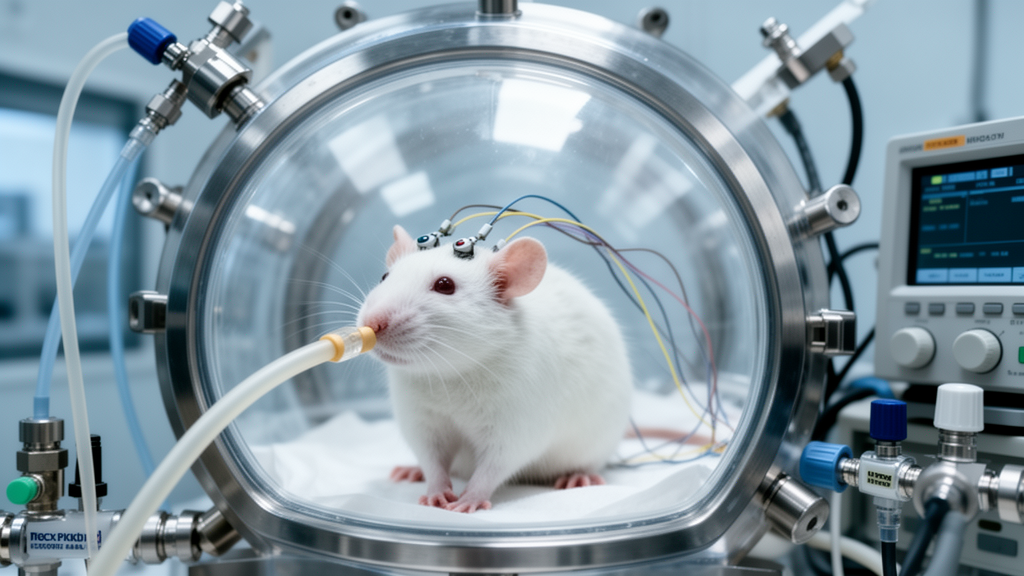
Rats exposed to hyperbaric nitrox showed a consistent shift in cortical electrical activity toward slower, more regular and less complex patterns, according to a controlled animal study using continuous electrocorticography. Animals breathing either 3% oxygen–97% nitrogen or 16% oxygen–84% nitrogen at 700 kPa developed greater low-frequency power, reduced high-frequency power, lower median frequency and diminished measures of signal complexity relative to their pre-exposure recordings. Several of these changes appeared earlier at the higher nitrogen partial pressure. After nitrox was replaced with a helium–oxygen mixture in one group, the measures generally moved back toward baseline, although statistical comparisons did not demonstrate a complete or significant reversal.
The experiment involved 24 male Sprague–Dawley rats weighing 230–250 grams, with eight animals randomly assigned to each of three exposure conditions. The 3% oxygen–nitrogen and 16% oxygen–nitrogen groups were held at 700 kPa for 60 minutes. The third group received pure oxygen at 200 kPa for 60 minutes. The investigators deliberately limited pressure in the pure-oxygen condition to reduce the risk of acute central nervous system oxygen toxicity. After the initial nitrox exposure, the 16% oxygen–nitrogen mixture was replaced within five minutes with a mixture of 16% oxygen and 84% helium, also known as heliox. Those rats remained at 700 kPa for another 60 minutes while their cortical activity continued to be recorded.
To monitor cortical activity throughout the pressure changes, the researchers implanted electrodes over the right frontal and left parietal cortices and used a cerebellar electrode as ground, creating a single differential electrocorticographic, or ECoG, recording channel. ECoG signals were acquired continuously at 400 hertz, beginning before pressurization and continuing throughout the hyperbaric exposures; the acquisition protocol did not specify a post-exposure recording phase. A stable 10-minute recording under normobaric conditions served as the baseline. The 60-minute main exposure was divided into six consecutive 10-minute intervals, while the subsequent heliox period was evaluated in the same way. Obvious movement-related interference, abrupt large-amplitude disturbances and marked baseline drift were excluded before the remaining continuous signal was divided into non-overlapping 10-second epochs. Epoch-level results were averaged within each phase for each animal, and each rat—not each individual epoch—was treated as the independent experimental unit.
The clearest response was a redistribution of power within the cortical spectrum. In both nitrox groups, low-frequency power rose while power above approximately 20–30 hertz generally declined below baseline. During exposure to 3% oxygen–97% nitrogen, the median baseline-relative increase ranged from 2.95 to 6.06 decibels in the delta band, 1.92 to 3.87 decibels in theta, 2.32 to 4.70 decibels in alpha and 1.10 to 2.45 decibels in beta. Gamma-band power moved in the opposite direction, with median decreases ranging from 1.05 to 2.94 decibels across the six exposure phases. After correction for multiple comparisons, all five frequency bands showed significant overall changes over time in this group. Time–frequency analysis indicated an early increase in low-frequency power at 10–20 minutes, followed by phase-dependent fluctuations. In the 16% oxygen–84% nitrogen group, the low-frequency increase became most apparent later, particularly around 40 minutes.
The broader pattern in the 16% oxygen–nitrogen group was similar but differed in its timing and statistical pattern. Delta, theta and gamma power changed significantly over the six phases: delta generally increased, gamma decreased, and theta followed an overall upward trend. Alpha and beta power did not exhibit significant overall time effects, although alpha power was higher than baseline during the middle exposure phases. Beta power remained statistically comparable with baseline throughout the exposure. Changes in several ECoG measures appeared earlier in the 3% oxygen group, where nitrogen partial pressure reached about 679 kPa, than in the 16% oxygen group, where it was about 588 kPa. The two groups also had different oxygen partial pressures—21 and 112 kPa, respectively—so the earlier onset cannot be attributed to nitrogen partial pressure in isolation. Comparisons between the two nitrox groups did not reveal significant differences in any frequency-band power, and the time pattern under the two gas mixtures was not directly identical in every measure.
Four composite features were used to characterize the signal beyond its individual frequency bands. A log-transformed ratio of delta-plus-theta power to alpha-plus-beta power, designated DTABR, increased during nitrox exposure, indicating that slow activity became more prominent relative to faster activity. Median frequency, defined as the frequency below which half of the total spectral power from 1 to 100 hertz was contained, declined. Sample entropy also fell, indicating greater repetition of local temporal patterns, increased short-term predictability and lower signal complexity. Higuchi fractal dimension decreased, indicating reduced multiscale geometric irregularity and a generally smoother waveform. Across the six exposure phases, DTABR increased and median frequency, sample entropy and Higuchi fractal dimension all decreased in every rat in both nitrox groups. In the pure-oxygen group, DTABR increased in six of eight rats, while the other three measures decreased in seven of eight.
Statistical comparisons confirmed differences between the nitrox and pure-oxygen conditions for several composite features. Averaged over exposure, median frequency, sample entropy and Higuchi fractal dimension were significantly lower in both nitrox groups than in the pure-oxygen group, while the overall difference for DTABR did not reach the corrected significance threshold. Phase-specific analysis nevertheless found elevated DTABR and lower median frequency in the 16% oxygen–nitrogen group relative to pure oxygen at some points, along with differences in sample entropy and fractal dimension during several phases. The pure-oxygen animals showed relatively limited alterations in frequency-band power: no band had a significant overall time effect, and no individual phase differed significantly from baseline. This control indicates that elevated oxygen partial pressure by itself may not account for the pronounced pattern observed during nitrox exposure, but it does not establish nitrogen as the sole cause because ambient pressure was 200 kPa in the pure-oxygen group and 700 kPa in both nitrox groups.
When the 16% oxygen–nitrogen mixture was replaced with helium and oxygen at the same pressure, several measures began to move back toward their pre-exposure values. DTABR tended to decrease, whereas median frequency, sample entropy and Higuchi fractal dimension tended to increase. Compared with the 30–40-minute nitrox phase selected as an exploratory reference, DTABR was lower during every heliox phase and median frequency was higher during every phase. When the six heliox phases were averaged, sample entropy and Higuchi fractal dimension were higher than the reference values in six of eight rats, while DTABR was lower in six of eight and median frequency was higher in six of eight. None of these differences reached statistical significance in either the overall or phase-specific analyses. Median frequency, sample entropy and fractal dimension also remained below the pre-exposure baseline during heliox, and gamma-band power stayed below baseline across all six phases. The results therefore support a trend toward baseline rather than demonstrated recovery.
Several limitations constrain how far the findings can be generalized. Each group contained only eight rats, limiting statistical power and leaving the results vulnerable to individual variation. The experiment used one differential cortical channel rather than the multichannel recordings available in clinical electroencephalography, and an invasive ECoG signal from rats cannot simply be assumed to reproduce human scalp EEG responses. Although the investigators observed animal behavior during exposure, they had no predefined quantitative scoring system and excluded those observations from statistical analysis. The electrophysiological changes therefore could not be matched reliably to impaired judgment, motor coordination or other behavioral manifestations of nitrogen narcosis. The study also did not directly measure neurotransmitter receptors or downstream signaling, leaving proposed molecular explanations untested. The fixed sequence of nitrox followed by heliox, the short duration of the experiment and the time potentially required for tissue nitrogen washout may also have influenced the heliox results.
Overall, the study characterizes a reproducible movement in rat ECoG activity under the tested conditions: stronger slow-wave activity, less high-frequency power, lower median frequency and reduced temporal and geometric complexity during hyperbaric nitrox exposure. The comparatively modest changes in animals receiving pure oxygen suggest that oxygen exposure alone was not sufficient to produce the same pattern, while the pressure difference prevents a definitive attribution to nitrogen. Helium substitution was followed by directions of change consistent with partial normalization, but the evidence does not establish that it reverses the electrophysiological effects of nitrox. Larger experiments using multichannel recording, quantitative behavioral and neurological assessment, and direct molecular measurements would be needed to determine whether these ECoG features correspond to the severity of nitrogen narcosis and whether they have value beyond this rat model.
Subject of Research: Effects of hyperbaric nitrox and heliox exposure on cortical electrocorticography in male rats
Article Title: Electrocorticographic characteristics of rats exposed to hyperbaric nitrox
Article References: Li, C., Yan, S., Shen, R., Zheng, H., Wang, K., Tang, J., Liu, W., & Wang, S. (2026). Electrocorticographic characteristics of rats exposed to hyperbaric nitrox. Frontiers in Physiology, 17, 1976565. https://doi.org/10.3389/fphys.2026.1976565
Image Credits: AI Generated
DOI: 10.3389/fphys.2026.1976565
Keywords: hyperbaric nitrox, electrocorticography, rat brain, nitrogen narcosis, hyperbaric heliox, cortical activity, signal complexity, frequency-band power, diving physiology, Electrocorticographic, characteristics, rats
Cite Scienmag News
Cassandra Pierce. (October 21, 2026). Hyperbaric nitrox shifts rat cortical activity toward slower patterns. Scienmag. https://scienmag.com/hyperbaric-nitrox-shifts-rat-cortical-activity-toward-slower-patterns/
Cassandra Pierce. "Hyperbaric nitrox shifts rat cortical activity toward slower patterns." Scienmag, 21 October 2026, https://scienmag.com/hyperbaric-nitrox-shifts-rat-cortical-activity-toward-slower-patterns/. Accessed 21 October 2026.
Cassandra Pierce. "Hyperbaric nitrox shifts rat cortical activity toward slower patterns." Scienmag. October 21, 2026. https://scienmag.com/hyperbaric-nitrox-shifts-rat-cortical-activity-toward-slower-patterns/


