

Wednesday, October 21, 2026
Science
No Result
View All Result
  • Login
  • HOME
  • SCIENCE NEWS
  • CONTACT US
  • HOME
  • SCIENCE NEWS
  • CONTACT US
No Result
View All Result
Scienmag
No Result
View All Result
Home Science News Medicine

Mouse study links spinal Hsp90 inhibition to enhanced morphine pain relief through DUSP15 in CGRP neurons

October 21, 2026
in Medicine, Science News
Juliet Wilcox
By Juliet Wilcox Scienmag Editorial Profile - Human Genetics
Reading Time: 3 mins read
0
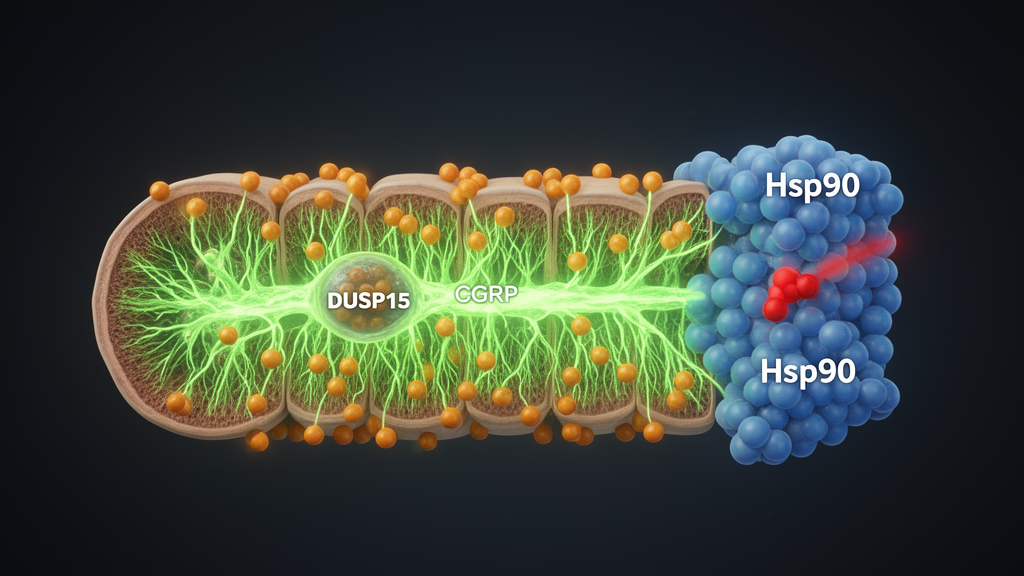
Spinal Hsp90 Blockade Boosts Morphine Pain Relief via DUSP15 in CGRP Neurons

Spinal Hsp90 Blockade Boosts Morphine Pain Relief via DUSP15 in CGRP Neurons

65
SHARES
587
VIEWS
Share on FacebookShare on Twitter
ADVERTISEMENT

In a mouse study, inhibiting heat shock protein 90 (Hsp90) in the spinal cord increased the pain-relieving effect of morphine by upregulating dual specificity protein phosphatase 15 (DUSP15), at least partly in calcitonin gene-related peptide (CGRP) neurons. Knockdown experiments showed that DUSP15 was required for the enhanced antinociception produced by spinal Hsp90 inhibition.

The researchers used male and female CD-1 mice in approximately equal numbers across experiments. They administered the non-isoform-selective Hsp90 inhibitor 17-AAG intrathecally and measured pain responses with a warm-water tail-flick assay and a post-surgical paw-incision model that assessed mechanical sensitivity through von Frey testing. Systemic morphine was used to evaluate antinociception. Investigators were blinded to treatment groups, and no significant sex differences were detected.

Spinal Hsp90 inhibition with 17-AAG approximately doubled morphine’s antinociceptive efficacy in both the tail-flick and paw-incision models. In vivo CRISPR knockdown of DUSP15 reversed this enhancement to baseline levels, while DUSP15 knockdown alone did not change morphine’s effect in the absence of 17-AAG. Immunohistochemistry also showed increased DUSP15 expression in the dorsal horn after Hsp90 inhibition.

A separate DUSP15 small interfering RNA approach reproduced the behavioral result in the tail-flick model, reducing the enhanced morphine effect caused by 17-AAG without independently altering morphine antinociception. The researchers therefore supported the necessity of DUSP15 using two complementary gene-silencing methods, although the work did not test whether DUSP15 is sufficient by itself to enhance opioid responses.

Biochemical and behavioral experiments placed DUSP15 upstream of phosphorylated ERK MAPK and phosphorylated AMPK in the spinal Hsp90–opioid receptor signaling cascade. DUSP15 knockdown eliminated enhanced ERK staining after Hsp90 inhibition and opioid stimulation. It also prevented the reduction in AMPK phosphorylation normally produced by 17-AAG. Blocking AMPK with dorsomorphin restored the enhanced morphine antinociception lost after DUSP15 knockdown in both pain models.

Immunohistochemical staining showed that Hsp90 inhibition increased the overlap of DUSP15 and CGRP signals in the superficial spinal dorsal horn. More selective CRISPR editing directed at DUSP15 in CGRP-expressing neurons removed that overlap and reversed the 17-AAG-associated enhancement of morphine antinociception in the tail-flick assay. These findings identify CGRP neurons as one necessary site of DUSP15 action in the mouse spinal cord.

The authors proposed a model in which DUSP15 reduces AMPK phosphorylation, relieving an inhibitory feedback pathway on ERK signaling and thereby strengthening opioid antinociception. However, the experiments did not demonstrate that DUSP15 directly dephosphorylates AMPK, and an intermediate factor could be involved. The cellular and spatial links between AMPK and ERK also remain unresolved.

This was a preclinical mouse study, not evidence of clinical benefit in people. Most experiments used the non-isoform-selective inhibitor 17-AAG, so the specific Hsp90 isoforms involved were not distinguished. DUSP15 was not evaluated in the authors’ chronic HIV-induced peripheral neuropathy model, and possible sex-dependent effects or distinct CGRP subpopulations were not defined.

Subject of Research: Mechanistic mouse study of spinal Hsp90 inhibition, DUSP15 and enhanced opioid antinociception

Article Title: Inhibition of heat shock protein 90 in the mouse spinal cord enhances opioid antinociception via the upregulation of dual specificity protein phosphatase 15 (DUSP15) in CGRP neurons

Article References: Gabriel, K. A., Bowden, J. L., & Streicher, J. M. (2026). Inhibition of heat shock protein 90 in the mouse spinal cord enhances opioid antinociception via the upregulation of dual specificity protein phosphatase 15 (DUSP15) in CGRP neurons. Frontiers in Pharmacology, 17, Article 1734504. https://doi.org/10.3389/fphar.2026.1734504

Image Credits: AI Generated

DOI: 10.3389/fphar.2026.1734504

Keywords: Hsp90 inhibition, DUSP15, CGRP neurons, opioid antinociception, morphine, mouse spinal cord, ERK MAPK, AMPK, CRISPR, pain models, Inhibition, heat

Cite Scienmag News

Juliet Wilcox. (October 21, 2026). Mouse study links spinal Hsp90 inhibition to enhanced morphine pain relief through DUSP15 in CGRP neurons. Scienmag. https://scienmag.com/mouse-study-links-spinal-hsp90-inhibition-to-enhanced-morphine-pain-relief-through-dusp15-in-cgrp-neurons/


Juliet Wilcox. "Mouse study links spinal Hsp90 inhibition to enhanced morphine pain relief through DUSP15 in CGRP neurons." Scienmag, 21 October 2026, https://scienmag.com/mouse-study-links-spinal-hsp90-inhibition-to-enhanced-morphine-pain-relief-through-dusp15-in-cgrp-neurons/. Accessed 21 October 2026.

Juliet Wilcox. "Mouse study links spinal Hsp90 inhibition to enhanced morphine pain relief through DUSP15 in CGRP neurons." Scienmag. October 21, 2026. https://scienmag.com/mouse-study-links-spinal-hsp90-inhibition-to-enhanced-morphine-pain-relief-through-dusp15-in-cgrp-neurons/

Tags: AMPKcalcitonin gene-related peptide neuronsCGRP neuronsCRISPRCRISPR knockdown of DUSP15DUSP15DUSP15 expression in dorsal hornDUSP15 regulation in CGRP neuronsERK MAPKheatheat shock protein 90 inhibitorsHsp90 inhibitioninhibitionintrathecal drug administrationmorphinemorphine pain relief enhancementmouse spinal cordopioid antinociceptionpain modelspaw-incision pain modelsex differences in pain studiesspinal cord pain modulationspinal Hsp90 inhibitiontail-flick assay
Share26Tweet16
Previous Post

Five cave velvet worms observed in Pedro Cave; Swansea records remain probable

Next Post

Research report: Radiative forcing variability and its moderation during a cyclonic event: a case study

Related Posts

Case Report Confirms Gastric Leiomyosarcoma in a 4-Year-Old Horse
Science News

Case Report Confirms Gastric Leiomyosarcoma in a 4-Year-Old Horse

October 21, 2026
Research report: Radiative forcing variability and its moderation during a cyclonic event: a case study
Earth Science

Research report: Radiative forcing variability and its moderation during a cyclonic event: a case study

October 21, 2026
Rarest Velvet Worm on Earth Found Alive Again in Jamaican Cave After 50 Years
Biology

Five cave velvet worms observed in Pedro Cave; Swansea records remain probable

October 21, 2026
Conservation challenges of the endangered gravel grasshopper Chorthippus (Glyptobothrus) pullus along Alpine rivers: Insights from remote sensing in Northwestern Italy
Science News

Remote sensing maps fragmented habitat and connectivity for threatened gravel grasshopper in northwestern Italy

October 21, 2026
Tiny Lynx-Eared Beetle Hidden in South Africa’s Afromontane Forests Rewrites Beetle Family Tree
Biology

Taxonomic study establishes new beetle genus and species from South African forests

October 21, 2026
Research report: Parameter optimization of IPT systems based on genetic algorithms
Science News

Research report: Parameter optimization of IPT systems based on genetic algorithms

October 21, 2026
Next Post
Research report: Radiative forcing variability and its moderation during a cyclonic event: a case study

Research report: Radiative forcing variability and its moderation during a cyclonic event: a case study

  • Mothers who receive childcare support from maternal grandparents show more optimized

    Mothers who receive childcare support from maternal grandparents show more parental warmth, finds NTU Singapore study

    27656 shares
    Share 11059 Tweet 6912
  • University of Seville Breaks 120-Year-Old Mystery, Revises a Key Einstein Concept

    1061 shares
    Share 424 Tweet 265
  • Bee body mass, pathogens and local climate influence heat tolerance

    682 shares
    Share 273 Tweet 171
  • Researchers record first-ever images and data of a shark experiencing a boat strike

    546 shares
    Share 218 Tweet 137
  • Groundbreaking Clinical Trial Reveals Lubiprostone Enhances Kidney Function

    531 shares
    Share 212 Tweet 133
Science

Embark on a thrilling journey of discovery with Scienmag.com—your ultimate source for cutting-edge breakthroughs. Immerse yourself in a world where curiosity knows no limits and tomorrow’s possibilities become today’s reality!

RECENT NEWS

  • Case Report Confirms Gastric Leiomyosarcoma in a 4-Year-Old Horse
  • Research report: Radiative forcing variability and its moderation during a cyclonic event: a case study
  • Mouse study links spinal Hsp90 inhibition to enhanced morphine pain relief through DUSP15 in CGRP neurons
  • Five cave velvet worms observed in Pedro Cave; Swansea records remain probable

Categories

  • Agriculture
  • Anthropology
  • Archaeology
  • Athmospheric
  • Biology
  • Biotechnology
  • Blog
  • Bussines
  • Cancer
  • Chemistry
  • Climate
  • Earth Science
  • Editorial Policy
  • Marine
  • Mathematics
  • Medicine
  • Pediatry
  • Policy
  • Psychology & Psychiatry
  • Science Education
  • Science News
  • Social Science
  • Space
  • Technology and Engineering

Subscribe to Blog via Email

Enter your email address to subscribe to this blog and receive notifications of new posts by email.

Join 5,150 other subscribers

© 2025 Scienmag - Science Magazine

Welcome Back!

Login to your account below

Forgotten Password?

Retrieve your password

Please enter your username or email address to reset your password.

Log In
No Result
View All Result
  • HOME
  • SCIENCE NEWS
  • CONTACT US

© 2025 Scienmag - Science Magazine

Discover more from Science

Subscribe now to keep reading and get access to the full archive.

Continue reading