

Wednesday, October 21, 2026
Science
No Result
View All Result
  • Login
  • HOME
  • SCIENCE NEWS
  • CONTACT US
  • HOME
  • SCIENCE NEWS
  • CONTACT US
No Result
View All Result
Scienmag
No Result
View All Result
Home Science News Biology

Five cave velvet worms observed in Pedro Cave; Swansea records remain probable

October 21, 2026
in Biology, Science News
Gavin Prescott
By Gavin Prescott Scienmag Editorial Profile - Ecology and Ecosystem Dynamics
Reading Time: 3 mins read
0
Rarest Velvet Worm on Earth Found Alive Again in Jamaican Cave After 50 Years

Rarest Velvet Worm on Earth Found Alive Again in Jamaican Cave After 50 Years

65
SHARES
587
VIEWS
Share on FacebookShare on Twitter
ADVERTISEMENT

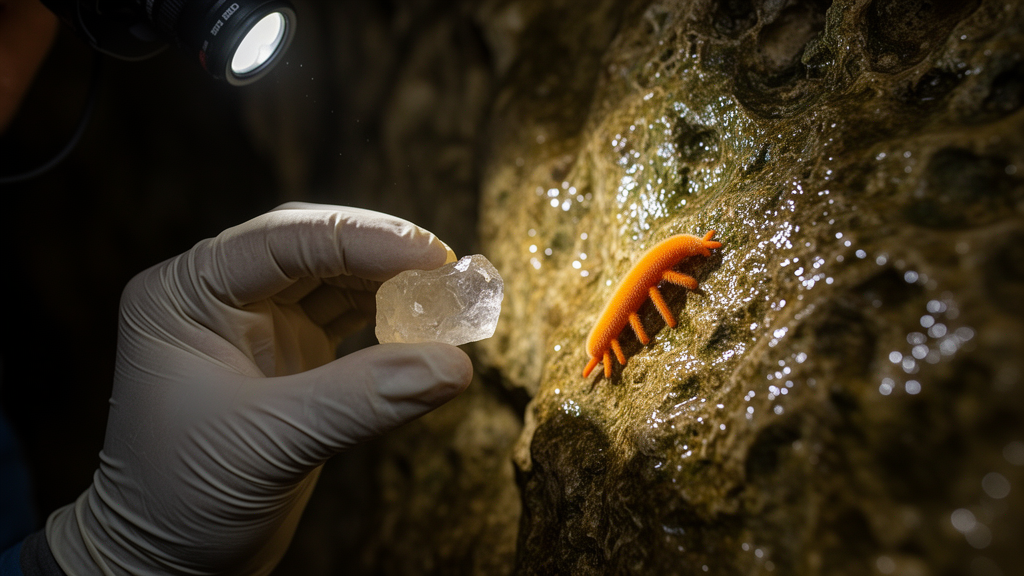
A six-person field team observed five specimens of the Critically Endangered Jamaican cave velvet worm Speleoperipatus spelaeus in Pedro Cave on January 18, 2025. These were the first recorded observations of the species in the cave since 1974, when the four specimens used in its original description were collected.

The observational study was conducted to assess the status of S. spelaeus, a troglobitic onychophoran known from Pedro Cave in Clarendon Parish. The team searched different sections of the cave and documented associated fauna, including bats, cave crickets, spiders, a whip-spider, a harvestman and several animals that are not cave-adapted.

Five velvet worms were found near the section known as Three Ways. They were walking on bat guano accumulated over a layer of clay beside water running from the cave roof. The animals were observed and photographed but not collected. They were not properly measured because the researchers sought to avoid manipulating the specimens.

One animal quickly retreated into crevices in porous rock, while another buried itself in mud until it disappeared. These observations indicate that Pedro Cave provides hiding places for the species, although the study did not determine its abundance or population size.

The five Pedro Cave animals showed variation in leg-pair number and in development of the final pair. Three had 19 pairs of legs, one had 23, and the largest had 22. The last pair could be fully developed, though small, or highly reduced and directed backward without touching the ground while the animal walked. By comparison, the specimens studied in the original description had 22 or 23 pairs, with one having 23 legs on the left and 22 on the right.

The newly observed leg-pair counts require the diagnosis of the genus and species to include a range of 19 to 23 pairs. This finding is based on visual documentation of animals encountered during the expedition rather than measurements of collected specimens.

Earlier Jamaican Cave Organisation work produced an additional apparent record at Swansea Cave in Saint Catherine Parish. One blind, depigmented velvet worm was observed on February 13, 2010, and two were photographed on November 6, 2021. None was collected or studied, and the researchers describe these Swansea animals as probably conspecific with S. spelaeus rather than as confirmed specimens of the species.

Pedro and Swansea caves are separated by less than 6 km in linear distance through an area containing numerous known caves. The Pedro Cave search was limited to selected sections, whereas the five animals were found in less than one hour of sampling. The authors therefore suggest that S. spelaeus may be less rare than previously thought, while stating that future work may help re-evaluate its Critically Endangered classification. Its ecology, distribution, population size and evolutionary history remain insufficiently understood.

The authors also call for investigation of the species’ phylogenetic placement to determine whether its closest relatives are other Jamaican velvet worms or species elsewhere. They identify phylogenetic methods using ultraconserved elements as a possible approach for addressing that question.

Subject of Research: Observational status assessment of the Critically Endangered Jamaican cave velvet worm Speleoperipatus spelaeus

Article Title: On the troglobitic velvet worm Speleoperipatus spelaeus Peck, 1975 ( Onychophora , Peripatidae ): assessing the status of a Critically Endangered Jamaican invertebrate

Article References: Giribet, G., Anilkumar, P. A., Goodwin, A., Stewart, R. S., Watkis, C. A., Whyte, D., & Hormiga, G. (2025). On the troglobitic velvet worm Speleoperipatus spelaeus Peck, 1975 (Onychophora, Peripatidae): assessing the status of a Critically Endangered Jamaican invertebrate. Subterranean Biology, 51, 49-59. https://doi.org/10.3897/subtbiol.51.151034

Image Credits: AI Generated

DOI: 10.3897/subtbiol.51.151034

Keywords: Speleoperipatus spelaeus, velvet worm, Onychophora, Pedro Cave, Swansea Cave, Jamaica, cave biodiversity, field observations, conservation status, troglobitic species, troglobitic, velvet

Cite Scienmag News

Gavin Prescott. (October 21, 2026). Five cave velvet worms observed in Pedro Cave; Swansea records remain probable. Scienmag. https://scienmag.com/five-cave-velvet-worms-observed-in-pedro-cave-swansea-records-remain-probable/


Gavin Prescott. "Five cave velvet worms observed in Pedro Cave; Swansea records remain probable." Scienmag, 21 October 2026, https://scienmag.com/five-cave-velvet-worms-observed-in-pedro-cave-swansea-records-remain-probable/. Accessed 21 October 2026.

Gavin Prescott. "Five cave velvet worms observed in Pedro Cave; Swansea records remain probable." Scienmag. October 21, 2026. https://scienmag.com/five-cave-velvet-worms-observed-in-pedro-cave-swansea-records-remain-probable/

Tags: cave biodiversitycave conservation efforts Jamaicacave ecology and faunacave ecosystem in Clarendon Parishcave fauna observation techniquescave fauna survey Jamaicacave habitat and species adaptationConservation statusCritically Endangered cave speciesfield observationsJamaicaJamaican cave velvet wormOnychophoraPedro CavePedro Cave biodiversitySpeleoperipatus spelaeussubterranean species behaviorSwansea Cavetroglobitictroglobitic onychophorantroglobitic speciesvelvetvelvet worm
Share26Tweet16
Previous Post

Remote sensing maps fragmented habitat and connectivity for threatened gravel grasshopper in northwestern Italy

Next Post

Mouse study links spinal Hsp90 inhibition to enhanced morphine pain relief through DUSP15 in CGRP neurons

Related Posts

Spinal Hsp90 Blockade Boosts Morphine Pain Relief via DUSP15 in CGRP Neurons
Medicine

Mouse study links spinal Hsp90 inhibition to enhanced morphine pain relief through DUSP15 in CGRP neurons

October 21, 2026
Conservation challenges of the endangered gravel grasshopper Chorthippus (Glyptobothrus) pullus along Alpine rivers: Insights from remote sensing in Northwestern Italy
Science News

Remote sensing maps fragmented habitat and connectivity for threatened gravel grasshopper in northwestern Italy

October 21, 2026
Tiny Lynx-Eared Beetle Hidden in South Africa’s Afromontane Forests Rewrites Beetle Family Tree
Biology

Taxonomic study establishes new beetle genus and species from South African forests

October 21, 2026
Research report: Parameter optimization of IPT systems based on genetic algorithms
Science News

Research report: Parameter optimization of IPT systems based on genetic algorithms

October 21, 2026
Research report: Full-process control enables emissions trading to promote synergistic reductions in carbon emissions and pollution in China
Earth Science

Research report: Full-process control enables emissions trading to promote synergistic reductions in carbon emissions and pollution in China

October 21, 2026
Spatial model reveals the best way to cull invasive deer in Tasmania
Science News

Spatial model finds broad, frequent aerial culling best limits invasive fallow deer in Tasmanian park

October 21, 2026
Next Post
Spinal Hsp90 Blockade Boosts Morphine Pain Relief via DUSP15 in CGRP Neurons

Mouse study links spinal Hsp90 inhibition to enhanced morphine pain relief through DUSP15 in CGRP neurons

  • Mothers who receive childcare support from maternal grandparents show more optimized

    Mothers who receive childcare support from maternal grandparents show more parental warmth, finds NTU Singapore study

    27656 shares
    Share 11059 Tweet 6912
  • University of Seville Breaks 120-Year-Old Mystery, Revises a Key Einstein Concept

    1061 shares
    Share 424 Tweet 265
  • Bee body mass, pathogens and local climate influence heat tolerance

    682 shares
    Share 273 Tweet 171
  • Researchers record first-ever images and data of a shark experiencing a boat strike

    546 shares
    Share 218 Tweet 137
  • Groundbreaking Clinical Trial Reveals Lubiprostone Enhances Kidney Function

    531 shares
    Share 212 Tweet 133
Science

Embark on a thrilling journey of discovery with Scienmag.com—your ultimate source for cutting-edge breakthroughs. Immerse yourself in a world where curiosity knows no limits and tomorrow’s possibilities become today’s reality!

RECENT NEWS

  • Mouse study links spinal Hsp90 inhibition to enhanced morphine pain relief through DUSP15 in CGRP neurons
  • Five cave velvet worms observed in Pedro Cave; Swansea records remain probable
  • Remote sensing maps fragmented habitat and connectivity for threatened gravel grasshopper in northwestern Italy
  • Taxonomic study establishes new beetle genus and species from South African forests

Categories

  • Agriculture
  • Anthropology
  • Archaeology
  • Athmospheric
  • Biology
  • Biotechnology
  • Blog
  • Bussines
  • Cancer
  • Chemistry
  • Climate
  • Earth Science
  • Editorial Policy
  • Marine
  • Mathematics
  • Medicine
  • Pediatry
  • Policy
  • Psychology & Psychiatry
  • Science Education
  • Science News
  • Social Science
  • Space
  • Technology and Engineering

Subscribe to Blog via Email

Enter your email address to subscribe to this blog and receive notifications of new posts by email.

Join 5,150 other subscribers

© 2025 Scienmag - Science Magazine

Welcome Back!

Login to your account below

Forgotten Password?

Retrieve your password

Please enter your username or email address to reset your password.

Log In
No Result
View All Result
  • HOME
  • SCIENCE NEWS
  • CONTACT US

© 2025 Scienmag - Science Magazine

Discover more from Science

Subscribe now to keep reading and get access to the full archive.

Continue reading