


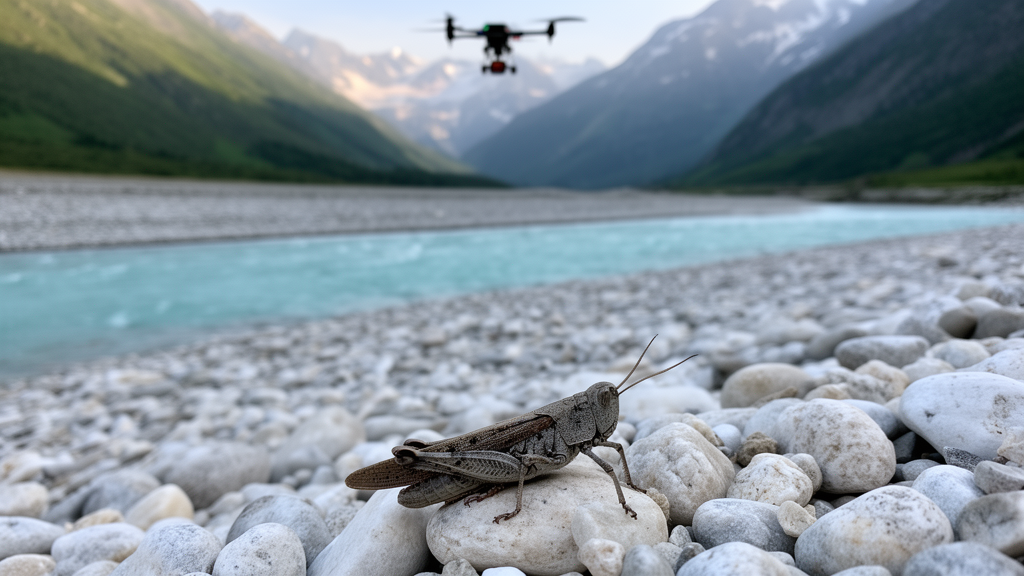
A field survey and remote-sensing study found the threatened gravel grasshopper Chorthippus (Glyptobothrus) pullus across sparsely vegetated gravel banks in the upper Susa Valley of northwestern Italy. The study examined the Dora Riparia and Dora di Bardonecchia river corridors, where the species was detected from 1,000 to 1,910 metres above sea level.
Researchers surveyed 2.52 square kilometres of recent riverbed in July 2022 using transects at least 250 metres long, with each occurrence and transect track georeferenced. The sampling period was chosen because adult density was expected to be near its seasonal maximum. At least one grasshopper was recorded in more than 266 10-by-10-metre cells, and the species was detected in all three Natura 2000 sites intercepted by the study area.
Most observations were of adults on sparsely vegetated gravel banks. Mean Normalized Difference Vegetation Index (NDVI) in presence cells was 0.28, with a standard deviation of 0.06. Calamagrostis pseudophragmites was the most frequent grass, while Salix species, Myricaria germanica and Hippophaë rhamnoides occurred in occupied patches at different stages of vegetation succession.
For distribution modelling, the researchers used presence-only maximum-entropy modelling in MaxEnt, with elevation, topographic position, terrain ruggedness and Sentinel-2B NDVI as predictors. Background samples were restricted to cells crossed by the transects to address the uneven sampling effort. Ten replicates produced a mean area under the curve of 0.86 (SD 0.02) and a mean True Skill Statistic of 0.63 (SD 0.01), which the authors considered sufficiently reliable for subsequent analysis.
NDVI was the model’s most informative predictor. The binary model estimated 0.58 square kilometres of suitable habitat, about 23% of the study area, divided into 881 patches with a mean size of 655.73 square metres. This was a model-based estimate rather than a direct map of observed occupancy, and the 10-metre environmental layers may miss suitable patches smaller than their resolution.
Circuit-theory analysis identified numerous geographic bottlenecks and interruptions in connectivity. Some stretches contained gaps longer than 250 metres between suitable patches, and bottlenecks were especially frequent in urbanised areas where rivers flowed between narrow, artificial banks. Only about 15% of the combined predicted-presence and high-connectivity area was included in Natura 2000 sites, while three other protected sites were close to suitable patches.
The researchers also analysed NDVI imagery from 2016 to 2022 in the presence cells. Of 266 regressions relating vegetation greenness to time, 115 met the study’s criteria of a p-value below 0.05 and an R-squared above 0.6. Their mean slope was 0.0346 (SD 0.0128), indicating increasing vegetation greenness in the retained cells over the seven-year series.
Under the assumption of undisturbed vegetation succession, the model estimated that C. pullus could colonise bare soil within about one year, reach the mean observed suitability level after approximately eight years and occupy a patch for at least 12 years. These estimates were derived from the satellite series and regression slopes, not observed colonisation or extinction deadlines; the authors noted that floods or human activity may have disrupted succession in more than half of the presence cells.
The authors identified hydrological modification, gravel extraction, restricted floodable surfaces and reduced connectivity as major pressures. Their conservation proposal prioritises large, connected floodplains that maintain a mosaic of sparsely vegetated patches. They also recommended including the species in the standard data forms for three Natura 2000 sites and limiting unavoidable gravel works in spatial extent, duration and succession stage.
Subject of Research: Remote-sensing assessment of threatened gravel grasshopper habitat and connectivity in northwestern Italy
Article Title: Conservation challenges of the endangered gravel grasshopper Chorthippus ( Glyptobothrus ) pullus along Alpine rivers: Insights from remote sensing in Northwestern Italy
Article References: Anselmo, L. (2025). Conservation challenges of the endangered gravel grasshopper Chorthippus (Glyptobothrus) pullus along Alpine rivers: Insights from remote sensing in Northwestern Italy. Journal of Orthoptera Research, 34(1), 119-130. https://doi.org/10.3897/jor.34.130377
Image Credits: AI Generated
Keywords: Chorthippus pullus, gravel grasshopper, remote sensing, species distribution model, connectivity, floodplains, Alpine rivers, conservation, challenges, endangered, gravel, grasshopper
Cite Scienmag News
Gavin Prescott. (October 21, 2026). Remote sensing maps fragmented habitat and connectivity for threatened gravel grasshopper in northwestern Italy. Scienmag. https://scienmag.com/remote-sensing-maps-fragmented-habitat-and-connectivity-for-threatened-gravel-grasshopper-in-northwestern-italy/
Gavin Prescott. "Remote sensing maps fragmented habitat and connectivity for threatened gravel grasshopper in northwestern Italy." Scienmag, 21 October 2026, https://scienmag.com/remote-sensing-maps-fragmented-habitat-and-connectivity-for-threatened-gravel-grasshopper-in-northwestern-italy/. Accessed 21 October 2026.
Gavin Prescott. "Remote sensing maps fragmented habitat and connectivity for threatened gravel grasshopper in northwestern Italy." Scienmag. October 21, 2026. https://scienmag.com/remote-sensing-maps-fragmented-habitat-and-connectivity-for-threatened-gravel-grasshopper-in-northwestern-italy/


