


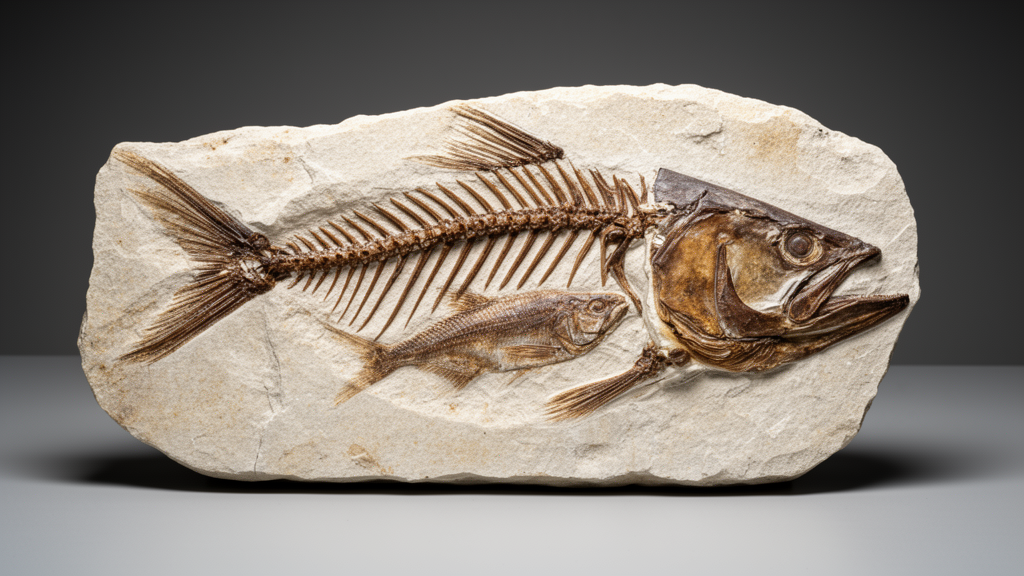
A paleontological re-examination of Late Jurassic fossils from the Solnhofen Archipelago documents gastrointestinal tracts attached to isolated skulls of the predatory fish Aspidorhynchus. In five newly highlighted cases, the remains include small juvenile bony fish or a small crustacean, providing direct evidence of prey consumed by this fish.
The study examined museum specimens from the Eichstätt and Solnhofen basins and assessed the preservation status of 343 Aspidorhynchus fossils. Aspidorhynchus was a large predatory teleost that occurred in the deeper Plattenkalk basins, where it represented about 4% of the known fish fauna and could reach 1 metre in total length. Its elongated body and fin arrangement have been associated with rapid swimming, and earlier observations indicate that it generally swallowed small fish whole.
Most previously described stomach contents were concealed beneath the predator’s thick scales in articulated specimens. The newly described isolated skulls and gut-bearing body fragments provide clearer views of preserved stomach and intestinal contents, although the authors did not identify prey in every gut-bearing specimen.
One specimen, SNSB-BSPG 1964 XXIII 140 from the Eichstätt Basin, contained a folded juvenile crustacean, interpreted tentatively as the eryonid Knebelia schuberti. The authors did not establish how Aspidorhynchus, which is generally associated with eating small fish, encountered this prey. The specimen is the only documented case in which crustacean remains have been identified as food in an aspidorhynchid.
Four newly described cases contained remains of small juvenile teleosts. SMF P6331a and b from Blumenberg held at least two probable Leptolepides sprattiformis. CM 15784 from “Solnhofen” contained at least three similar juvenile fish, while USNM PAL 182209 preserved fragments representing at least five prey fish. A separate gut-bearing body fragment at Museum Bergér contained two probable juvenile Tharsis, each about 6 centimetres long; one fish retained its body shape, whereas the other was coiled and partly disintegrated.
Several articulated Aspidorhynchus also preserve identifiable prey. A 56-centimetre specimen, GZG.RF.999 from Solnhofen, contained a 16-centimetre Allothrissops in its stomach. GZG.RF.998 has the posterior portion of a small pholidophorid projecting from its mouth, and other specimens contain juvenile teleosts, including probable juvenile Tharsis dubius and approximately five juvenile Orthogonikleithridae.
Among the 343 fossils assessed, 171, or 50%, were complete; 53, or 15%, were incompletely collected; and 120, or 35%, were feeding or decayed remains. Ten specimens, 3% of the total, were isolated skulls with guts attached. Among the feeding or decayed remains, 65% preserved the anterior portion of the body. Isolated heads accounted for 46% of that category and 16% of all specimens.
The authors infer that larger predators may have consumed the postcranial body while leaving the pointed skull, which could have been difficult to swallow. This is a taphonomic interpretation rather than a demonstrated cause of death, and the identity of the larger predators remains uncertain; ichthyosaurs, other marine reptiles and large sharks are proposed possibilities. The evidence establishes prey remains in some isolated gastrointestinal tracts, while the remaining gut-bearing specimens contain obscure residues or no identifiable remains.
Overall, the fossils show that Aspidorhynchus consumed juvenile bony fish and, in one specimen, a small crustacean. They also illustrate how gastrointestinal tracts could remain attached to skulls and be preserved in the exceptional Plattenkalk deposits of the Solnhofen Archipelago.
Subject of Research: Paleontological evidence of prey in isolated Aspidorhynchus gastrointestinal tracts from the Late Jurassic Solnhofen Archipelago
Article Title: Hunted hunters – prey of Aspidorhynchus ( Actinopterygii ) within isolated gastrointestinal tracts from the late Jurassic of the Solnhofen Archipelago
Article References: Ebert, M., & Kölbl-Ebert, M. (2025). Hunted hunters – prey of Aspidorhynchus (Actinopterygii) within isolated gastrointestinal tracts from the late Jurassic of the Solnhofen Archipelago. Fossil Record, 28(2), 347-357. https://doi.org/10.3897/fr.28.169110
Image Credits: AI Generated
DOI: 10.3897/fr.28.169110
Keywords: Aspidorhynchus, Solnhofen Archipelago, Late Jurassic, fossil stomach contents, paleontology, taphonomy, Aspidorhynchiformes, Eichstätt Basin, juvenile fish, Hunted, hunters, prey
Cite Scienmag News
Gavin Prescott. (October 21, 2026). Late Jurassic Aspidorhynchus skulls preserve evidence of fish and crustacean prey. Scienmag. https://scienmag.com/late-jurassic-aspidorhynchus-skulls-preserve-evidence-of-fish-and-crustacean-prey/
Gavin Prescott. "Late Jurassic Aspidorhynchus skulls preserve evidence of fish and crustacean prey." Scienmag, 21 October 2026, https://scienmag.com/late-jurassic-aspidorhynchus-skulls-preserve-evidence-of-fish-and-crustacean-prey/. Accessed 21 October 2026.
Gavin Prescott. "Late Jurassic Aspidorhynchus skulls preserve evidence of fish and crustacean prey." Scienmag. October 21, 2026. https://scienmag.com/late-jurassic-aspidorhynchus-skulls-preserve-evidence-of-fish-and-crustacean-prey/


