


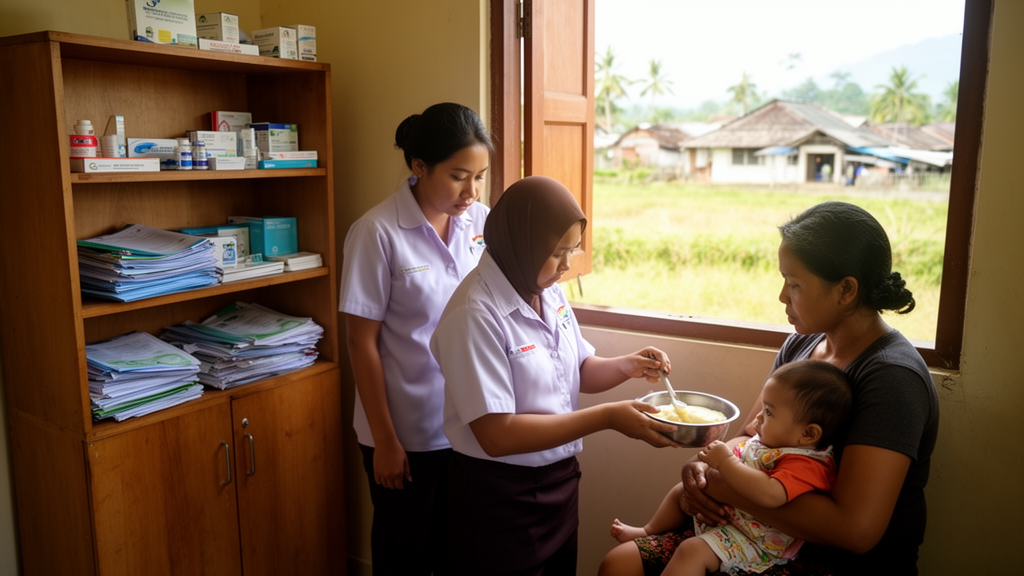
Community health workers in a village on the Indonesia–Malaysia border showed moderate-to-high knowledge of breastfeeding and complementary feeding, but a mixed-methods study identified remaining misconceptions and practical challenges in applying that knowledge. The study involved 13 cadres in Jagoi Babang Village, Bengkayang Regency, West Kalimantan, where stunting remains a public health concern and access to healthcare and food distribution is limited. Among the participants, 69.2% were classified as having high knowledge of breastfeeding and complementary feeding, while 61.5% had moderate knowledge of stunting and 30.8% had high knowledge.
The research, published in BMC Public Health, used a sequential explanatory mixed-methods design to assess cadres’ knowledge and explore complementary feeding practices, local food use and reported experiences of food access. Researchers first used investigator-developed questionnaires covering stunting, breastfeeding and complementary feeding. Knowledge scores were categorized using modified Bloom’s cut-offs, and the investigators explored associations using Kendall’s Tau-b correlation. The same 13 cadres then participated in non-participant observation, in-depth interviews and field documentation. Thematic analysis was used to examine the qualitative findings and help explain the questionnaire results.
The quantitative results showed that substantial knowledge scores did not mean that all recommendations were understood correctly. Participants retained misconceptions about the definition and assessment of stunting, sanitation-related factors associated with stunting, and the recommended timing for introducing complementary foods. The exploratory analysis found a positive but not statistically significant correlation between knowledge of stunting and knowledge of breastfeeding and complementary feeding (τ = 0.375, p = 0.115). Because the sample was small and the association was not statistically significant, the study did not establish a reliable relationship between the two knowledge domains.
Qualitative analysis identified five themes: limited formal training, local food utilization, cross-border food access, economic constraints and challenges in translating knowledge into complementary food preparation. Cadres described using foods from the village alongside selected foods obtained from markets in Malaysia, which they perceived as readily available, affordable and of good quality. Their accounts also showed that knowledge alone did not determine how feeding guidance could be put into practice. Limited training, household economic constraints and differences in food availability shaped the reported preparation of complementary foods, highlighting a gap between formal nutrition information and everyday implementation.
The findings are specific to one border community and do not represent all Indonesian community health workers or other cross-border settings. The sample included only 13 cadres, and the study relied on researcher-developed questionnaires, observations, interviews and field documentation. It assessed cadres’ knowledge and reported practices rather than directly measuring children’s dietary intake or nutritional outcomes. The researchers therefore called for further work involving caregivers, children’s diets and nutritional status. The study does not show that cadre guidance reduced stunting or improved child growth; instead, it documents how moderate-to-high measured knowledge coexisted with misconceptions, limited formal training, economic constraints and practical difficulties in preparing complementary foods.
Subject of Research: Community health workers’ knowledge and reported infant-feeding practices in an Indonesia–Malaysia border village
Article Title: Challenges for stunting prevention in an Indonesia-Malaysia border community: health cadres’ knowledge of breastfeeding and complementary feeding practices
Article References: Tejoyuwono, A. A. T., Fitriangga, A., Alex, A., Efriani, E., Asfar, D. A., & Yusriadi, Y. (2026). Challenges for stunting prevention in an Indonesia-Malaysia border community: health cadres’ knowledge of breastfeeding and complementary feeding practices. BMC Public Health. https://doi.org/10.1186/s12889-026-29841-5
Image Credits: AI Generated
DOI: 10.1186/s12889-026-29841-5
Keywords: stunting prevention, community health workers, breastfeeding, complementary feeding, child nutrition, Indonesia, Malaysia, border communities, mixed-methods study, food security, Challenges, stunting
Cite Scienmag News
Ophelia Keating. (October 21, 2026). Mixed-methods study finds feeding knowledge gaps among Indonesian border health cadres. Scienmag. https://scienmag.com/mixed-methods-study-finds-feeding-knowledge-gaps-among-indonesian-border-health-cadres/
Ophelia Keating. "Mixed-methods study finds feeding knowledge gaps among Indonesian border health cadres." Scienmag, 21 October 2026, https://scienmag.com/mixed-methods-study-finds-feeding-knowledge-gaps-among-indonesian-border-health-cadres/. Accessed 21 October 2026.
Ophelia Keating. "Mixed-methods study finds feeding knowledge gaps among Indonesian border health cadres." Scienmag. October 21, 2026. https://scienmag.com/mixed-methods-study-finds-feeding-knowledge-gaps-among-indonesian-border-health-cadres/


