


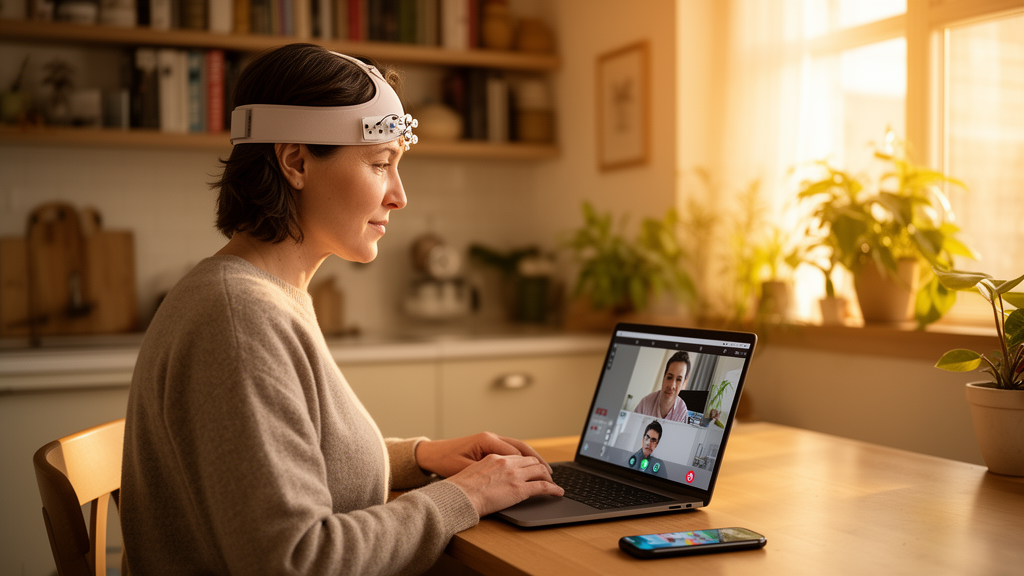
An international randomized clinical trial found that adults with major depressive disorder could complete a six-week course of home-based transcranial direct current stimulation combined with a video game after no more than five instructional visits. The DiSCoVeR trial met its primary objective by demonstrating the feasibility of remote treatment, but the active treatment did not produce greater improvement than a double-sham control condition. Both groups showed marked reductions in depressive symptoms.
Researchers conducted the trial through clinical centers in Jerusalem, Riga, and Munich. The experimental intervention combined active non-invasive brain stimulation with computerized cognitive training delivered through a video game. Participants were asked to complete 30 treatment sessions over six weeks, primarily at home, following up to five clinic visits for instruction. The control group received sham stimulation with a similar-looking game that did not contain the same cognitive training exercises.
The study enrolled 109 adults diagnosed with major depressive disorder. Its feasibility findings indicated that the treatment protocol could be delivered across three countries. Overall, 79% of participants completed at least 20 sessions, and almost 2,500 sessions were completed successfully across the three sites. The treatment was generally well tolerated, with no significant difference in adverse event rates between the active and control groups.
The trial did not find evidence that its particular combination of active stimulation and cognitive training was more effective than the control intervention. Participants receiving active stimulation and cognitive training improved by an average of 7.3 points on a standard depression rating scale. Those in the double-sham condition improved by an average of 8.2 points. The difference was not statistically significant, although the control group’s numerical improvement was larger.
Prof. Mor Nahum, who led the project, said the parallel improvement in both groups remained the central result. The study cannot determine whether improvement was associated with the stimulation, cognitive training, expectations, engagement, ongoing care, or the structured routine of returning to treatment each day. The findings therefore do not establish which elements, if any, produced the observed symptom reduction.
Expectations were also examined during the trial. Participants who believed they had received the control treatment tended to show less improvement, regardless of which treatment they actually received. The researchers cautioned that this association does not show that belief in treatment cures depression or that expectations directly caused recovery. They also said the study cannot determine whether control-group improvement arose from the treatment routine, ongoing medical care, natural changes in symptoms, participation in a clinical study, or other factors.
DiSCoVeR was a European consortium funded through ERA-NET NEURON. Clinical sites were based at Hadassah Medical Center in Jerusalem, LMU Munich, and Riga Stradins University. The intervention technology was developed with the University of Geneva and EPFL, while statistical analyses were led by researchers at the Hebrew University and LMU Munich. The results were published in JAMA Network Open as a randomized clinical trial with a feasibility objective.
The findings do not show that brain stimulation is ineffective for depression. Rather, they indicate that this specific combination of stimulation and cognitive training did not demonstrate added benefit over the double-sham control in the population studied. The trial was not designed to determine whether another stimulation protocol, set of cognitive exercises, treatment schedule, patient group, or level of clinical support might yield different results, and the researchers said the intervention requires further investigation before it can be recommended for routine clinical use.
The practical result is that a relatively complex brain-stimulation program can be administered mostly at home by adults with major depressive disorder after limited in-person instruction. The efficacy result is more equivocal: although both trial groups improved substantially, the active combination did not outperform the control. The study therefore supports the feasibility of home-based delivery while showing why credible control conditions are needed to identify the components responsible for improvement in depression trials.
Subject of Research: A randomized trial of home-based brain stimulation and cognitive training for major depression
Article Title: Home-based brain stimulation passes major feasibility test, while depression results raise new questions
Article References: Home-based brain stimulation passes major feasibility test, while depression results raise new questions. Original publication (Bibliographic details unavailable.)
Image Credits: AI Generated
DOI: Not provided
Keywords: major depression, home-based treatment, brain stimulation, tDCS, cognitive training, randomized clinical trial, remote care, double-sham control, treatment feasibility, Home-based, brain, stimulation
Cite Scienmag News
Glenn Wilkins. (October 21, 2026). Home-based brain stimulation passes major feasibility test, while depression results raise new questions. Scienmag. https://scienmag.com/home-based-brain-stimulation-passes-major-feasibility-test-while-depression-results-raise-new-questions/
Glenn Wilkins. "Home-based brain stimulation passes major feasibility test, while depression results raise new questions." Scienmag, 21 October 2026, https://scienmag.com/home-based-brain-stimulation-passes-major-feasibility-test-while-depression-results-raise-new-questions/. Accessed 21 October 2026.
Glenn Wilkins. "Home-based brain stimulation passes major feasibility test, while depression results raise new questions." Scienmag. October 21, 2026. https://scienmag.com/home-based-brain-stimulation-passes-major-feasibility-test-while-depression-results-raise-new-questions/


