


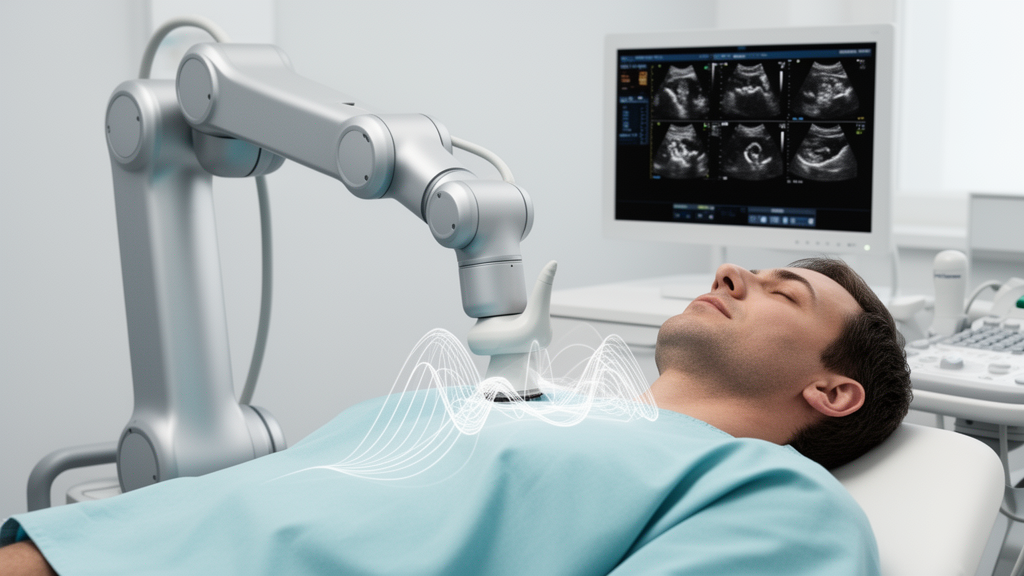
A hospital-trained deep-learning system for detecting myocardial infarction from echocardiographic videos showed a substantial loss of normal-case specificity when transferred directly to an autonomous robotic ultrasound platform, according to a study conducted with limited target-domain data. The model’s specificity fell from 90.6% on hospital-acquired normal cases to 65.7% on 150 robotic echocardiographic clips from 15 healthy participants, while the false-positive rate rose from 9.4% to 34.3%. Adversarial domain adaptation recovered most of that difference without requiring robot-acquired pathological cases, but the researchers stressed that the experiment was not full clinical validation because the robotic cohort contained no participants with myocardial infarction.
The study, published in Frontiers in Robotics and AI, used a three-dimensional ResNet-18 network to classify echocardiographic videos as myocardial-infarction positive or normal. The network was trained on 10,000 studies from a tertiary cardiac center in Tokyo, including 5,000 infarction-positive and 5,000 normal studies, and evaluated on an independent set of 500 studies. At the video-clip level, the baseline model achieved 92.3% accuracy, 94.0% sensitivity and 90.6% specificity in the hospital domain. The robotic acquisitions were made with the ORIZURU platform, which uses a robotic arm to control probe positioning and follows predefined sequences for parasternal long-axis, parasternal short-axis and apical four-chamber views. The target dataset comprised 150 view-specific clips, each approximately two to four seconds long and spanning multiple cardiac cycles, recorded from 15 volunteers with no prior cardiovascular disease, current cardiac symptoms or known structural abnormalities.
Because every robotic participant was healthy, the investigators restricted robotic-domain evaluation to normal-case specificity and false-positive rate. Robotic sensitivity and overall diagnostic accuracy could not be calculated because the target cohort included no myocardial-infarction cases. To account for the clustering of multiple clips within each participant and reduce leakage, the team used leave-one-subject-out cross-validation across the 15 robotic participants. In each fold, one participant was held out exclusively for testing, 12 remaining participants supplied adaptation data and two were reserved for validation. Clips from the held-out participant were excluded from training, validation, hyperparameter selection and early stopping. The independent hospital test set was also excluded from adaptation and model selection, while a patient-level subset of the original hospital training partition was used to monitor hospital-domain classification loss.
To address the cross-platform gap, the researchers added adversarial feature alignment to the baseline architecture. The 3D ResNet-18 feature extractor and binary classification head were retained, while a two-layer domain discriminator with 512, 128 and one output units was introduced through a gradient-reversal layer. During forward propagation, that layer acts as an identity transformation. During backpropagation, it reverses the discriminator’s gradient before the signal reaches the feature extractor, encouraging the extractor to produce representations from which hospital and robotic images are harder to distinguish. The discriminator was trained to identify the acquisition domain, whereas the feature extractor was trained through the reversed gradient to obscure that information. No backbone layers were frozen, and the diagnostic classification objective continued to use labeled hospital data. The adaptation coefficient was selected from five candidate values, 0.01, 0.05, 0.1, 0.2 and 0.5, through nested subject-level validation, with 0.1 chosen before final evaluation.
Two adaptation configurations were tested. Mixed-DANN used myocardial-infarction-positive and normal hospital samples together with healthy robotic samples in the domain-adversarial loss. Normal-only DANN restricted the adversarial loss to normal hospital cases and healthy robotic cases, while both disease classes remained available for the supervised classification loss. The second configuration was designed to reduce confounding arising from the different disease composition of the mixed hospital cohort and the healthy-only robotic cohort. Under leave-one-subject-out validation, robotic specificity reached 86.1% ± 4.3% with Mixed-DANN and 89.3% ± 4.8% with Normal-only DANN, compared with 65.7% ± 6.4% after direct transfer. The 95% confidence intervals for the mean were 83.9% to 88.1% for Mixed-DANN and 86.9% to 91.6% for Normal-only DANN. Both improvements over direct transfer were statistically significant at p < 0.001 in paired Wilcoxon signed-rank tests, and all 15 participants showed higher specificity after adaptation.
Normal-only DANN reduced the robotic false-positive rate from 34.3% to 10.7%, a decrease of 23.6 percentage points. It recovered 94.8% of the specificity gap between the hospital model’s normal-case performance and its unadapted robotic performance. The improvement varied by cardiac view. Pooled specificity reached 100% for both parasternal long-axis and parasternal short-axis clips after adaptation, whereas apical four-chamber specificity rose from 60.0% with direct transfer to 61.8% under Mixed-DANN and 70.9% under Normal-only DANN. These pooled view-level values did not mean that every participant was classified perfectly. The apical four-chamber view nevertheless remained the main location of residual false-positive predictions, which indicates that the adaptation was not equally effective across the available robotic views.
The investigators also examined whether conventional image degradation could explain the performance difference. In comparisons involving 1,500 hospital studies and 150 robotic clips, signal-to-noise ratio did not differ significantly between domains, with p = 0.31 and a standardized effect size of d = 0.12. Myocardial-blood-pool contrast and spatial sharpness also showed small standardized differences, d = 0.09 and d = 0.11, respectively. The authors cautioned that a nonsignificant p value does not establish equivalence, and no formal equivalence testing was conducted. The cohorts also differed in size and population composition. Even with those qualifications, the descriptive measurements did not indicate a large global image-quality deterioration that could readily account for the specificity loss.
Acquisition geometry produced a different pattern. ORIZURU joint-encoder data showed a mean probe-orientation variability of 12.3° ± 3.1° across robotic participants. Direct probe-angle measurements were unavailable for hospital scans, so investigators characterized hospital geometry indirectly through the proportion of frames that two board-certified cardiologists judged diagnostically acceptable. Hospital frames had a view-consistency score of 95.2% ± 3.1%, compared with 60.3% ± 8.7% for robotic frames. Restricting the hospital analysis to 750 normal studies produced the same broad pattern, with 94.8% ± 3.4% judged acceptable. Because hospital and robotic geometry were measured with different metrics, those values cannot establish a direct difference in probe-angle variability or demonstrate that geometry caused the performance gap. Device-specific image formation and other acquisition-related characteristics could also have contributed. The findings therefore support an association between robotic acquisition and lower view consistency, not a proven causal mechanism.
Feature-space measurements were consistent with a learnable domain shift. Before adaptation, the domain discriminator achieved 92.0% accuracy and an area under the receiver operating characteristic curve of 0.95, showing that hospital and robotic features were readily distinguishable. Its performance fell to 56.0% accuracy and an AUROC of 0.57 after Mixed-DANN adaptation and to 53.5% accuracy and an AUROC of 0.54 after Normal-only DANN. These values approached the 50% accuracy and 0.50 AUROC expected from an uninformative discriminator. A t-distributed stochastic neighbor embedding visualization also showed greater overlap between the two feature groups after adaptation, although the researchers treated the projection as a qualitative illustration rather than independent inferential evidence. Together, the discriminator results support reduced domain separability after adaptation, but they do not establish why the learned representations differed between hospital and robotic acquisitions.
Adaptation did involve a modest trade-off on hospital data. At the same fixed classification threshold of 0.50, Mixed-DANN reduced hospital accuracy from 92.3% to 89.9%, sensitivity from 94.0% to 92.3% and specificity from 90.6% to 87.5%. Normal-only DANN produced smaller reductions, with 91.1% accuracy, 93.3% sensitivity and 89.0% specificity, while AUROC decreased from 0.961 to 0.955. The normal-only approach therefore retained hospital sensitivity to within 0.7 percentage points of baseline while delivering the largest robotic-specificity improvement. Important limitations remain. The robotic cohort was small and entirely healthy; hospital and robotic acquisitions could not be characterized with the same geometric measure; the apical two-chamber view was not included; and the method was not benchmarked against correlation-alignment or maximum-mean-discrepancy approaches. Larger multicentre cohorts containing robot-acquired pathological cases will be required to assess sensitivity, broader generalizability and possible clinical deployment.
Subject of Research: Adversarial domain adaptation for reducing false positives in hospital-trained myocardial-infarction detection using robotic echocardiography
Article Title: Adversarial domain adaptation for false-positive reduction in hospital-to-robotic echocardiographic screening under limited target-domain data
Article References: Soe, H. T., Yuki, Y., & Iwata, H. (2026). Adversarial domain adaptation for false-positive reduction in hospital-to-robotic echocardiographic screening under limited target-domain data. Frontiers in Robotics and AI, 13, 1900388. https://doi.org/10.3389/frobt.2026.1900388
Image Credits: AI Generated
DOI: 10.3389/frobt.2026.1900388
Keywords: robotic echocardiography, domain adaptation, false-positive reduction, myocardial infarction, deep learning, medical robotics, adversarial learning, ultrasound imaging, acquisition domain shift, Adversarial, domain, adaptation
Cite Scienmag News
Gavin Prescott. (October 21, 2026). Adversarial domain adaptation for false-positive reduction in hospital-to-robotic echocardiographic screening under limited target-domain data. Scienmag. https://scienmag.com/adversarial-domain-adaptation-for-false-positive-reduction-in-hospital-to-robotic-echocardiographic-screening-under-limited-target-domain-data/
Gavin Prescott. "Adversarial domain adaptation for false-positive reduction in hospital-to-robotic echocardiographic screening under limited target-domain data." Scienmag, 21 October 2026, https://scienmag.com/adversarial-domain-adaptation-for-false-positive-reduction-in-hospital-to-robotic-echocardiographic-screening-under-limited-target-domain-data/. Accessed 21 October 2026.
Gavin Prescott. "Adversarial domain adaptation for false-positive reduction in hospital-to-robotic echocardiographic screening under limited target-domain data." Scienmag. October 21, 2026. https://scienmag.com/adversarial-domain-adaptation-for-false-positive-reduction-in-hospital-to-robotic-echocardiographic-screening-under-limited-target-domain-data/


