

Wednesday, October 21, 2026
Science
No Result
View All Result
  • Login
  • HOME
  • SCIENCE NEWS
  • CONTACT US
  • HOME
  • SCIENCE NEWS
  • CONTACT US
No Result
View All Result
Scienmag
No Result
View All Result
Home Science News Climate

Induction furnace study recovers up to 73% iron from ore pellets

October 21, 2026
in Climate
Sloane Callahan
By Sloane Callahan Scienmag Editorial Profile - Climate Mitigation
Reading Time: 2 mins read
0
Induction furnace study recovers up to 73% iron from ore pellets

Induction furnace study recovers up to 73% iron from ore pellets

65
SHARES
587
VIEWS
Share on FacebookShare on Twitter
ADVERTISEMENT

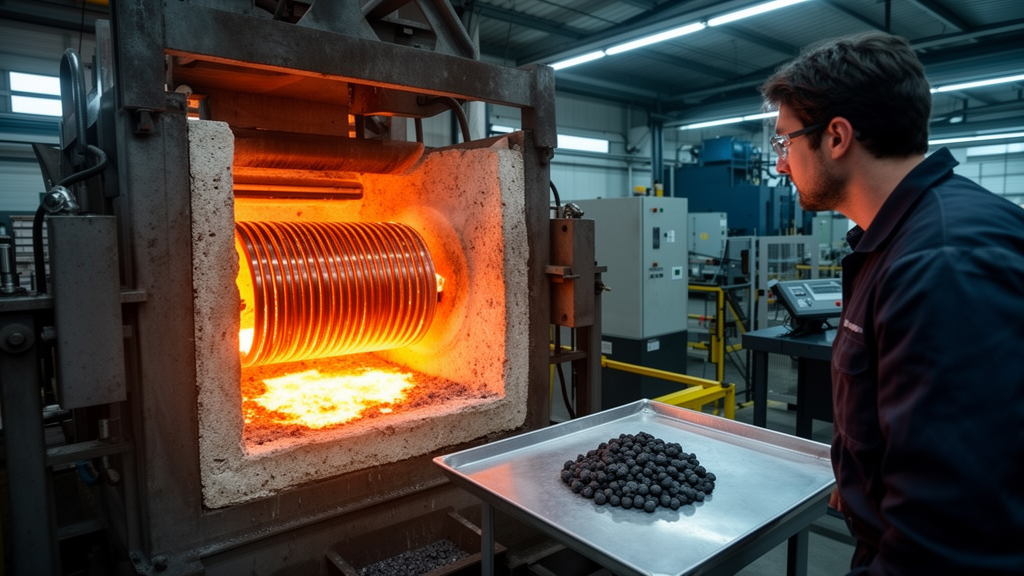
In a preliminary laboratory study, iron was recovered from hematite–goethite pellets in an induction furnace at rates of up to 73% when the researchers controlled slag basicity and the carbon-to-oxygen ratio at 1,300 °C. The best result was obtained at a basicity of 1.3 and a carbon-to-oxygen ratio of 1.4, according to the study in Clean Technologies and Environmental Policy. At these conditions, 1.99 tonnes of pellets were required for every tonne of recovered cast iron.

The experiment focused on an alternative to the blast-furnace ironmaking route, which the paper describes as the most widely used method for producing iron but also as a significant source of carbon dioxide emissions. The researchers used hematite–goethite pellets as feed material in the induction furnace and varied basicity and the carbon-to-oxygen ratio to assess their relationship with iron recovery. The reported maximum of 73% was achieved under a specific combination of conditions rather than through furnace temperature alone, because the temperature was maintained at 1,300 °C while the charge composition and carbon-to-oxygen ratio were adjusted.

Metal recovery was closely associated with two calculated properties of the slag: its estimated liquidus temperature and its viscosity. These properties were evaluated using FactSage 6.0, allowing the researchers to compare the operating conditions with modeled estimates of slag behavior. The study’s central technical finding is that the highest recovery coincided with a basicity of 1.3 and a carbon-to-oxygen ratio of 1.4. It also supplies a material-use benchmark: at the optimum conditions, 1.99 tonnes of pellets were needed per tonne of recovered cast iron.

The environmental results are modeled scenarios rather than direct measurements of the furnace’s full emissions performance. Electricity consumption and off-gas were not measured experimentally, so the researchers conducted a calculated material-and-carbon assessment and used published induction-furnace energy data to estimate electricity-related emissions. For electricity consumption of 500–800 kilowatt-hours per tonne, the scenario gives emissions of approximately 410–736 kilograms of carbon dioxide per tonne when an electricity factor of 0.82–0.92 kilograms of carbon dioxide per kilowatt-hour is applied. These values depend on the assumed energy consumption and electricity carbon intensity and should not be read as observed emissions from the reported trials.

Within the paper’s assessment, replacing fossil-fuel-related heating with an induction furnace could cut carbon dioxide emissions by approximately 258 kilograms per tonne when the furnace uses near-zero-carbon electricity. The authors identify three principal decarbonization opportunities: low-carbon electricity, higher metal recovery, and reduced use of fossil carbon in metal reduction. The experimental recovery result and the pellet requirement therefore provide a preliminary technical baseline, while the emissions savings remain conditional on the energy source and the assumptions used in the scenario analysis.

Subject of Research: Laboratory assessment of induction-furnace production of cast iron from hematite–goethite pellets

Article Title: Cast iron production from hematite–goethite pellets using the induction furnace

Article References: Chiwandika, E. K., Maritsa, S., & Masuka, S. M. (2026). Cast iron production from hematite–goethite pellets using the induction furnace. Clean Technologies and Environmental Policy, 28(11), Article 283. https://doi.org/10.1007/s10098-026-03629-y

Image Credits: AI Generated

DOI: 10.1007/s10098-026-03629-y

Keywords: induction furnace, cast iron, hematite–goethite pellets, iron recovery, slag basicity, carbon-to-oxygen ratio, FactSage, metallurgy, carbon dioxide emissions, low-carbon electricity, Cast, iron

Cite Scienmag News

Sloane Callahan. (October 21, 2026). Induction furnace study recovers up to 73% iron from ore pellets. Scienmag. https://scienmag.com/induction-furnace-study-recovers-up-to-73-iron-from-ore-pellets/

Sloane Callahan. "Induction furnace study recovers up to 73% iron from ore pellets." Scienmag, 21 October 2026, https://scienmag.com/induction-furnace-study-recovers-up-to-73-iron-from-ore-pellets/. Accessed 21 October 2026.

Sloane Callahan. "Induction furnace study recovers up to 73% iron from ore pellets." Scienmag. October 21, 2026. https://scienmag.com/induction-furnace-study-recovers-up-to-73-iron-from-ore-pellets/


Tags: alternative ironmaking methodscarbon dioxide emissionscarbon-to-oxygen ratiocarbon-to-oxygen ratio in metal recoveryCastcast ironFactSagehematite–goethite pelletsimpact of furnace temperature and charge compositioninduction furnaceinduction furnace ironmakingironiron recoveryiron recovery from hematite-goethite pelletslaboratory study on ore pellet processinglow-carbon electricitymetallurgyoptimizing induction furnace conditions for iron recoveryreduction of CO2 emissions in iron productionslag basicityslag basicity and iron extractionslag liquidus temperature and viscositysustainable ironmaking technologiesuse of FactSage software for metallurgical analysis
Share26Tweet16
Previous Post

Research report: Framing science in the digital age: exploring the relationships between general, social media-specific, and research-specific news values and audience engagement with science news on Sina Weibo

Next Post

Pilot study maps preschool word retention across speaker reliability and language background

Related Posts

Suppressing radiocesium uptake and root-to-shoot translocation in crops: Molecular, agronomic, and ecological strategies
Climate

Suppressing radiocesium uptake and root-to-shoot translocation in crops: Molecular, agronomic, and ecological strategies

October 20, 2026
Only 25.7% of reviewed circular business model archetypes met criteria
Climate

Only 25.7% of reviewed circular business model archetypes met criteria

October 20, 2026
Ecuador study links carrying capacity to income, corruption and informality
Climate

Ecuador study links carrying capacity to income, corruption and informality

October 20, 2026
Ancona cold-ironing model links hourly forecasts to 44.9% capacity reduction
Climate

Ancona cold-ironing model links hourly forecasts to 44.9% capacity reduction

October 20, 2026
High-emissions model projects more frequent southward SICZ swings
Climate

High-emissions model projects more frequent southward SICZ swings

October 20, 2026
New emissions gap tracker exposes widening distance from climate pledges
Climate

New emissions gap tracker exposes widening distance from climate pledges

October 20, 2026
Next Post
Pilot study maps preschool word retention across speaker reliability and language background

Pilot study maps preschool word retention across speaker reliability and language background

  • Mothers who receive childcare support from maternal grandparents show more optimized

    Mothers who receive childcare support from maternal grandparents show more parental warmth, finds NTU Singapore study

    27656 shares
    Share 11059 Tweet 6912
  • University of Seville Breaks 120-Year-Old Mystery, Revises a Key Einstein Concept

    1061 shares
    Share 424 Tweet 265
  • Bee body mass, pathogens and local climate influence heat tolerance

    682 shares
    Share 273 Tweet 171
  • Researchers record first-ever images and data of a shark experiencing a boat strike

    546 shares
    Share 218 Tweet 137
  • Groundbreaking Clinical Trial Reveals Lubiprostone Enhances Kidney Function

    531 shares
    Share 212 Tweet 133
Science

Embark on a thrilling journey of discovery with Scienmag.com—your ultimate source for cutting-edge breakthroughs. Immerse yourself in a world where curiosity knows no limits and tomorrow’s possibilities become today’s reality!

RECENT NEWS

  • Sorbitol-nitrate pyrolysis as a method for phase composition control of bismuth oxides and composites based thereon
  • Pilot study maps preschool word retention across speaker reliability and language background
  • Induction furnace study recovers up to 73% iron from ore pellets
  • Research report: Framing science in the digital age: exploring the relationships between general, social media-specific, and research-specific news values and audience engagement with science news on Sina Weibo

Categories

  • Agriculture
  • Anthropology
  • Archaeology
  • Athmospheric
  • Biology
  • Biotechnology
  • Blog
  • Bussines
  • Cancer
  • Chemistry
  • Climate
  • Earth Science
  • Editorial Policy
  • Marine
  • Mathematics
  • Medicine
  • Pediatry
  • Policy
  • Psychology & Psychiatry
  • Science Education
  • Science News
  • Social Science
  • Space
  • Technology and Engineering

Subscribe to Blog via Email

Enter your email address to subscribe to this blog and receive notifications of new posts by email.

Join 5,150 other subscribers

© 2025 Scienmag - Science Magazine

Welcome Back!

Login to your account below

Forgotten Password?

Retrieve your password

Please enter your username or email address to reset your password.

Log In
No Result
View All Result
  • HOME
  • SCIENCE NEWS
  • CONTACT US

© 2025 Scienmag - Science Magazine

Discover more from Science

Subscribe now to keep reading and get access to the full archive.

Continue reading