


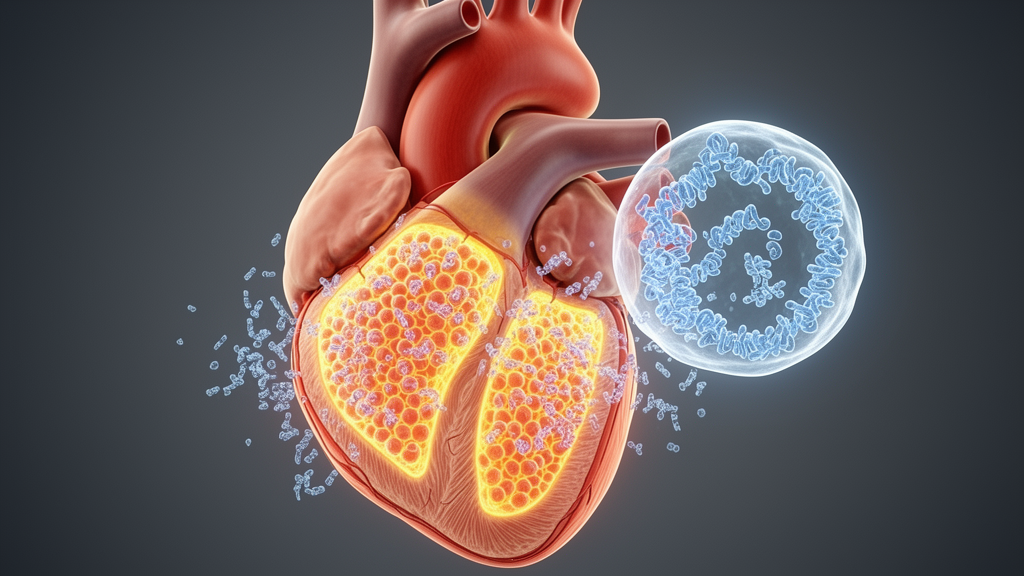
A minireview in Frontiers in Pharmacology proposes that the heart’s circadian clock may normally restrain growth hormone signaling, helping separate physiological growth from harmful cardiac remodeling. The strongest supporting evidence comes from mice whose cardiomyocytes lack the core clock gene Bmal1: their hearts show heightened responses to growth hormone, and reducing growth hormone receptor gene dosage partially protects against cardiomyopathy. The authors emphasize that the mechanism remains a hypothesis, because the relevant experiments have not yet established that environmental circadian disruption produces the same effect in people.
The proposal addresses a molecular gap between established links. Long-term rotating-shift work is associated in meta-analyses with a 20%–40% excess risk of coronary heart disease and incident heart failure after adjustment for smoking, obesity and hypertension, while chronic phase shifts and forced rest-phase activity can produce cardiac hypertrophy or fibrosis in rodents. Cardiomyocytes also operate an intrinsic molecular clock: BMAL1 and CLOCK activate genes involved in timing metabolism, contractile-protein turnover and stress responses, and an estimated 8%–13% of the cardiac transcriptome varies over the course of a day. Deleting Bmal1 specifically in cardiomyocytes causes age-dependent dilated cardiomyopathy in mice, making genetic clock loss a powerful model for studying the underlying biology.
Growth hormone is a plausible bridge between timing and cardiac disease. About 70% of daily growth hormone release in humans occurs during early nocturnal sleep, but its pulse amplitude, timing and trough concentrations can change with circadian misalignment. Cardiomyocytes express functional growth hormone receptors, which signal through JAK2, STAT5, PI3K–AKT and MAPK–ERK pathways involved in cardiac growth, metabolism and fibrosis. The review’s central hypothesis is that the cardiomyocyte clock acts as a temporal filter: it may restrict receptor availability or downstream responsiveness during phases when growth hormone would otherwise provoke an unhelpful response. Circadian misalignment could remove or blur that restraint, allowing mistimed growth hormone pulses to engage remodeling programs.
Direct cardiac evidence comes from the cardiomyocyte-specific Bmal1 knockout model, or CBK mice. Compared with floxed controls, these animals exhibited approximately twice as much cardiac Igf1 messenger RNA and stronger STAT5 phosphorylation after an injected growth hormone challenge. The same hearts also showed activation of phosphorylated ERK, mTOR and 4EBP1. This response was cardiac-specific: livers from the same animals did not display a corresponding increase, suggesting that the local cardiomyocyte clock limits growth hormone responsiveness rather than merely reflecting a systemic change. In a separate causal test, deleting one Ghr allele normalized cardiac Igf1 expression and partially reduced hypertrophy and the progression of fibrosis in CBK mice.
That rescue is important but requires careful interpretation. Global Ghr haploinsufficiency cannot show that growth hormone receptors in cardiomyocytes alone caused the benefit, because reducing receptor gene dosage could also alter systemic growth hormone and circulating IGF-1. The partial rescue further indicates that other pathways contribute to clock-related cardiac damage. The downstream measurements also leave ambiguity: elevated Igf1 supports local production through GHR–JAK2–STAT5 signaling, but some PI3K–AKT and mTOR activity could arise from IGF-1 acting on IGF-1 receptors or hybrid receptors. Cardiac-specific Igf1r deletion or receptor blockade would be needed to separate these routes. Moreover, a larger response to an injected growth hormone pulse is not the same as continuous signaling without stimulation, because basal STAT5 phosphorylation was not measured across the day.
The proposed molecular restraint is led by REV-ERBα, a clock-controlled transcriptional repressor. The authors suggest that REV-ERBα may periodically suppress Ghr, Stat5a or Stat5b, while SOCS2 could provide a second, rhythmically timed negative-feedback brake. Hepatic studies provide a precedent: liver growth hormone receptor expression, JAK2 abundance and growth hormone-induced STAT5 activity vary by time of day, and hepatic SOCS2 follows growth hormone pulse timing. Nevertheless, no direct cardiomyocyte evidence yet shows REV-ERBα binding at the relevant cardiac gene promoters, and the idea that the cardiac Socs2 promoter contains functional ROR response elements has not been tested in any tissue. The precise chromatin mechanism therefore remains inferred rather than demonstrated.
Environmental disruption models expose a major gap between genetic clock loss and realistic misalignment. CBK mice have their cardiomyocyte clock abolished, potentially providing a ceiling estimate of how much clock perturbation can affect growth hormone signaling. By contrast, shift work, social jet lag and chronic sleep disturbance change the phase, amplitude or synchrony of oscillations without necessarily eliminating them. Chronic weekly 12-hour phase reversals have produced cardiomyopathy in hamsters and mice, while five weeks of enforced wakefulness during the rest phase reprogrammed a rat cardiac transcriptome, increased extracellular-matrix and inflammatory genes and caused fibrosis. Neither model measured cardiac growth hormone or IGF-1 pathway activity. Human forced-desynchrony studies have found blunted nocturnal growth hormone surges, redistributed pulses and elevated troughs, but cardiac pathway measurements in environmentally disrupted humans are unavailable.
Several pharmacological strategies follow from the hypothesis, but none has yet been validated as a treatment for circadian cardiomyopathy. Somatostatin analogues such as octreotide and lanreotide suppress pituitary growth hormone release; in acromegaly, six to 12 months of biochemical control is associated with a 5%–15% reduction in left-ventricular mass index and improved diastolic function. Their weakness in a timing disorder is that they suppress pulses without distinguishing ectopic release from physiological nocturnal secretion. Pegvisomant, a pegylated growth hormone receptor antagonist, instead blocks signaling regardless of pulse timing and normalizes serum IGF-1 in roughly 90% of acromegaly patients at reported doses of 10–30 mg per day. Whether it can prevent remodeling after chronic jet lag remains an untested preclinical question, and transaminase elevations occur in about 5%–10% of treated patients.
Clock-targeted compounds offer another experimental approach. The REV-ERB agonists SR9009 and SR9011 enhance recruitment of the NCoR/HDAC3 corepressor complex and could, under the proposed model, restore repression of growth hormone pathway genes. SR9009 has reduced fibrosis and improved function in a mouse pressure-overload model, but that study did not measure growth hormone signaling, the compound has poor oral bioavailability and a plasma half-life below one hour in mice, and it retains metabolic effects in cells lacking REV-ERBα/β. Nobiletin can enhance circadian amplitude in rodent models, while CRY stabilizers such as KL001 extend the negative feedback phase of the clock. Neither class has convincing cardiac data for this pathway, and lengthening the clock period could worsen desynchrony between the heart and central clock. A combined clock-stabilizing and growth hormone-modulating treatment is therefore a testable concept without supporting preclinical efficacy data.
The review also places the proposed growth hormone axis alongside better-established alternatives. A chronic jet-lag model in mice produced an HFpEF-like combination of hypertrophy, fibrosis and diastolic dysfunction while reducing Clock-dependent soluble guanylate cyclase expression and cGMP–PKG1 signaling; the sGC stimulator riociguat attenuated the structural changes. Inflammation, altered fuel use and loss of nocturnal blood-pressure dipping are also recognized candidates. Growth hormone–STAT5 and sGC–cGMP–PKG1 pathways may converge on shared hypertrophic and fibrotic genes, but their relative importance is unresolved. Priority experiments include measuring cardiac STAT5 phosphorylation across multiple day times during chronic jet lag, testing pegvisomant against vehicle in disrupted animals, determining whether SR9009 acts through REV-ERBα, and separately manipulating cardiac IGF-1 receptors. Most direct evidence currently comes from one laboratory and one genetic mouse model, and the differences between rodent and human growth hormone physiology require independent replication. If controlled experiments confirm that misalignment amplifies cardiac growth hormone responsiveness, targeted restoration of timing or selective suppression of excess signaling could become a component of future circadian-cardiomyopathy therapy; at present, that possibility remains an experimental direction rather than a clinically established intervention.
Subject of Research: Circadian control of cardiac growth hormone signaling and cardiomyopathy
Article Title: Augmented cardiac growth hormone signaling in circadian-disrupted cardiomyopathy
Article References: Ibrahim, D., & Sonkar, R. (2026). Augmented cardiac growth hormone signaling in circadian-disrupted cardiomyopathy. Frontiers in Pharmacology, 17, Article 1982446. https://doi.org/10.3389/fphar.2026.1982446
Image Credits: AI Generated
DOI: 10.3389/fphar.2026.1982446
Keywords: cardiac hypertrophy, cardiomyopathy, chronopharmacology, circadian clock, growth hormone, Bmal1, REV-ERBα, STAT5, IGF-1, shift work, Augmented, cardiac
Cite Scienmag News
Ophelia Keating. (October 21, 2026). Circadian Clock Loss May Amplify Growth Hormone Signaling in the Heart. Scienmag. https://scienmag.com/circadian-clock-loss-may-amplify-growth-hormone-signaling-in-the-heart/
Ophelia Keating. "Circadian Clock Loss May Amplify Growth Hormone Signaling in the Heart." Scienmag, 21 October 2026, https://scienmag.com/circadian-clock-loss-may-amplify-growth-hormone-signaling-in-the-heart/. Accessed 21 October 2026.
Ophelia Keating. "Circadian Clock Loss May Amplify Growth Hormone Signaling in the Heart." Scienmag. October 21, 2026. https://scienmag.com/circadian-clock-loss-may-amplify-growth-hormone-signaling-in-the-heart/


