

Wednesday, October 21, 2026
Science
No Result
View All Result
  • Login
  • HOME
  • SCIENCE NEWS
  • CONTACT US
  • HOME
  • SCIENCE NEWS
  • CONTACT US
No Result
View All Result
Scienmag
No Result
View All Result
Home Science News Technology and Engineering

Three-layer sisal-biochar epoxy laminate achieves 88.1 MPa tensile strength

October 21, 2026
in Technology and Engineering
Denise Maddox
By Denise Maddox Scienmag Editorial Profile - Mechanical Engineering
Reading Time: 2 mins read
0
Three-layer sisal-biochar epoxy laminate achieves 88.1 MPa tensile strength

Three-layer sisal-biochar epoxy laminate achieves 88.1 MPa tensile strength

65
SHARES
587
VIEWS
Share on FacebookShare on Twitter
ADVERTISEMENT

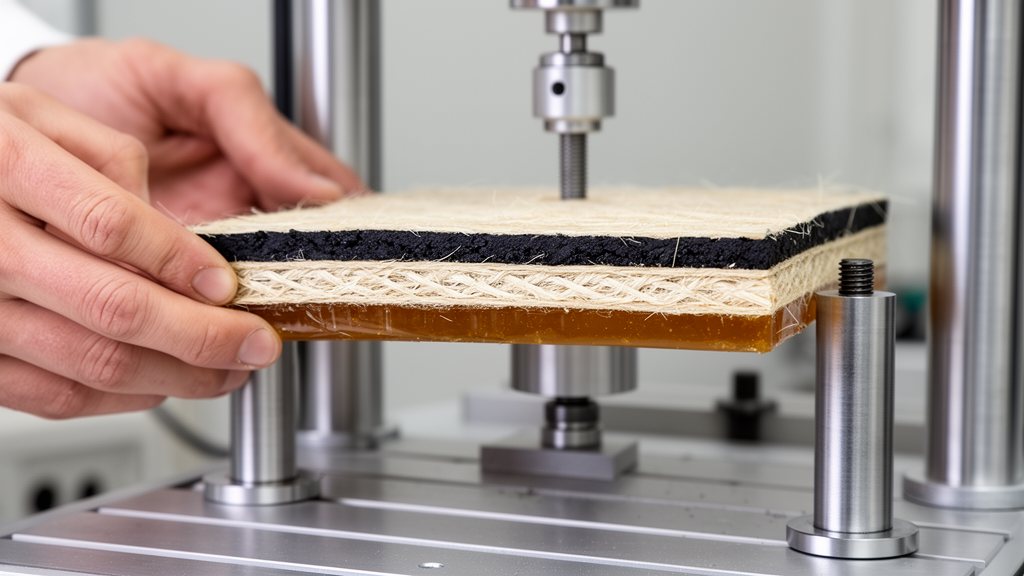
A laboratory study of five sisal-fiber epoxy laminates found that the formulation containing three layers of sisal mat had the best reported mechanical performance, with a tensile strength of 88.1 MPa, a flexural strength of 132.10 MPa and an elongation of 5.50%. Each laminate also contained fine biochar particles derived from sisal fibers at a fixed loading of 5 wt%. The results were reported in the Journal of Materials Science.

For the experimental series, the researchers produced biochar through controlled pyrolysis of sisal fibers and incorporated the particles into an epoxy matrix as filler. They then made five laminates containing zero, one, two, three or four layers of sisal mat using the hand lay-up method. Mechanical performance improved incrementally as the number of mat layers increased, with the three-layer formulation recording the highest reported values. The available abstract does not provide numerical results for all five formulations, so the size of the improvement between adjacent samples cannot be determined from the supplied evidence.

The three-layer composite’s elongation value of 5.50% was reported alongside its tensile and flexural strengths, but the abstract does not describe the deformation sequence, failure mode or test conditions. It likewise does not provide individual measurements, error bars or other statistical measures of variation. The study therefore establishes the strongest reported result within this laboratory series, but the supplied material does not show how reproducible that result would be across larger batches, different processing conditions or service environments.

Physical-property measurements showed density rising from 1.10 to 1.31 g/cm3 across the tested material series. At the same time, thermal conductivity decreased from 1.30 to 1.16 W/m K, which the researchers described as improved insulation. These changes were measured properties of the composites, not evidence of a quantified trade-off between reinforcement and heat transfer. The abstract also does not identify which individual formulation produced either endpoint, report measurement uncertainty or compare the thermal performance with conventional fiber-reinforced epoxy systems.

Scanning electron microscopy showed that the sisal-derived biochar was dispersed homogeneously and that adhesion between the sisal fiber and epoxy matrix was strong. The supplied source does not support additional conclusions about load transfer, interfacial defects or the causes of the measured mechanical behavior. By combining sisal fiber mats with particles made from the same plant fiber, the researchers developed a hybrid composite aimed at improving strength and thermal behavior while retaining a sustainability objective. However, the abstract reports no lifecycle assessment, comparison with other composite materials, recycling test or long-term durability measurement, so it does not demonstrate an end-to-end environmental advantage or suitability for a finished engineering structure.

Subject of Research: Laboratory characterization of sisal-fiber and sisal-biochar reinforced epoxy laminates

Article Title: Development and characterization of sustainable hybrid epoxy biocomposites reinforced with sisal fiber mats and sisal-derived biochar particles

Article References: Arunraja, K. M., Lavanya, R., Arunkumar, S., & Senthilkumar, V. (2026). Development and characterization of sustainable hybrid epoxy biocomposites reinforced with sisal fiber mats and sisal-derived biochar particles. Journal of Materials Science. https://doi.org/10.1007/s10853-026-13918-y

Image Credits: AI Generated

DOI: 10.1007/s10853-026-13918-y

Keywords: sisal fiber, biochar, epoxy composite, biocomposites, tensile strength, flexural strength, thermal conductivity, scanning electron microscopy, sustainable materials, Development, characterization, sustainable

Cite Scienmag News

Denise Maddox. (October 21, 2026). Three-layer sisal-biochar epoxy laminate achieves 88.1 MPa tensile strength. Scienmag. https://scienmag.com/three-layer-sisal-biochar-epoxy-laminate-achieves-88-1-mpa-tensile-strength/


Denise Maddox. "Three-layer sisal-biochar epoxy laminate achieves 88.1 MPa tensile strength." Scienmag, 21 October 2026, https://scienmag.com/three-layer-sisal-biochar-epoxy-laminate-achieves-88-1-mpa-tensile-strength/. Accessed 21 October 2026.

Denise Maddox. "Three-layer sisal-biochar epoxy laminate achieves 88.1 MPa tensile strength." Scienmag. October 21, 2026. https://scienmag.com/three-layer-sisal-biochar-epoxy-laminate-achieves-88-1-mpa-tensile-strength/

Tags: Biocharbiochar as filler in epoxy matricesbiochar from sisal fibersbiochar particle reinforcement in epoxybiochar-enhanced natural fiber compositesbiocompositescharacterizationdevelopmentepoxy compositeflexural strengthflexural strength of sisal epoxy laminateslayered natural fiber biochar compositesmechanical properties of sisal fiber compositesnatural fiber reinforced polymer compositesscanning electron microscopysisal fibersisal-biochar epoxy laminatesustainablesustainable bio-based composite materialssustainable materialstensile strengthtensile strength of natural fiber laminatesthermal conductivitythree-layer sisal fiber composite
Share26Tweet16
Previous Post

TB sputum smear positivity rose during Taiwan’s COVID-19 transition, study finds

Next Post

Brazilian cancer biobank targets precision prevention for diverse population

Related Posts

Duke Leads National Push for Trustworthy AI in Aging Care
Technology and Engineering

Duke Leads National Push for Trustworthy AI in Aging Care

October 21, 2026
Sawdust ferrocene composites show pollutant-removal potential in laboratory water tests
Technology and Engineering

Sawdust ferrocene composites show pollutant-removal potential in laboratory water tests

October 21, 2026
Liquid Metals Offer a Route to Programmable Defects in Two-Dimensional Materials
Technology and Engineering

Liquid Metals Offer a Route to Programmable Defects in Two-Dimensional Materials

October 21, 2026
Weakly supervised framework improves TFT-LCD defect detection in industrial study
Technology and Engineering

Weakly supervised framework improves TFT-LCD defect detection in industrial study

October 21, 2026
ADGB-ONet: an attention-driven gradient balancing operator network for scattering pressure field prediction
Technology and Engineering

ADGB-ONet: an attention-driven gradient balancing operator network for scattering pressure field prediction

October 21, 2026
Zirconium and strontium reshape phosphate coatings for titanium implants
Technology and Engineering

Zirconium and strontium reshape phosphate coatings for titanium implants

October 21, 2026
Next Post
Brazilian cancer biobank targets precision prevention for diverse population

Brazilian cancer biobank targets precision prevention for diverse population

  • Mothers who receive childcare support from maternal grandparents show more optimized

    Mothers who receive childcare support from maternal grandparents show more parental warmth, finds NTU Singapore study

    27656 shares
    Share 11059 Tweet 6912
  • University of Seville Breaks 120-Year-Old Mystery, Revises a Key Einstein Concept

    1061 shares
    Share 424 Tweet 265
  • Bee body mass, pathogens and local climate influence heat tolerance

    682 shares
    Share 273 Tweet 171
  • Researchers record first-ever images and data of a shark experiencing a boat strike

    546 shares
    Share 218 Tweet 137
  • Groundbreaking Clinical Trial Reveals Lubiprostone Enhances Kidney Function

    531 shares
    Share 212 Tweet 133
Science

Embark on a thrilling journey of discovery with Scienmag.com—your ultimate source for cutting-edge breakthroughs. Immerse yourself in a world where curiosity knows no limits and tomorrow’s possibilities become today’s reality!

RECENT NEWS

  • Near-Freezing Water Balances Oxygen Evolution Activity and Catalyst Stability
  • Brazilian cancer biobank targets precision prevention for diverse population
  • Three-layer sisal-biochar epoxy laminate achieves 88.1 MPa tensile strength
  • TB sputum smear positivity rose during Taiwan’s COVID-19 transition, study finds

Categories

  • Agriculture
  • Anthropology
  • Archaeology
  • Athmospheric
  • Biology
  • Biotechnology
  • Blog
  • Bussines
  • Cancer
  • Chemistry
  • Climate
  • Earth Science
  • Editorial Policy
  • Marine
  • Mathematics
  • Medicine
  • Pediatry
  • Policy
  • Psychology & Psychiatry
  • Science Education
  • Science News
  • Social Science
  • Space
  • Technology and Engineering

Subscribe to Blog via Email

Enter your email address to subscribe to this blog and receive notifications of new posts by email.

Join 5,150 other subscribers

© 2025 Scienmag - Science Magazine

Welcome Back!

Login to your account below

Forgotten Password?

Retrieve your password

Please enter your username or email address to reset your password.

Log In
No Result
View All Result
  • HOME
  • SCIENCE NEWS
  • CONTACT US

© 2025 Scienmag - Science Magazine

Discover more from Science

Subscribe now to keep reading and get access to the full archive.

Continue reading