


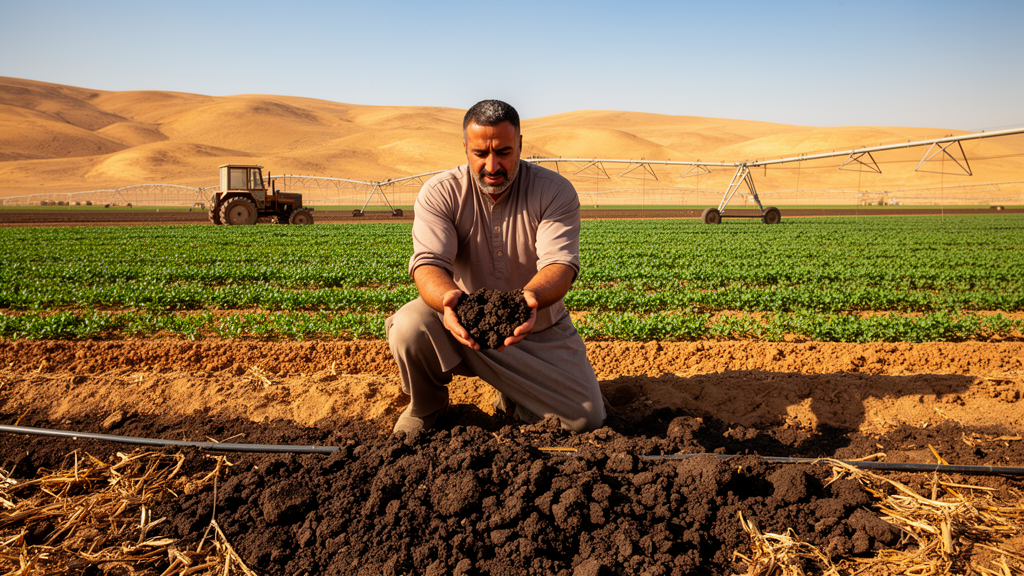
A national scenario model for Jordan found that raising soil organic carbon could pair the largest modeled carbon-storage potential with comparatively low implementation costs, but the strongest economic case appeared in high-value vegetables and fruit crops rather than cereals. Under the study’s high-intensity scenario, increased soil organic carbon produced a modeled maximum of 27.44 metric tons of carbon dioxide per hectare per year for cucumbers, compared with 12.78 tCO₂/ha/year for lemons and no more than 1.65 tCO₂/ha/year for wheat. Barley reached 0.45 tCO₂/ha/year. These are screening estimates, not field measurements, and the authors emphasized that local validation remains necessary before the figures can be treated as achievable outcomes for individual farms.
The study combined Jordanian crop-production and market data with published soil-carbon estimates to compare four land-management pathways: increasing soil organic carbon through measures such as cover crops, rotations, organic amendments and reduced tillage; adding biochar; introducing agroforestry; and improving cropland management. Production records covered vegetables and fruit crops from 1998 through 2023, while wheat and barley records began in 2016 because continuous, reliable data were unavailable earlier. Because the agricultural statistics were available only as national totals, the analysis compared broad crop types rather than individual regions or farms and did not include spatial or geographic modelling.
To construct Jordan-specific estimates, the researchers used global mitigation ranges for the four practices and allocated them according to each practice’s relative contribution. They then applied implementation levels of 10%, 20% and 30% of cultivated land for the low, medium and high scenarios. Jordan’s soil-carbon gains previously estimated under improved management supplied the local scale. Carbon was converted consistently between units of elemental carbon and carbon dioxide, and outputs were expressed per hectare per year. The resulting practice weights were 0.358 for increased soil organic carbon, 0.264 for biochar, 0.231 for agroforestry and 0.147 for improved cropland management, making the first pathway the largest component of the modeled strategy.
Across the scenarios, increased soil organic carbon generated the widest potential range, from 0.11 to 1.65 gigagrams of carbon per year nationally for the selected pathway. Biochar ranged from 0.08 to 1.21 GgC/year, agroforestry from 0.07 to 1.06 GgC/year, and improved cropland management from 0.04 to 0.68 GgC/year. Within individual crops, biochar reached 9.06 tCO₂/ha/year for cucumbers under the high scenario, while agroforestry reached 7.9 tCO₂/ha/year and improved cropland management topped out at 5.05 tCO₂/ha/year. The high scenario also expanded the modeled area under improvement to as much as 28,784 ha for barley and 19,360 ha for olives, whereas the smallest low-scenario areas were about 73 ha for cucumbers and 158 ha for lemons.
Uncertainty testing used 1,000 Monte Carlo simulations for each crop-practice-scenario combination, with an assumed normal-distribution uncertainty of plus or minus 15%. A separate plus or minus 20% sensitivity analysis examined changes in management coefficients. Increased soil organic carbon was the most sensitive of the four pathways, with a modeled impact range of 1.11 tCO₂/ha/year, whereas improved cropland management had the smallest response at 0.46 tCO₂/ha/year. The highest simulated mean was 13.63 tCO₂/ha/year for cucumbers under increased soil organic carbon in the high scenario; the lowest was 0.02 tCO₂/ha/year for barley under improved cropland management in the low scenario. Only 43.8% of simulated cases fell within the cited published benchmark ranges, illustrating the screening nature of the model and the need for local measurements.
The economic model evaluated farms from the producer’s perspective, adding carbon-management expenses to operating farming costs and comparing agricultural profit with adjusted profit that includes hypothetical carbon-credit revenue. It deliberately excluded possible yield gains, fixed costs, future inflation, temporary market fluctuations, future cash flows and a discount rate. Marginal abatement costs rose with implementation intensity: increased soil organic carbon and improved cropland management were assigned costs of 1, 5 and 10 US dollars per ton of carbon dioxide in the low, medium and high scenarios, while biochar and agroforestry were assigned 10, 50 and 100 dollars per ton. Estimated carbon prices ranged from 11 to 110 dollars per ton in the low scenario and from 20 to 200 dollars per ton in the high scenario.
Among the vegetables, cucumbers displayed the strongest financial results, with net profits ranging from negative 2,626 to 20,959 dollars per hectare and adjusted profits, including carbon revenue, from negative 1,976 to 21,593 dollars per hectare. Potatoes produced net-profit estimates of negative 193 to 12,946 dollars per hectare, while open-field tomatoes produced negative 574 to 18,652 dollars per hectare. Greenhouse tomatoes were a conspicuous exception: their net profit ranged from negative 12,944 to only 536 dollars per hectare, and their adjusted profit reached no more than 651 dollars per hectare. Grapes performed strongly, with maximum net and adjusted profits of 17,844 and 18,348 dollars per hectare, while lemons reached 13,086 and 14,020 dollars per hectare. Olives were less profitable, topping out at 3,819 and 3,846 dollars per hectare.
Biochar carried the highest total costs, ranging approximately from 240 to 33,856 dollars per hectare in low scenarios, 244 to 34,054 dollars in medium scenarios and 255 to 34,634 dollars in high scenarios. Increased soil organic carbon and improved cropland management had lower modeled costs, although implementing any pathway was generally more expensive when it produced a larger carbon-storage rate. The crop choice remained decisive. High-value open-field vegetables and profitable perennial fruits combined stronger agricultural returns with larger sequestration potentials, while olives, wheat and barley were more economically vulnerable and often depended on carbon revenue. The authors therefore described soil carbon as a potential complement to crop economics, not a universal substitute for crop profitability.
An economic sensitivity analysis tested an optimistic case with 10% higher yields, sequestration and carbon prices alongside implementation costs 10% below the base case, and a pessimistic case that reversed those changes. Under the optimistic case, net profit reached 28,903 dollars per hectare and adjusted profit 29,866 dollars per hectare. These modeled gains depended strongly on carbon-market and agronomic assumptions. The study did not engage farmers, policymakers or other stakeholders, did not establish actual carbon-credit demand and did not predict adoption rates; its low, medium and high implementation levels were scenario assumptions adapted from earlier work rather than observed trends.
The central result is therefore a screening-level business case rather than evidence that Jordanian soil can be converted into a verified carbon-credit asset. The analysis identifies increased soil organic carbon as the most promising of the four pathways by modeled storage potential and cost, while locating the clearest commercial opportunity in cucumbers, potatoes, open-field tomatoes, grapes and lemons. Yet the estimates depend on global coefficients, national production averages, assumed land coverage and hypothetical prices, and the 43.8% agreement rate with published ranges shows that substantial uncertainty remains. The researchers call for long-term field measurements of soil carbon, tests of the management coefficients under Jordanian conditions, spatially explicit datasets and farmer surveys. Until those steps are completed, the figures point toward where targeted research and investment may be most productive rather than demonstrating realized sequestration or guaranteed income.
Subject of Research: Scenario-based assessment of soil carbon sequestration and economic feasibility in Jordanian croplands
Article Title: Turning dirt into gold: the business case of soil carbon for agrarian pathways in arid climate
Article References: Althalaj, T., Thompson, R. M., Qtaishat, T., Bumblauskas, D., & Al-Shibli, F. (2026). Turning dirt into gold: the business case of soil carbon for agrarian pathways in arid climate. Frontiers in Sustainable Food Systems, 10, Article 1966265. https://doi.org/10.3389/fsufs.2026.1966265
Image Credits: AI Generated
DOI: 10.3389/fsufs.2026.1966265
Keywords: soil carbon sequestration, Jordan, agriculture, carbon credits, soil organic carbon, biochar, agroforestry, crop profitability, arid climates, scenario modelling, Turning, dirt
Cite Scienmag News
Alan Morgan. (October 21, 2026). Jordanian Crops Reveal the Business Potential of Soil Carbon. Scienmag. https://scienmag.com/jordanian-crops-reveal-the-business-potential-of-soil-carbon/
Alan Morgan. "Jordanian Crops Reveal the Business Potential of Soil Carbon." Scienmag, 21 October 2026, https://scienmag.com/jordanian-crops-reveal-the-business-potential-of-soil-carbon/. Accessed 21 October 2026.
Alan Morgan. "Jordanian Crops Reveal the Business Potential of Soil Carbon." Scienmag. October 21, 2026. https://scienmag.com/jordanian-crops-reveal-the-business-potential-of-soil-carbon/


