


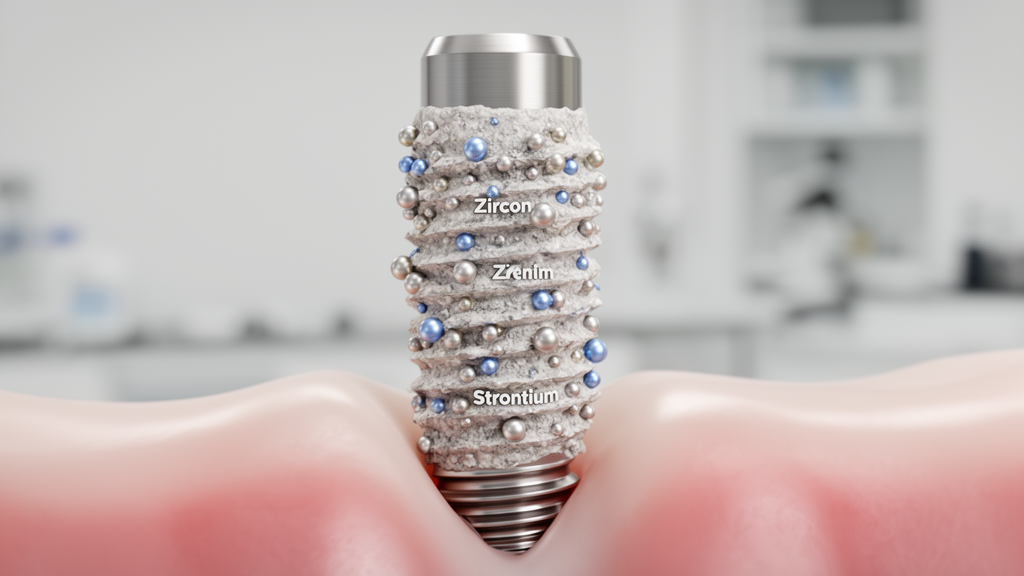
Chemical conversion coatings containing zinc, zirconium and strontium improved the corrosion resistance of Ti6Al4V alloy in three laboratory solutions, but their performance depended strongly on the electrolyte and the balance between crystal growth and layer compactness. In the study, three phosphate-coating formulations were deposited on titanium alloy for 60 minutes at 90 °C, then examined by microscopy, elemental and phase analysis, electrochemical testing and wettability measurements. Every coated specimen showed better corrosion behavior than uncoated Ti6Al4V in the tested media. The lowest corrosion rate in Ringer solution was measured for formulation S1, at 0.22 micrometres per year compared with 2.94 micrometres per year for the bare alloy. In phosphate-buffered saline, S2 reached 0.16 micrometres per year, versus 5.58 for uncoated Ti6Al4V, while S3 gave the lowest rate in Earle’s Balanced Salt Solution, at 0.21 micrometres per year versus 0.73 for the alloy.
The coatings were formed on cylindrical Ti6Al4V specimens ground to 1200 grit and chemically activated before immersion in acidic zinc-based phosphating solutions containing different concentrations of Zr4+ and Sr2+. Scanning electron microscopy revealed dendritic, acicular and lamellar phosphate crystals arranged through overlapping and staged growth. S1 produced a rough, broadly continuous layer with relatively few extensive intercrystalline areas. Its crystals had flat faces and well-defined edges, and their orientation suggested a combination of primary and secondary nucleation. S2 developed thicker and longer lamellar crystals with more visible gaps between them. S3 contained more numerous, smaller crystals and had the most compact appearance at low magnification. At higher magnification, however, its structure appeared immature, with fragmented crystals and incomplete cohesion between neighboring grains. Thus, the visual compactness of a coating did not necessarily mean that it was chemically uniform or free of local pathways for electrolyte penetration.
Energy-dispersive X-ray spectroscopy showed zinc, phosphorus and oxygen across all three coatings, together with smaller quantities of zirconium, strontium and iron. The measured zinc-to-phosphorus atomic ratios were approximately 1.34 for S1, 1.60 for S2 and 1.19 for S3. Titanium detected within the coating signals indicated that the analytical beam reached the substrate in some areas, consistent with the thin, heterogeneous layers observed by microscopy. X-ray diffraction identified hopeite, Zn3(PO4)2·4H2O, as the dominant phase in every sample. Phosphophyllite was also detected, as were strontium-zinc phosphate and hydrated zinc-zirconium phosphate phases associated with the added ions. The coatings were therefore multiphase systems rather than pure zinc phosphate layers. Their formation was interpreted as a sequence in which hopeite developed first, phosphophyllite coprecipitated, and strontium- and zirconium-containing phases formed as zinc levels fell, local pH stabilized and the layer entered a slower-growth stage.
Fourier-transform infrared spectroscopy supported the presence of phosphate groups and showed that the three coatings differed in hydration and network structure. Hydroxyl stretching bands between 3600 and 3000 inverse centimetres were strongest and broadest for S3, indicating greater hydration. S2 produced a weaker, narrower band in this region and a shift of the phosphate deformation band from about 602 to 614 inverse centimetres. The researchers associated this shift with stronger Zr-O-P interactions and a stiffer phosphate network, consistent with S2’s relatively compact and less hydrated surface. At the same time, the coating’s chemical properties could not be separated from its morphology. Zirconium concentration promoted larger phosphate crystals, whereas increasing strontium encouraged more nucleation centers and denser growth. The data support a role for both ions in coating formation, but they do not establish that either ion improves biological performance directly.
Potentiodynamic polarization tests showed that coating superiority could change with the surrounding medium. In Ringer solution, S1 had a corrosion current density of 24.7 nanamperes per square centimetre and a corrosion rate of 0.22 micrometres per year. S2 and S3 produced rates of 0.38 and 0.34 micrometres per year, respectively, still below the alloy’s 2.94 micrometres per year. S3 recorded the highest polarization resistance, 764.8 kilohm square centimetres, but that barrier measure did not translate into the lowest corrosion rate. The investigators distinguished these outcomes: S1 provided the strongest kinetic suppression of electrochemical reactions, whereas S3 offered the greatest barrier resistance and S2 the most positive corrosion potential in Ringer solution. Local penetration through intercrystalline areas could sustain corrosion even when the coating as a whole displayed a substantial overall resistance.
The same medium-dependent pattern appeared in Dulbecco’s Phosphate-Buffered Saline and Earle’s Balanced Salt Solution. In DPBS, S2 had the lowest corrosion current density, at 18.6 nanamperes per square centimetre, and the lowest corrosion rate, at 0.16 micrometres per year. S1 had the highest polarization resistance in this medium, while S3 showed more pronounced local activity and a corrosion rate of 0.74 micrometres per year. In EBSS, S3 produced the lowest rate, 0.21 micrometres per year, and the most positive corrosion potential; S2 retained the highest polarization resistance, 662.4 kilohm square centimetres. The study attributed the variation to electrolyte composition: chloride-containing Ringer solution could expose defective regions, phosphate-containing DPBS could promote passivation and pore blocking, and the chemically complex EBSS could promote hydration, ion exchange and reorganization of the coating. A formulation that ranked first under one set of conditions therefore did not necessarily rank first under another.
Electrochemical impedance spectroscopy reinforced the distinction between barrier performance and localized reactions. Fitted equivalent circuits associated the coated systems with a phosphate-layer resistance, an interfacial or pore resistance, and a charge-transfer resistance at the metal-electrolyte interface. S1 in Ringer solution had a charge-transfer resistance approximately 300 times that of uncoated Ti6Al4V, while S2’s phosphate-layer resistance reached 1.83 million ohm square centimetres. In DPBS, S2 combined a high external-layer resistance with a low current density, consistent with effective suppression of ion transfer. In EBSS, the S3 system required a Warburg diffusion element, indicating that ionic transport through hydrated or intergranular regions contributed to its response. Even with substantial impedance, low-resistance pathways remained detectable. The data therefore support a barrier mechanism while showing that coating continuity, phase stability, hydration and electrolyte-driven changes must be considered together rather than treating density or total surface coverage as sufficient measures of protection.
Wettability measurements showed that phosphating shifted Ti6Al4V from a largely hydrophobic state toward greater affinity for aqueous liquids. The water contact angle of the uncoated alloy was 89.1 degrees, whereas the initial values for S1, S2 and S3 were 43.2, 53.2 and 57.4 degrees, respectively. The coatings’ polar surface-energy components increased to roughly 19–22 millinewtons per metre, compared with 7.7 for the bare alloy. S1 had the greatest initial hydrophilicity, consistent with a lamellar surface that allowed liquid to enter intercrystalline spaces. S2 combined high roughness with a less hydrated and more strongly bonded phosphate network, while S3’s dense fine-grained structure limited capillary spreading despite its greater chemical hydration. These measurements show that contact angle depends on both surface chemistry and physical topography. They do not, by themselves, establish improved cell attachment, tissue integration or implant performance.
Exposure to the test solutions also changed the wettability of the coated surfaces. S1’s Ringer contact angle rose from 50.8 to 62.0 degrees as its polar surface-energy component fell to 16.5 millinewtons per metre. In EBSS, by contrast, its contact angle decreased from 65.2 to 56.3 degrees and its polar component rose to 27.7 millinewtons per metre, behavior consistent with hydration and chemical reorganization in the complex medium. S2’s contact angle in EBSS fell to 47 degrees while the polar component increased to 26.04 millinewtons per metre, even though its electrochemical resistance remained high. S3 retained nearly unchanged wettability in Ringer and DPBS but developed a lower polar component after EBSS exposure, consistent with reaction products that may seal local pathways. Overall, S2 provided the most consistently stable barrier response, S3 was especially effective in EBSS and maintained more predictable wetting, and S1 performed best in Ringer solution. Because the study used electrochemical and surface measurements without direct biological testing, claims about osseointegration, antibacterial activity, osteogenic response or clinical benefit remain unverified.
Subject of Research: Effects of zirconium and strontium on zinc-based phosphate conversion coatings for Ti6Al4V alloy
Article Title: Effect of Zr4+ and Sr2+ addition on morphology, surface characteristics, and corrosion behavior of a new functional Zn-based phosphate conversion coating deposited on Ti6Al4V
Article References: Burduhos Nergis, D. P., Istrate, B., Epure, E.-L., Cazac, A., Bejinariu, C., Sandu, A.-V., & Burduhos-Nergis, D.-D. (2026). Effect of Zr4+ and Sr2+ addition on morphology, surface characteristics, and corrosion behavior of a new functional Zn-based phosphate conversion coating deposited on Ti6Al4V. Journal of Materials Science. https://doi.org/10.1007/s10853-026-13824-3
Image Credits: AI Generated
DOI: 10.1007/s10853-026-13824-3
Keywords: Ti6Al4V, phosphate conversion coating, zirconium, strontium, corrosion resistance, electrochemical impedance, surface chemistry, wettability, biomaterials, Effect, addition, morphology
Cite Scienmag News
Neil Sanderson. (October 21, 2026). Zirconium and strontium reshape phosphate coatings for titanium implants. Scienmag. https://scienmag.com/zirconium-and-strontium-reshape-phosphate-coatings-for-titanium-implants/
Neil Sanderson. "Zirconium and strontium reshape phosphate coatings for titanium implants." Scienmag, 21 October 2026, https://scienmag.com/zirconium-and-strontium-reshape-phosphate-coatings-for-titanium-implants/. Accessed 21 October 2026.
Neil Sanderson. "Zirconium and strontium reshape phosphate coatings for titanium implants." Scienmag. October 21, 2026. https://scienmag.com/zirconium-and-strontium-reshape-phosphate-coatings-for-titanium-implants/


