


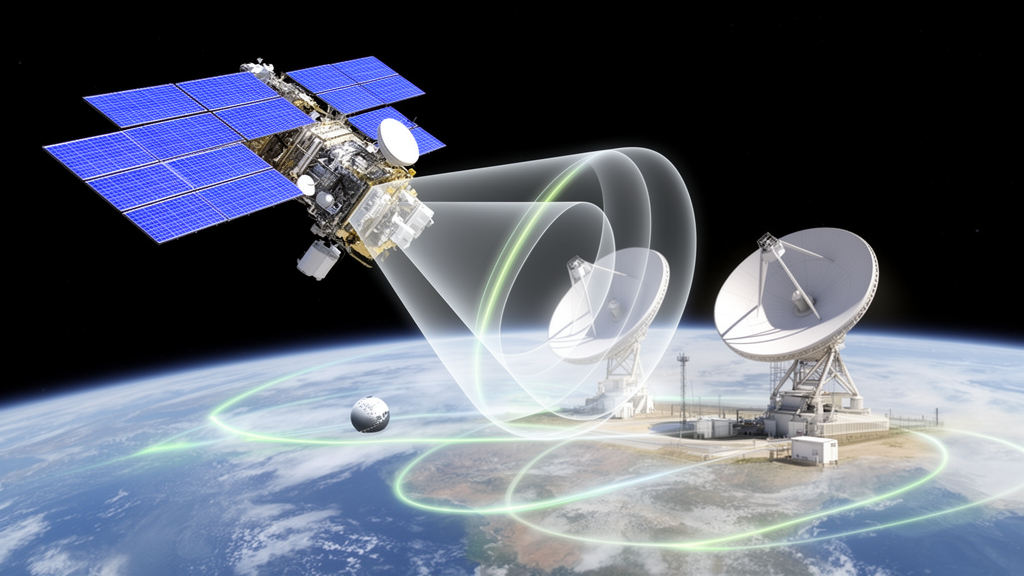
A task-aware conformal framework selected joint uncertainty regions for multi-horizon spacecraft power monitoring on BUPT-1, according to the study. Researchers used a residual iTransformer to generate point forecasts for five primitive electrical states at 1-, 5-, and 15-minute horizons, then selected, fitted and calibrated candidate residual geometries on chronologically separated blocks of complete spacecraft orbits. The final evaluation covered 25,278 forecast origins from subsequent telemetry collected in July 2023.
The selection criterion was the downstream efficiency of power-envelope calculation rather than residual volume alone. Across three random-seed runs, the task-aware procedure consistently chose a joint box for the five primitive-state residuals, whereas the residual-volume control selected a sample-covariance ellipsoid. Power envelopes were constructed from synchronized sets of primitive current and bus-voltage forecasts, allowing the framework to tailor joint uncertainty geometry to the final monitoring task.
At the 90% nominal level, orbit-balanced joint coverage across the primitive electrical states was 0.892, with a 95% complete-orbit bootstrap confidence interval of 0.883–0.899. At the 95% nominal level, coverage was 0.947, with a 95% confidence interval of 0.943–0.952. Simultaneous coverage of both power channels across all three forecast horizons was 0.913 at the 90% nominal level and 0.957 at the 95% nominal level. These were empirical results from the chronologically subsequent July 2023 telemetry, not guarantees of future performance.
Compared with residual-volume selection, the task-aware method reduced the normalized power interval score by 34.3% at the 90% nominal level and by 30.3% at the 95% level. The paired absolute reductions were 1.522, with a 95% confidence interval of 1.505–1.540, and 1.552, with a 95% confidence interval of 1.534–1.570, respectively. Because the selected region was a non-negative box, its zero algebraic gap and full containment of the resulting interval image follow by construction; the empirical analyses quantify its coverage and interval sharpness.
The findings demonstrate task-aware geometry selection for BUPT-1 multi-horizon power monitoring. The evidence is limited to the studied satellite, telemetry period, three forecast horizons, five primitive electrical states and evaluation protocol, so the results do not establish performance for other spacecraft or operating conditions.
Subject of Research: Task-aware conformal uncertainty quantification for multi-horizon spacecraft power monitoring
Article Title: Task-aware conformal power envelopes for multi-horizon spacecraft monitoring
Article References: Lu, N., Cui, L., & Zhi, X. (2026). Task-aware conformal power envelopes for multi-horizon spacecraft monitoring. PLOS One, 21(10), e0360910. https://doi.org/10.1371/journal.pone.0360910
Image Credits: AI Generated
DOI: 10.1371/journal.pone.0360910
Keywords: spacecraft monitoring, conformal prediction, power envelopes, uncertainty quantification, iTransformer, electrical forecasting, BUPT-1, telemetry, multivariate residuals, Task-aware, conformal, power
Cite Scienmag News
Alan Morgan. (October 21, 2026). Task-aware conformal power envelopes for multi-horizon spacecraft monitoring. Scienmag. https://scienmag.com/task-aware-conformal-power-envelopes-for-multi-horizon-spacecraft-monitoring/
Alan Morgan. "Task-aware conformal power envelopes for multi-horizon spacecraft monitoring." Scienmag, 21 October 2026, https://scienmag.com/task-aware-conformal-power-envelopes-for-multi-horizon-spacecraft-monitoring/. Accessed 21 October 2026.
Alan Morgan. "Task-aware conformal power envelopes for multi-horizon spacecraft monitoring." Scienmag. October 21, 2026. https://scienmag.com/task-aware-conformal-power-envelopes-for-multi-horizon-spacecraft-monitoring/


