


The study, published in Frontiers in Psychology by a team from the University of Salerno, the cooperative Giovamente, and the local health authority ASL Salerno, tracked 54 children and deliberately set out to ask not whether the intervention worked, but precisely where it worked. Sensory processing differences affect an estimated 69 to 93 percent of children with autism, according to prevalence estimates cited in the diagnostic literature, manifesting as hyperreactivity to ordinary stimuli, hyporeactivity to relevant input, or sensory-seeking behaviors involving repetitive tactile and visual exploration. Neuroimaging studies have linked these patterns to altered activation in primary sensory cortices, atypical thalamocortical connectivity, and disrupted multisensory integration.
Such differences are now formalized in the DSM-5 as core diagnostic characteristics, and they carry real consequences: sensory overload and distress can drive avoidance, anxiety, and reduced participation in everyday activities, straining both learning and family life. Motor difficulties compound the picture, affecting roughly 50 to 85 percent of children with autism. Impairments span gross and fine motor skills, coordination, motor planning, postural control, and perceptual-motor integration, and both DSM-5 and ICD-11 acknowledge that many of these children also meet criteria for Developmental Coordination Disorder.
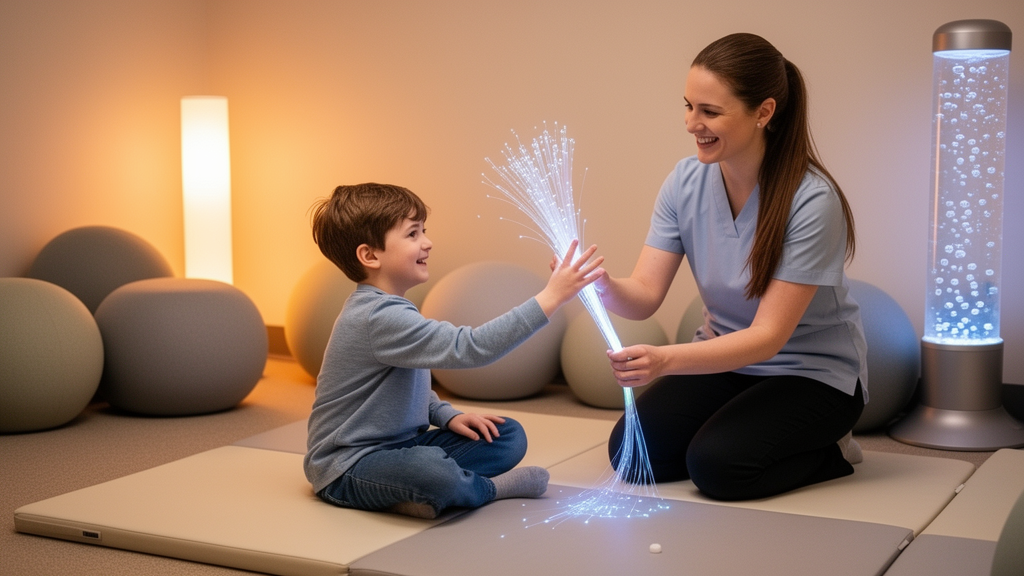
Over twelve consecutive weeks, each participating child attended two individual 60-minute sessions per week, totaling 24 sessions delivered by therapists trained in developmental and sensory-motor interventions. Every session followed the same six-phase architecture: a welcome and regulation period with breathing exercises and calming music, ten minutes of free sensory exploration, fifteen minutes of guided sensory-motor activities such as obstacle courses and balance exercises, fifteen minutes of immersion in a pre-heated, temperature-controlled sensory pool providing deep-pressure stimulation, a reorientation phase to return arousal to baseline, and structured therapist documentation. Although conceptually informed by Ayres Sensory Integration principles, the researchers are explicit that the program was not delivered under the standardized ASI Fidelity Measure and should be considered ASI-informed rather than a true ASI protocol.
The study enrolled 44 children in the intervention arm and compared them with a 10-child cohort receiving treatment as usual alone, all continuing their existing psychoeducational, behavioral, and speech therapy programs. The intervention group was clinically heterogeneous: mean age 6.59 years, 38 boys and 6 girls, with half classified at DSM-5 severity Level 3 and 43 percent nonverbal. Baseline adaptive difficulties were pronounced, with more than half of the sample not yet toilet trained and nearly 60 percent showing inadequate personal hygiene or food selectivity.
The team recoded ordinal behavioral items directionally into eight composites, feeding, sleep, coordination, play, personal autonomy, communication, social interaction, and behavioral regulation, and tested Time by Group interactions with Bonferroni correction applied separately across the behavioral and sensory families. Non-random allocation meant the interaction term could signal association but not causation, a limitation the authors state plainly rather than obscure. The headline result was the selectivity itself.
Mean autonomy scores in the MSR group nearly doubled from 0.44 to 0.86 on the study's ordinal scale, while the comparison group remained flat at 0.77. The between-group difference in change was 0.42 points with a 95 percent confidence interval of 0.22 to 0.63, and a nonparametric Mann-Whitney sensitivity analysis confirmed the finding. No other domain, including coordination, communication, feeding, sleep, play, social interaction, or behavioral regulation, survived correction.
Four tactile and thermal items, responses to rough, smooth, and soft surfaces and to warm sensations, showed statistically significant group-by-time interactions after correction, but the researchers argue these cannot be labeled clinical improvement. The raw ordinal scores quantified response intensity without classifying each child as hyperreactive or hyporeactive at baseline, meaning a decrease in score could be beneficial for one child and detrimental for another. Moreover, the interactions primarily reflected score reductions in the untreated comparison group and relative stability in the intervention group, patterns better described as divergent trajectories than as therapeutic gains.
No auditory, visual, gustatory, or olfactory item survived adjustment at all. The authors interpret the autonomy signal as compatible with a specific mechanism: a structured, repeatedly practiced therapeutic environment may first influence routine participation, initiation, and supported independence, capacities that transfer to daily self-care before broader behavioral or communicative change emerges. Personal autonomy is clinically meaningful because it concerns everyday routines and dependence on caregivers, and the size of the effect justifies focused replication using validated adaptive-behavior instruments capable of distinguishing dressing, washing, initiation, and need for adult prompting.
The team is equally clear about what the data do not show: a 12-week MSR program should not be expected to produce broad short-term gains in complex socio-communicative or regulatory domains, and descriptive within-group improvements in those areas must not be mistaken for intervention effects. Allocation was non-random, the comparison cohort comprised only 10 children, and baseline imbalances in autism severity, with standardized mean differences reaching 0.37, preclude any claim of equivalence. There was no a priori power calculation, the autonomy composite was study-specific rather than a validated standardized measure, observers reached consensus without archiving independent ratings, and the age range from just over two to nearly eleven years spans dramatic developmental change that the modest sample could not disentangle.
The authors frame their central result as hypothesis-generating: preliminary evidence of a selective, MSR-associated change in personal autonomy that now requires confirmation in randomized, adequately powered trials with prespecified autonomy endpoints, standardized intervention fidelity, and longitudinal follow-up to determine whether the gains endure and which clinical profiles benefit most.
Subject of Research: Effects of multisensory motor-sensory room training on behavioral and sensory functioning in children with autism spectrum disorder
Article Title: Selective change in personal autonomy associated with motor sensory room training in children with autism: an exploratory controlled pre-post study
Article References: Savarese, G., Carpinelli, L., Mandia, R., Diavoletto, A., Piscitelli, M., Impemba, F., Di Siervi, A., Vertullo, A., Bottiglieri, F., Sessa, M., & Corrivetti, G. (2026). Selective change in personal autonomy associated with motor sensory room training in children with autism: an exploratory controlled pre-post study. Frontiers in Psychology, 17, Article 1933418. https://doi.org/10.3389/fpsyg.2026.1933418
Image Credits: AI Generated
DOI: 10.3389/fpsyg.2026.1933418
Keywords: autism spectrum disorder, sensory integration, motor sensory room, personal autonomy, adaptive functioning, pediatric intervention, Bonferroni correction, quasi-experimental study, sensory processing, motor coordination, Frontiers in Psychology, child development
Cite Scienmag News
Glenn Wilkins. (October 21, 2026). Research report: Selective change in personal autonomy associated with motor sensory room training in children with autism: an exploratory controlled pre-post study. Scienmag. https://scienmag.com/research-report-selective-change-in-personal-autonomy-associated-with-motor-sensory-room-training-in-children-with-autism-an-exploratory-controlled-pre-post-study/
Glenn Wilkins. "Research report: Selective change in personal autonomy associated with motor sensory room training in children with autism: an exploratory controlled pre-post study." Scienmag, 21 October 2026, https://scienmag.com/research-report-selective-change-in-personal-autonomy-associated-with-motor-sensory-room-training-in-children-with-autism-an-exploratory-controlled-pre-post-study/. Accessed 21 October 2026.
Glenn Wilkins. "Research report: Selective change in personal autonomy associated with motor sensory room training in children with autism: an exploratory controlled pre-post study." Scienmag. October 21, 2026. https://scienmag.com/research-report-selective-change-in-personal-autonomy-associated-with-motor-sensory-room-training-in-children-with-autism-an-exploratory-controlled-pre-post-study/


