


A PRISMA-based systematic review of 47 articles published from 2017 through 2023 identified 38 distinct ecosystem services associated with the Milpa System and other maize-based intercropping polycultures. Food provision was the most frequently reported service, followed by biodiversity conservation and soil fertility, according to the review, which followed PRISMA principles and classified services using the Common International Classification of Ecosystem Services.
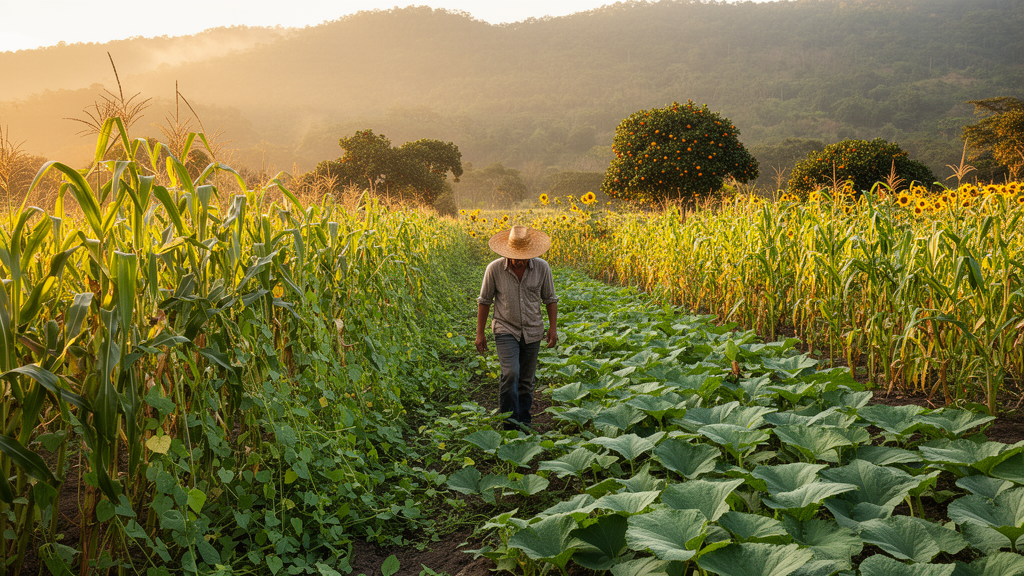
The Milpa System is an ancestral Mesoamerican agroecosystem centered on maize grown with companion plants. Its best-known form is the Mesoamerican triad of maize, beans and squash. Other configurations include crops such as chili and tomatoes, as well as fruit and timber trees. The review assessed literature relating ecosystem services to the Milpa System while broadening its scope to include maize-based polycultures more generally, where direct research on milpas was limited.
The researchers searched Scopus in October 2023. An initial query combining “ecosystem services” with “milpa” in titles, abstracts and keywords returned eight publications. A broader query combining “ecosystem services” with “maize” returned 252 publications. Together, the searches produced 259 works for abstract screening; the expanded query did not represent 252 additional publications beyond the initial set.
Two reviewers independently screened abstracts using Abstrackr, excluding studies focused on monocultures, crop rotations, agroecosystems without maize, or work that did not discuss ecosystem services in an agroecosystem. Full-text assessment added criteria requiring clear identification and evaluation of services, methodological transparency, robust designs such as randomized controlled trials or longitudinal studies, and a focus on milpas or maize-based intercropping polycultures. The reviewers recorded service mentions in a spreadsheet and standardized them under the CICES framework: provisioning, regulation and maintenance, and cultural services.
Five provisioning services accounted for 48 mentions, with plant-based food provision the most recurrent. Studies in the review associated polycultures with higher food yields and economic gains than monocultures, alongside more efficient use of water and soil nutrients, microclimate and greenhouse-gas regulation, biodiversity conservation, and cultural benefits such as aesthetic value, education and recreation. One cited study reported that polycultures in Yucatán met the basic needs of more than 50,000 families and had yields 31% to 53% higher than maize monocultures; that result came from the cited study, not from a new analysis by the reviewers.
Regulation and maintenance formed the largest category, with 20 services recorded across 151 mentions. Biodiversity conservation appeared in 24 articles, and soil fertility processes in 23. Other reported services included groundwater recharge and conservation, erosion and wind control, carbon sequestration, pest and weed control, pollination, flood mitigation and microclimate regulation. In a three-year experiment cited by the review, maize grown with beans and buckwheat produced total carbon deposits above 24.9 and 23.0 metric tons per hectare at soil depths of 0–10 cm and 10–20 cm, respectively.
A separate 36-year mathematical simulation cited in the review estimated that integrating legumes into maize polycultures could increase soil carbon by 7% and reduce nitrogen leaching by 41% compared with other monoculture techniques. These were modeled projections rather than direct field observations made by the review. The reviewed evidence also associated multi-layered crop structures with habitat for predators, beneficial arthropods and pollinators, natural pest control, and resilience to extreme weather conditions.
Thirteen cultural services received 51 mentions. Aesthetic beauty appeared in nine articles, while education, cultural identity and recreation were also prominent. Studies connected traditional milpa agriculture with social identity, community cohesion, knowledge transmission, physical and mental health, and spiritual or intellectual stimulation. Research in the Lacandon Jungle examined songs, stories and beliefs associated with traditional ecological knowledge, while other studies considered scenic attractiveness and combinations of milpa with timber-tree production. Cultural services were discussed in 12 articles overall and were the least-studied category.
The reviewers supplemented the review with a bibliometric analysis using the R implementation of Bibliometrix. Publication output was relatively stable, averaging seven articles per year from 2017 to 2023, with two articles in 2017 and ten in 2021. Mexican authors were the largest national group in the reviewed corpus. The authors also applied an ecosystem-services cascade model to interpret how ecosystem structure and biophysical processes support ecological functions and service flows contributing to human well-being.
The review’s main limitation is the scarcity of research directly examining ecosystem services in the Milpa System, especially outside Mexico. Because much of the evidence concerns broader maize-based polycultures rather than milpas specifically, the findings cannot be generalized fully beyond the Mexican context. Cultural services also pose difficulties for standardized quantification and economic valuation because they are intangible, community-specific and often lack direct market value. The authors concluded that the documented services demonstrate the multifunctionality of the Milpa System, while the limited and geographically uneven evidence base constrains stronger claims about its performance in other settings.
Subject of Research: Systematic review of ecosystem services provided by the Milpa System and related maize-based polycultures
Article Title: Ecosystem Services in the Milpa System: A Systematic Review
Article References: Romero-Natale, A., Acevedo-Sandoval, O., & Sanchez-Porras, A. (2024). Ecosystem Services in the Milpa System: A Systematic Review. One Ecosystem, 9, Article e131969. https://doi.org/10.3897/oneeco.9.e131969
Image Credits: AI Generated
Keywords: Milpa System, ecosystem services, maize polycultures, agroecosystems, food provision, biodiversity conservation, soil fertility, cultural services, systematic review, Ecosystem, Services, Milpa
Cite Scienmag News
Alan Morgan. (October 20, 2026). Systematic review maps 38 ecosystem services in maize-based polycultures. Scienmag. https://scienmag.com/systematic-review-maps-38-ecosystem-services-in-maize-based-polycultures/
Alan Morgan. "Systematic review maps 38 ecosystem services in maize-based polycultures." Scienmag, 20 October 2026, https://scienmag.com/systematic-review-maps-38-ecosystem-services-in-maize-based-polycultures/. Accessed 21 October 2026.
Alan Morgan. "Systematic review maps 38 ecosystem services in maize-based polycultures." Scienmag. October 20, 2026. https://scienmag.com/systematic-review-maps-38-ecosystem-services-in-maize-based-polycultures/


