


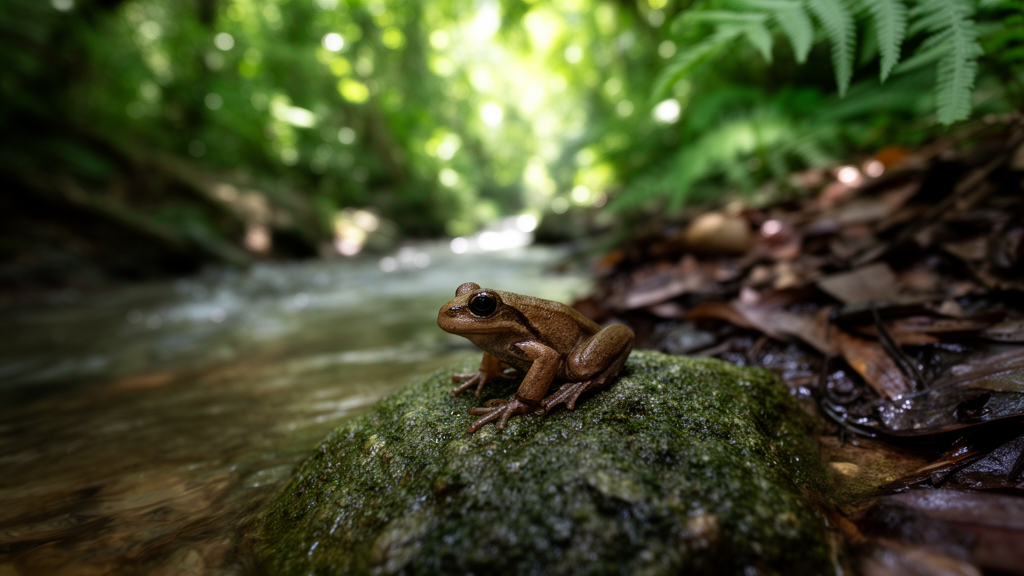
An integrative taxonomic study identified and formally described Leptobrachella xinshaoensis sp. nov. from Xinshao County in central Hunan, China, using mitochondrial DNA analyses and comparisons of external anatomy. The study examined three adult male specimens collected at the type locality on 19 March 2024, establishing a holotype and two paratypes.
The specimens were deposited at the Chengdu Institute of Biology, Chinese Academy of Sciences. The holotype was collected at 27.5065° N, 111.4597° E at approximately 350 metres above sea level. All three animals were found on plant leaves near mountain streams with relatively torrential flow. Animal procedures were conducted under a permit from the Chengdu Institute of Biology’s Animal Care Advisory Committee.
For the molecular analysis, researchers extracted DNA from muscle tissue and sequenced fragments of the mitochondrial 16S rRNA and cytochrome c oxidase subunit I, or COI, genes. They combined these new sequences with available GenBank data for related species, aligned them in BioEdit and analysed the concatenated dataset using maximum likelihood and Bayesian inference.
The concatenated dataset comprised 528 base pairs of 16S and 612 base pairs of COI. A GTR + G + I substitution model was selected using the Bayesian information criterion. Maximum-likelihood support was assessed with 1,000 bootstrap replicates. The Bayesian analysis used four Markov chains for 50 million generations, sampled every 1,000 generations, with the first 25% of sampled trees discarded as burn-in.
The maximum-likelihood and Bayesian trees had nearly consistent topologies, although relationships among many broader lineages remained unresolved. The Xinshao specimens formed a distinct lineage within Leptobrachella, with a Bayesian posterior probability of 1.00 and a maximum-likelihood bootstrap value of 100%. This lineage was sister to a clade containing L. wulingensis and L. yongshunensis.
Uncorrected sequence distances also distinguished the Xinshao population from its congeners. The smallest 16S divergence was 2.1% against L. wulingensis, while the minimum COI distance was 8.1% against L. yongshunensis. The authors reported that these values were equal to or greater than the differentiation observed between some recognized species pairs, including L. bijie and L. jinshaensis, and L. dong and L. dushanensis.
The diagnosis identifies L. xinshaoensis by a combination of characters. Males have a snout–vent length of 27.8–31.4 millimetres. Their toes have rudimentary webbing and narrow lateral fringes; the tympanum is distinct and surrounded by distinct tubercles; and the dorsal surface is shagreened with small, raised tubercles and longitudinal ridges. The ventral surface is creamy white with dark brown spots on the chest and margins, and black spots occur on the flanks. When the hindlimbs are flexed at right angles to the body axis, the heels do not meet.
Measurements and external features separate the new species from its closest relatives. Unlike L. wulingensis, whose heels meet when the hindlimbs are flexed, L. xinshaoensis has a tibia–tarsal articulation reaching between the eye and tympanum rather than the middle of the eye. In L. yongshunensis, the heels overlap, the tibia–tarsal articulation reaches the anterior edge of the eye, and the dorsal skin bears sparse large warts, dense small wart grains and, in some specimens, longitudinal ridges. Comparisons with 83 congeners north of the Isthmus of Kra and 27 species south of it also distinguished the new taxon by body size, glandular anatomy, coloration, toe webbing, limb proportions and skin texture.
The type specimens showed variation in preserved coloration. The holotype had a brown dorsum with an inverted triangular marking between the eyes and a W-shaped marking on the anterior mid-dorsum. Black flank spots occurred among two rows of large warts; the supra-axillary gland was orange; and the upper forelimbs were orange with black transverse bars below. Both paratypes were darker dorsally. One had a whiter abdomen, while the posterior abdominal margin of the other was pale purple. Adult males had subgular vocal sacs and femoral adipose glands, but no nuptial pads or spines.
The specific name xinshaoensis refers to Xinshao County, the type locality. The authors propose the English name “Xinshao Leaf-litter Toad” and the Chinese name “Xin Shao Zhang Tu Chan (新邵掌突蟾).” The species is currently known only from the type locality, and the survey found no females, eggs or tadpoles; late March is therefore described as a speculated breeding season rather than an observed one. Given its restricted known distribution and dependence on specific stream-side habitat, the authors recommend assessing its conservation status in future evaluations and advocate more intensive biodiversity surveys in central Hunan, where other cryptic species may occur.
Subject of Research: Description of Leptobrachella xinshaoensis from Xinshao County, Hunan, China, using integrative morphological and mitochondrial DNA analysis
Article Title: Morphological and molecular evidence support a new species of the genus Leptobrachella ( Anura , Megophryidae ) from central China
Article References: Jiang, L., Liu, J., Huang, Y., Zhang, H., & Wang, B. (2026). Morphological and molecular evidence support a new species of the genus Leptobrachella (Anura, Megophryidae) from central China. Zoosystematics and Evolution, 102(1), 253-269. https://doi.org/10.3897/zse.102.175462
Image Credits: AI Generated
Keywords: Leptobrachella xinshaoensis, new frog species, Hunan China, integrative taxonomy, morphological analysis, mitochondrial DNA, 16S rRNA, COI gene, cryptic species, amphibian diversity, Morphological, molecular
Cite Scienmag News
Juliet Wilcox. (October 20, 2026). Morphological and mitochondrial DNA evidence support new Leptobrachella species from central Hunan. Scienmag. https://scienmag.com/morphological-and-mitochondrial-dna-evidence-support-new-leptobrachella-species-from-central-hunan/
Juliet Wilcox. "Morphological and mitochondrial DNA evidence support new Leptobrachella species from central Hunan." Scienmag, 20 October 2026, https://scienmag.com/morphological-and-mitochondrial-dna-evidence-support-new-leptobrachella-species-from-central-hunan/. Accessed 21 October 2026.
Juliet Wilcox. "Morphological and mitochondrial DNA evidence support new Leptobrachella species from central Hunan." Scienmag. October 20, 2026. https://scienmag.com/morphological-and-mitochondrial-dna-evidence-support-new-leptobrachella-species-from-central-hunan/


