


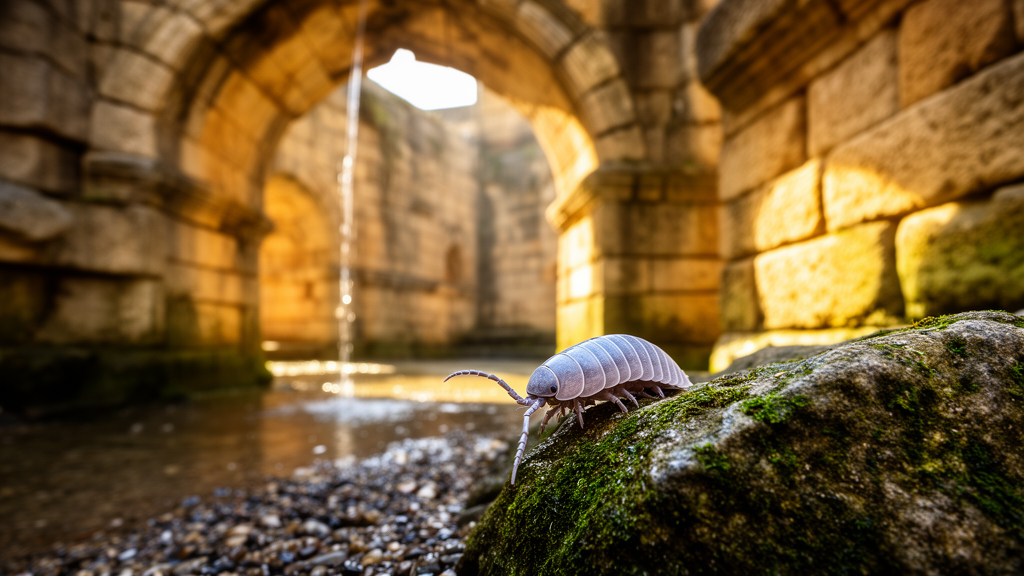
It is an engineered hydraulic system, confirmed by recent studies to date back possibly to the Roman Republican period, with major construction between the first and second centuries AD, the height of the Roman city then known as Carmo. The complex includes a main gallery or aqueduct stretching 880 meters, five forks and three short branches, all designed to intercept and store groundwater. The system maintained a permanent stream and was used until recent times to supply water to residents, orchards and hydraulic infrastructure.
It is precisely this kind of ancient, human-made, lightless environment that the new isopod calls home. According to the research team, the description of Baeticoniscus carmonaensis represents one of the few cases worldwide in which a new species has been formally described from a subterranean archaeological site. Underground ecosystems in general remain underrepresented in conservation policies, and those created by human activity are studied even less.
The authors point out that fauna exploiting abandoned or still-functioning human infrastructure is only now beginning to be properly understood, citing examples such as amphibians found in disused railway tunnels and drainage galleries, and even a cave beetle subspecies discovered exclusively in the dungeons of a castle in Brescia, Italy. Morphologically, the new species belongs to the family Trichoniscidae and, more specifically, to the subfamily Haplophthalminae, a group whose members are characterized by prominent tubercles on the body surface. Until this study, the genus Baeticoniscus contained only a single species, Baeticoniscus bullonorum, described in 2020 from Cueva de la Pileta in the province of Málaga.
The new species shares key features with its relative, including prominent cephalic tubercles, four longitudinal ribs arranged in two pairs on the first six pereonites, two central ribs on the seventh, a smooth pleon, and striations on the tip of the male's first pleopod, which together justify its placement in the genus. What sets Baeticoniscus carmonaensis apart is a combination of subtle but diagnostic traits. Its cephalon bears two elongated tubercles in the middle zone and four on the posterior edge, rather than the bilobed frontal tubercles seen in B. bullonorum, and it lacks lateral roughness.
The males' first pleopod ends in a hollow, striated conical point, while the second pleopod carries a very long endopod terminating in a single silk-like tip. These fine anatomical differences, examined under microscope and stereomicroscope and documented with detailed drawings, are what formally distinguish the species. The animals themselves are minute.
The largest male measured 2.5 millimeters and the largest female 2.7 millimeters, and the examined specimens are colorless apart from the dark ocellus. Fieldwork was conducted by hand, without traps, and specimens were preserved in 70 percent ethanol. Microscopic preparations used the synthetic resin DMHF, and the resulting illustrations were drawn with the help of free graphic software.
Type material, including the holotype and numerous paratypes, has been deposited in the isopod collection of the National Museum of Natural Sciences in Madrid, with additional specimens retained in a personal collection. Ecologically, the researchers' knowledge of the new species remains limited. The only known population was found in elevated areas of the gallery system, beyond the reach of floodwaters, and every specimen was discovered on or within pieces of rotten wood, likely debris that had fallen from wells connected to the underground galleries.
When the wood was handled, the isopods were observed moving and hiding in the crevices of the decomposing material. As part of the same study, the team recorded another isopod, Platyarthrus caudatus, in the Carmona galleries, marking the first citation of this species in the province of Seville. That species has a much wider Mediterranean distribution, known from Algeria, Tunisia, Spain, France, Italy and several Mediterranean islands.
Its presence alongside the new species underscores how subterranean urban environments can harbor both widespread and highly localized fauna within the same dark corridors. The conservation outlook for Baeticoniscus carmonaensis is uncertain but delicate. The species is known only from its type locality, and the total number of individuals observed during fieldwork did not exceed roughly 150 to 200.
The site remains well preserved because it receives no tourist visits, only occasional scientific entries, typically between zero and five per year. However, recent surveys have detected microplastics in the mine's water and sediments, suggesting a potential interaction with the species, and the authors warn that any contamination event or alteration of environmental conditions could severely affect the only known population. Archaeological activities or other environmental transformations pose similar risks, making increased human presence and habitat transformation the major threats.
The authors note that the description of a new species in an urbanized underground environment can help draw attention to often overlooked ecosystems, particularly in cities with archaeological sites, canals and tunnels. Growing research suggests cities can play a genuine role in nature conservation, sometimes serving as the main habitat for certain species. Future surveys in other underground environments across southern Spain, both artificial and natural, could reveal additional populations of the new isopod and inform conservation measures with more comprehensive knowledge.
Subject of Research: Discovery and morphological description of a new subterranean isopod species from a Roman-period aqueduct in Carmona, Spain
Article Title: Baeticoniscus carmonaensis sp. nov. a new Isopod found in an underground aqueduct from the Roman period located in Southwest Spain ( Crustacea , Isopoda , Trichoniscidae )
Article References: Cifuentes, J., Peña Pérez, E., & Luna, Á. (2025). Baeticoniscus carmonaensis sp. nov. a new Isopod found in an underground aqueduct from the Roman period located in Southwest Spain (Crustacea, Isopoda, Trichoniscidae). Subterranean Biology, 51, 135-146. https://doi.org/10.3897/subtbiol.51.139380
Image Credits: AI Generated
DOI: 10.3897/subtbiol.51.139380
Keywords: Baeticoniscus carmonaensis, isopod, Trichoniscidae, subterranean biology, Roman aqueduct, Carmona, Spain, new species, groundwater ecosystem, microplastics, urban biodiversity, conservation
Cite Scienmag News
Margaret Porter. (October 20, 2026). Roman-Era Aqueduct Hides a Brand-New Species of Woodlouse in Spain. Scienmag. https://scienmag.com/roman-era-aqueduct-hides-a-brand-new-species-of-woodlouse-in-spain/
Margaret Porter. "Roman-Era Aqueduct Hides a Brand-New Species of Woodlouse in Spain." Scienmag, 20 October 2026, https://scienmag.com/roman-era-aqueduct-hides-a-brand-new-species-of-woodlouse-in-spain/. Accessed 20 October 2026.
Margaret Porter. "Roman-Era Aqueduct Hides a Brand-New Species of Woodlouse in Spain." Scienmag. October 20, 2026. https://scienmag.com/roman-era-aqueduct-hides-a-brand-new-species-of-woodlouse-in-spain/


