


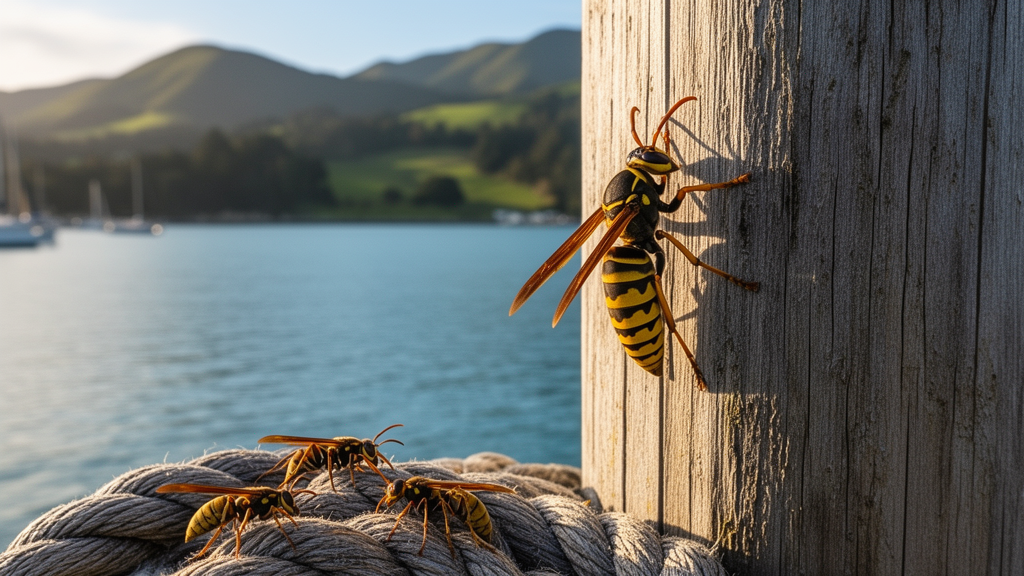
A literature-based inventory identifies 11 alien social wasp species recorded in the South Pacific, nine of which have become established in at least one country or territory within the study area. The review covers the oceanic islands of Melanesia and Polynesia south of the Equator, from the western limit near Papua New Guinea to Easter Island, and excludes Australia and Papua New Guinea. The compiled records include species-level and subspecies-level distribution and invasion information for wasps in the subfamilies Polistinae and Vespinae.
The authors developed the inventory through an exploratory search of Web of Science and Google Scholar, using taxonomic terms for social wasps alongside regional and country-specific terms. They then conducted targeted searches for first records, invasive ranges and other evidence concerning each candidate taxon and area. Records were checked against the Global Biodiversity Information Facility and comprehensive vespid checklists by Carpenter and Carpenter and Brown. The search included failed incursions because they provide information relevant to biosecurity and invasion history, but it excluded native South Pacific species and taxa whose arrival predated modern faunal records.
Eleven alien species in four genera were documented. Seven belong to Polistes in Polistinae, while the Vespinae records comprise one Dolichovespula species, one Vespa species and two Vespula species. At least four subspecies from two of the species were also represented. Established invaders occurred in nine countries or territories: the Cook Islands, Easter Island, French Polynesia, Fiji, New Caledonia, New Zealand, Niue, Samoa and Tonga. Most introductions were recorded during the 20th century, particularly its earlier decades. The exceptions included a 19th-century introduction and the newly detected Vespa velutina incursion in New Zealand in 2025.
New Zealand contained five established alien species and was the most extensively studied part of the inventory. Vespula germanica was first observed in 1922 but did not become established until 1945, after which it spread throughout the country. In beech forests, the invasive wasps have reached densities of up to 40 nests per hectare. Studies have documented predation on native arthropods and competition with native invertebrates and vertebrates for sugary food resources. A biological-control programme introduced the parasitoid Sphecophaga vesparum in the 1980s, but it did not significantly reduce wasp population densities. New Zealand regulators approved the predatory hoverfly Volucella inanis and parasitoid beetle Metoecus paradoxus for import and release in 2021, although they had not been widely released by the time of the review.
The other widespread Vespula species, V. vulgaris, was first reported in New Zealand in 1923 and was considered established by the late 1970s. It spread across the country by the late 1980s and early 1990s, with records particularly at elevations above 1,000 metres, where V. germanica was absent. Genetic analysis identified six haplotypes in New Zealand, suggesting multiple introductions and closer relationships to populations in Western Europe, Britain and Ireland. Polistes chinensis antennalis was first recorded in 1979 and subsequently expanded from northern and central parts of the North Island to the South Island and offshore islands. Molecular evidence indicated at least two introductions from distinct Japanese populations.
Diet studies in New Zealand found that native invertebrates could constitute up to 50% of the diet of P. chinensis antennalis. For P. dominula, molecular analysis of gut contents indicated that more than half of its diet consisted of native invertebrates. The species was first recorded at several South Island sites in 2016 and was already considered likely to have been present for several years. It was most abundant in northern areas of the South Island but was also recorded around Auckland. Historical observations from Fiji described P. olivaceus as both a predator of insects affecting sugarcane and a recurring source of stings to plantation labourers. That species has established across numerous Pacific locations, although it failed to establish after two specimens were found in Auckland in 1921.
The inventory’s newest record concerns Vespa velutina, probably the nigrithorax subspecies, detected in Auckland during the Austral spring of 2025. By December 2025, New Zealand’s Ministry of Primary Industries reported that more than 17 nests and 30 queens had been located and destroyed. The pathway into the country had not been established, although the discovery location near a major port was considered consistent with accidental transport on commercial vessels. The clustered nests were interpreted as probably representing the first generation after an undetected introduction during the 2024–2025 warm season. New Zealand was conducting an eradication campaign with assistance from European experts, and the species was not yet considered established in the country.
European research cited in the review found that commercial western honeybee hives could make up more than 30% of the diet of V. velutina colonies. The authors noted that New Zealand’s temperate conditions and substantial apicultural industry resemble conditions in the species’ invaded range in Western Europe, but establishment was a possibility rather than an observed outcome. For V. velutina in Europe, the proposed introduction pathway was accidental maritime transport in imported pottery from China around the early 2000s. The New Zealand entry pathway remained unknown, and the review did not report a measured effect on honeybee colonies or beekeeping in New Zealand.
The authors identified substantial limitations in the available evidence, including patchy historical records, a concentration of research in New Zealand, possible underreporting and confusion with similar species, and sparse information about introduction pathways. The inventory therefore provides a baseline rather than a complete account of South Pacific wasp invasions. It also notes that the fossil record is limited and that the origins of some populations may be impossible to determine. Although the source discusses border biosecurity, early detection and biological control as management approaches, its central contribution is the consolidation of documented records into a geographically and historically organized resource for conservation, management and biosecurity.
Subject of Research: A review of invasive social wasp records and establishment histories across South Pacific islands
Article Title: Annotated inventory of invasive social wasps ( Hymenoptera , Vespidae ) in the South Pacific, excluding Australia and Papua New Guinea
Article References: Detoni, M., Hayes, L., & Brown, R. L. (2026). Annotated inventory of invasive social wasps (Hymenoptera, Vespidae) in the South Pacific, excluding Australia and Papua New Guinea. NeoBiota, 106, 1-27. https://doi.org/10.3897/neobiota.106.160421
Image Credits: AI Generated
DOI: 10.3897/neobiota.106.160421
Keywords: invasive species, social wasps, Vespidae, South Pacific, New Zealand, Vespa velutina, Vespula, Polistes, biosecurity, literature inventory, Annotated, inventory
Cite Scienmag News
Patricia Pace. (October 20, 2026). Review documents 11 invasive social wasp species across the South Pacific. Scienmag. https://scienmag.com/review-documents-11-invasive-social-wasp-species-across-the-south-pacific/
Patricia Pace. "Review documents 11 invasive social wasp species across the South Pacific." Scienmag, 20 October 2026, https://scienmag.com/review-documents-11-invasive-social-wasp-species-across-the-south-pacific/. Accessed 20 October 2026.
Patricia Pace. "Review documents 11 invasive social wasp species across the South Pacific." Scienmag. October 20, 2026. https://scienmag.com/review-documents-11-invasive-social-wasp-species-across-the-south-pacific/


