


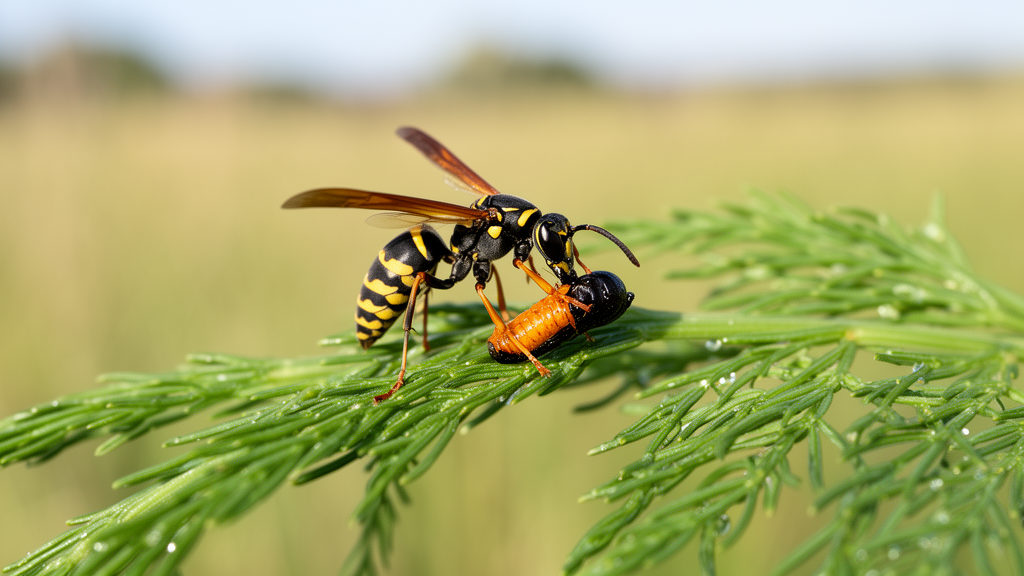
A taxonomic and molecular study of parasitoid wasps reared from a chrysomelid beetle in Uttar Pradesh, India, describes the new species Lemophagus larvivorus and reports the first recorded occurrence of the genus Lemophagus in India. The wasp was reared from larvae of Crioceris nigroornata Clarke, 1866, and was recorded as the predominant parasitoid of the beetle during the October 2020 survey.
The researchers collected larvae of C. nigroornata feeding on Asparagus racemosus at Lucknow, Uttar Pradesh, India, at 26°53’38″N, 80°59’2″E and 120 m above sea level. The sampling took place in October 2020 and involved 80 larvae collected at a rate of 20 per week for four consecutive weeks during a survey of insect pests of A. racemosus. Larvae and portions of the host plant were held individually in rearing cages under laboratory conditions of 25 ± 5 °C, 65 ± 5% relative humidity and a 12-hour light:12-hour dark photoperiod. Fresh shoots were supplied regularly until parasitoids or adult beetles emerged.
Specimens were examined morphologically, illustrated with a Keyence VHX-6000 digital microscope and compared with the known species of Lemophagus. The female holotype measured 4.4 mm in body length and had a fore wing 2.9 mm long. The holotype was deposited in the National Zoological Collections of the Zoological Survey of India, Western Ghats Regional Centre, Kozhikode, Kerala, under specimen number ZSI/WGRC/I.R.-INV.28945. Paratypes were deposited in the Department of Zoology at the University of Calicut, Malappuram, Kerala.
The species diagnosis combines a rugose-punctate face with longitudinal striae, a punctate clypeus, a rugose malar space, and an occipital carina that joins the hypostomal carina at the base of the mandible. Other distinguishing features include transverse striations associated with the mid-longitudinal carina of the frons, a coriaceous mesopleural speculum, transverse striations on the posterior mesoscutum and a distinct small glymma on the first metasomal tergite. The ovipositor has a dorsal notch positioned well away from the apex, identified in the study as characteristic of the genus.
Morphological comparisons placed L. larvivorus close to L. curtus. The new species differs from L. curtus in having a distinct small glymma on the first metasomal tergite, the occipital carina joining the hypostomal carina at the base of the mandible, transverse striations on the frons, a coriaceous rather than smooth and shiny speculum, and transverse posterior striation rather than uniformly rugose-punctate sculpture on the mesoscutum. The authors also compared it with L. pulcher, L. japonicus and L. nanus.
For molecular analysis, one female of the new species was barcoded using a 657-base-pair cytochrome c oxidase I fragment and a 660-base-pair fragment of the 28S ribosomal RNA D2–D3 expansion region. Representative sequences of four previously described Lemophagus species were obtained from BOLD or GenBank, and an Olesicampe sequence was used as the outgroup. A concatenated 1,317-base-pair dataset was analyzed by maximum likelihood in IQ-TREE v2.1.3, with 1,000 ultrafast bootstrap replicates used to assess branch support.
The maximum-likelihood analysis recovered L. larvivorus as a distinct lineage with 95% ultrafast rapid bootstrap support. It was recovered as a close relative of L. curtus, with those two species forming a clade separate from L. pulcher, L. errabundus and L. crioceritor. The molecular dataset included the new species and four of the ten described species in the genus, so it did not include every known member of Lemophagus.
During the October sampling period, L. larvivorus was the predominant parasitoid recorded from C. nigroornata, with a mean parasitism rate of 12.5%. An unidentified tachinid fly was also recovered, contributing a mean parasitism rate of 5.0%. The host record adds C. nigroornata to the known host associations of Lemophagus and documents a parasitoid associated with an asparagus-feeding beetle in India.
The study was taxonomic and observational, based on reared specimens from one locality, a four-week sampling period and molecular sequences available for only part of the genus. It did not test biological-control performance, host specificity under controlled conditions or effects on crop yields. The authors note that most host-association information for Lemophagus comes from the Palaearctic and that India’s campoplegine fauna remains understudied, with 192 species in 21 genera previously reported. They describe the new host record as contributing to knowledge of natural-enemy dynamics and as increasing the possibility of evaluating the parasitoid for biological control of asparagus beetles.
Subject of Research: Taxonomic and molecular description of a new larval parasitoid wasp associated with Crioceris nigroornata in Uttar Pradesh, India
Article Title: New species of Lemophagus Townes, 1965 ( Hymenoptera , Ichneumonidae , Campopleginae ) from India reared as a larval parasitoid of Crioceris nigroornata Clarke, 1866 ( Coleoptera , Chrysomelidae )
Article References: Ranjith, A. P., & Kedar, S. C. (2025). New species of Lemophagus Townes, 1965 (Hymenoptera, Ichneumonidae, Campopleginae) from India reared as a larval parasitoid of Crioceris nigroornata Clarke, 1866 (Coleoptera, Chrysomelidae). Journal of Hymenoptera Research, 98, 743-755. https://doi.org/10.3897/jhr.98.154760
Image Credits: AI Generated
Keywords: Lemophagus, L. larvivorus, new species, Ichneumonidae, parasitoid wasp, Crioceris nigroornata, Asparagus racemosus, India, molecular phylogeny, taxonomy, species, Townes
Cite Scienmag News
Gavin Prescott. (October 20, 2026). Indian taxonomic study describes new larval parasitoid wasp and first record of Lemophagus. Scienmag. https://scienmag.com/indian-taxonomic-study-describes-new-larval-parasitoid-wasp-and-first-record-of-lemophagus/
Gavin Prescott. "Indian taxonomic study describes new larval parasitoid wasp and first record of Lemophagus." Scienmag, 20 October 2026, https://scienmag.com/indian-taxonomic-study-describes-new-larval-parasitoid-wasp-and-first-record-of-lemophagus/. Accessed 20 October 2026.
Gavin Prescott. "Indian taxonomic study describes new larval parasitoid wasp and first record of Lemophagus." Scienmag. October 20, 2026. https://scienmag.com/indian-taxonomic-study-describes-new-larval-parasitoid-wasp-and-first-record-of-lemophagus/


