


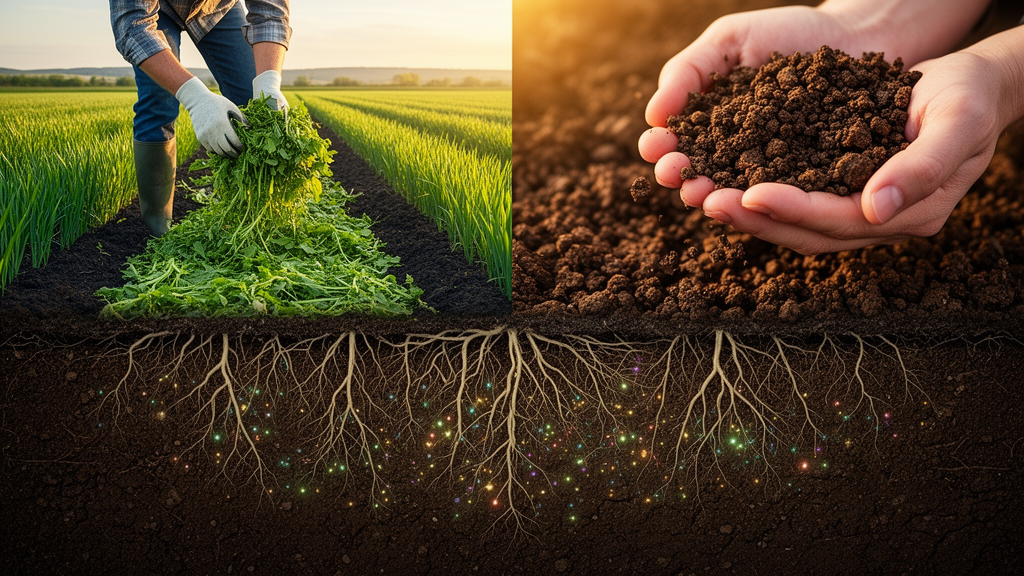
A 2023 field trial in Bulgaria found that fertiliser inputs and the preceding cropping system were associated with distinct bacterial communities in the rhizosphere of fodder winter barley. The study examined whether an oat–vetch intercrop incorporated as green manure left a detectable microbial legacy after barley was sown, and whether that legacy varied with mineral fertiliser, vermicompost, combined mineral fertiliser and vermicompost, or biochar.
The experiment was conducted at the Training and Experimental Station of the Agricultural University of Plovdiv in southern Bulgaria. The site had a Mollic Fluvisol with an initial total organic carbon content of 1.14%, a slightly alkaline pH of 8.22, low available nitrogen, and comparatively high phosphorus and potassium. Thirty barley plots were arranged in a randomised complete block design, with three replicates per treatment.
In spring 2022, the researchers established two prior cropping systems: monocultured oats and an intercrop of oats and common vetch sown at a 3:1 vetch-to-oats ratio, for a total of 220 kg/ha. Oat monoculture biomass was harvested, while the oat–vetch biomass was ploughed into the soil as green manure to a depth of 30 cm. Winter barley was then planted in November 2022. Each cropping system received an unfertilised control, mineral NPK fertiliser at 100 kg/ha, vermicompost at 12 t/ha, half-rate mineral fertiliser plus vermicompost, or biochar at 10 t/ha.
Rhizosphere soil was collected from randomly selected barley plants at ripening in 2023. Samples were kept on ice during transport, sieved to 2 mm and stored at –80 °C before DNA extraction. The authors used 16S rRNA gene amplicon sequencing and bioinformatic analysis of ten samples. Reads underwent quality control, merging and chimera removal before inference of amplicon sequence variants and taxonomic assignment against SILVA v138. Sequencing quality was high: all samples exceeded 98% at Q20 and 95% at Q30, while Good’s coverage ranged from 0.998 to 1.000.
Proteobacteria, Actinobacteriota and Acidobacteriota dominated at the phylum level across the treatments. Vermicompost and combined mineral–vermicompost treatments had relatively elevated Actinobacteriota and Bacteroidota, while mineral-fertilised and unfertilised soils had relatively higher Acidobacteriota proportions. Biochar produced a comparatively distinct profile, including slightly higher Verrucomicrobiota and Chloroflexi. At genus level, Sphingomonas was consistently prominent, while green-manure and organic-amendment treatments showed enrichment of genera including Nocardioides, Agromyces, Rubrobacter, Solirubrobacter and Noviherspirillum.
Alpha-diversity measurements also varied among treatments. VC2, grown without green manure and treated with vermicompost, recorded the highest Chao1 richness at 2,868.429, narrowly ahead of VC1, which followed the oat–vetch green manure, at 2,864.731. VC2 also had the highest Shannon index at 10.572 and a Pielou evenness of 0.921. By comparison, the combined mineral–vermicompost treatments had lower richness values of 2,406.176 for MF1.VC1 and 2,379.850 for MF2.VC2, while Bch2 recorded 2,315.000. A treatment-comparison analysis identified 363 taxa shared across treatments. The largest numbers of treatment-specific taxa occurred in VC2, with 837, and VC1, with 779.
Community-composition analyses indicated that individual treatments occupied different positions in PCA and PCoA space. Bch1, VC2 and the MF2.VC2 treatment were relatively separated from several other groups, whereas Control1, MF1 and VC1 clustered more closely. Pairwise Bray–Curtis and UniFrac distances were also greatest for comparisons involving Bch2. These ordination and distance results show differences in the observed bacterial assemblages among treatments; the supplied results do not report the outcomes of the planned ANOSIM or PERMANOVA group comparisons.
The findings associate the preceding oat–vetch green manure with a legacy in the barley rhizosphere bacterial community. The study’s authors interpret the enrichment of degradative and nitrogen-cycling taxa under green manure and organic-input treatments as evidence that these practices may support broader microbial diversity and potential functional redundancy. They also report that mineral fertiliser alone was associated with comparatively lower diversity in some comparisons. These functional interpretations remain indirect because the analysis was based on bacterial community composition and inferred ecological roles rather than direct measurements of nutrient turnover, disease suppression or barley growth.
The experiment has several bounded limitations. It was conducted at one Bulgarian field site over a two-year rotation, with 16S data from ten samples representing the broader set of 30 plots, and it examined bacteria rather than fungi, protozoa or the complete soil food web. The study therefore shows treatment-associated shifts in the barley rhizosphere bacteriome, not demonstrated improvements in crop yield, soil fertility or farm performance. The authors note that broader metagenomic work incorporating fungal and protozoan contributions would be needed to assess the wider microbial community.
Subject of Research: A 2023 Bulgarian field study of how fertilisation and an oat–vetch green-manure legacy affected winter barley rhizosphere bacterial communities.
Article Title: Barley Rhizosphere Bacteriome Dynamics under Organic and Mineral Inputs: The importance of intercropping predecessor
Article References: Shilev, S., Petkova, M., Popova, V., Neykova, I., & Rangelov, I. (2025). Barley Rhizosphere Bacteriome Dynamics under Organic and Mineral Inputs: The importance of intercropping predecessor. Metabarcoding and Metagenomics, 9, Article e167231. https://doi.org/10.3897/mbmg.9.167231
Image Credits: AI Generated
Keywords: barley rhizosphere, bacterial communities, 16S rRNA sequencing, oat–vetch intercropping, green manure, vermicompost, biochar, mineral fertiliser, soil microbiome, field experiment, Barley, Rhizosphere
Cite Scienmag News
Alan Morgan. (October 20, 2026). Barley Rhizosphere Bacteriome Dynamics under Organic and Mineral Inputs: The importance of intercropping predecessor. Scienmag. https://scienmag.com/barley-rhizosphere-bacteriome-dynamics-under-organic-and-mineral-inputs-the-importance-of-intercropping-predecessor/
Alan Morgan. "Barley Rhizosphere Bacteriome Dynamics under Organic and Mineral Inputs: The importance of intercropping predecessor." Scienmag, 20 October 2026, https://scienmag.com/barley-rhizosphere-bacteriome-dynamics-under-organic-and-mineral-inputs-the-importance-of-intercropping-predecessor/. Accessed 20 October 2026.
Alan Morgan. "Barley Rhizosphere Bacteriome Dynamics under Organic and Mineral Inputs: The importance of intercropping predecessor." Scienmag. October 20, 2026. https://scienmag.com/barley-rhizosphere-bacteriome-dynamics-under-organic-and-mineral-inputs-the-importance-of-intercropping-predecessor/


