

Tuesday, October 20, 2026
Science
No Result
View All Result
  • Login
  • HOME
  • SCIENCE NEWS
  • CONTACT US
  • HOME
  • SCIENCE NEWS
  • CONTACT US
No Result
View All Result
Scienmag
No Result
View All Result
Home Science News Science Education

Baseline preparedness and evaluation of a blended disaster medicine course among medical students at Yarmouk University, Jordan

October 20, 2026
in Science Education
Courtney Benton
By Courtney Benton Scienmag Editorial Profile - Science and Technology Policy
Reading Time: 2 mins read
0
Medical Students in Jordan Are Eager for Disaster Duty but Feel Unprepared, Course Shows

Medical Students in Jordan Are Eager for Disaster Duty but Feel Unprepared, Course Shows

65
SHARES
587
VIEWS
Share on FacebookShare on Twitter
ADVERTISEMENT

Medical students at Yarmouk University in Jordan showed high willingness to participate in disaster response but reported limited perceived competence, according to the abstract of a two-stage study. In the baseline survey, 298 fifth- and sixth-year students assessed their preparedness, previous disaster-related training, willingness to respond, perceived competence, and future training needs for wars, pandemics, and earthquakes. Most were willing to respond to wars (82.2%), pandemics (77.6%), and earthquakes (79.9%), while fewer considered themselves competent in those scenarios: 38.2%, 43.2%, and 24.2%, respectively.

The study then assessed a blended disaster medicine course combining online theoretical instruction with face-to-face practical training. Forty-nine students completed the course and submitted module-specific usefulness ratings, while 37 also completed a comprehensive post-course evaluation that included retrospective pre- and post-course self-ratings of knowledge. This was a cross-sectional survey followed by an educational intervention, not a randomized or controlled trial. The analyses included descriptive statistics, Pearson’s chi-square test, paired-samples t test, Wilcoxon signed-rank test, and the Friedman test.

Among the 37 students who completed the comprehensive evaluation, mean self-reported knowledge rose from 1.46 ± 0.80 before the course to 3.97 ± 0.64 afterward, a statistically significant difference reported as p < 0.001. Because these were retrospective self-ratings, the abstract describes the change as an association with course participation rather than a controlled demonstration of educational effectiveness. Baseline analyses also found that sixth-year students reported higher perceived competence in war-related disaster management than fifth-year students (p = 0.010), while female students reported higher earthquake-related competence than male students (p = 0.036).

Course modules differed significantly in perceived usefulness (p < 0.001). Case-based learning, disaster triage, CBRN and personal protective equipment, and disaster medical care received the highest usefulness ratings. The abstract concludes that the findings support the feasibility and acceptability of structured disaster-medicine education in the undergraduate curriculum, while controlled studies are needed to evaluate its effectiveness. The supplied evidence reports preparedness, willingness, retrospective self-rated knowledge, and course evaluations among participating students; it does not establish clinical performance or patient outcomes.

Subject of Research: Evaluation of a blended disaster medicine course and baseline preparedness among medical students in Jordan

Article Title: Baseline preparedness and evaluation of a blended disaster medicine course among medical students at Yarmouk University, Jordan

Article References: Albeitawi, S., Issa, F., & Al-lawama, M. (2026). Baseline preparedness and evaluation of a blended disaster medicine course among medical students at Yarmouk University, Jordan. BMC Medical Education. https://doi.org/10.1186/s12909-026-10451-z

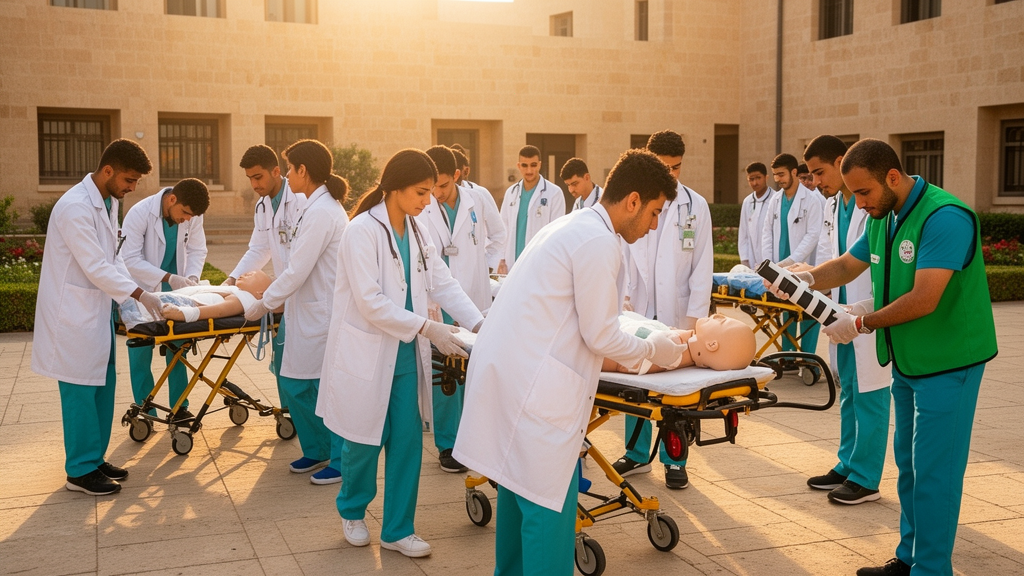
Image Credits: AI Generated

DOI: 10.1186/s12909-026-10451-z

Keywords: medical education, disaster medicine, blended learning, student preparedness, disaster response, medical triage, CBRN training, Yarmouk University, Jordan, Baseline, preparedness, evaluation

Cite Scienmag News

Courtney Benton. (October 20, 2026). Baseline preparedness and evaluation of a blended disaster medicine course among medical students at Yarmouk University, Jordan. Scienmag. https://scienmag.com/baseline-preparedness-and-evaluation-of-a-blended-disaster-medicine-course-among-medical-students-at-yarmouk-university-jordan/


Courtney Benton. "Baseline preparedness and evaluation of a blended disaster medicine course among medical students at Yarmouk University, Jordan." Scienmag, 20 October 2026, https://scienmag.com/baseline-preparedness-and-evaluation-of-a-blended-disaster-medicine-course-among-medical-students-at-yarmouk-university-jordan/. Accessed 20 October 2026.

Courtney Benton. "Baseline preparedness and evaluation of a blended disaster medicine course among medical students at Yarmouk University, Jordan." Scienmag. October 20, 2026. https://scienmag.com/baseline-preparedness-and-evaluation-of-a-blended-disaster-medicine-course-among-medical-students-at-yarmouk-university-jordan/

Tags: baselineblended disaster response trainingblended learningCBRN trainingdisaster medicinedisaster medicine educationdisaster responsedisaster response willingness among medical studentseducational intervention in disaster medicineevaluationevaluation of disaster medicine curriculumimpact of disaster medicine trainingJordanJordan medical educationMedical Educationmedical student disaster preparednessmedical triageonline and face-to-face disaster medicine coursepandemic and earthquake disaster trainingpreparednessretrospective self-evaluation of disaster knowledgeself-assessed disaster response competencestudent preparednessYarmouk University
Share26Tweet16
Previous Post

Integrative revision splits Malayan dwarf toad into two species, including golden-crested toad from Thailand

Next Post

Computational study finds rock availability and collection effort do not fully explain plesiosaur diversity patterns

Related Posts

Qualitative Tehran study links anatomy curriculum perceptions to specialty alignment and safety
Science Education

Qualitative Tehran study links anatomy curriculum perceptions to specialty alignment and safety

October 20, 2026
Real-Time Analytics, Not Raw Data, Drives Adaptive Digital Assessment, Study Finds
Science Education

Indian practitioner survey links real-time analytics to stronger adaptive digital assessment practices

October 20, 2026
Surgical Rotations Lag Behind Medicine in Uganda’s Intern Learning Environments
Science Education

Cross-sectional survey finds lower learning-environment scores among Ugandan medical interns in surgery

October 20, 2026
Teacher Training for Democracy Works in Classrooms, but Schools Themselves Rarely Change, Review Finds
Science Education

Scoping review finds stronger evidence for democratic teacher practice than sustained institutional reform

October 20, 2026
Micro-Learning Modules Boost Knowledge Retention and Clinical Decision-Making Among Physiotherapists
Science Education

Saudi physiotherapists report favorable perceptions of micro-learning in cross-sectional survey

October 20, 2026
AI in the Classroom: Where a Teacher Trains May Decide Who Gets Left Behind
Science Education

Small qualitative study finds South African trainee life sciences teachers’ AI readiness varies with school resources and equity concerns

October 20, 2026
Next Post
Where Hidden Plesiosaurs Wait: New Study Maps the Fossil Record’s Blind Spots

Computational study finds rock availability and collection effort do not fully explain plesiosaur diversity patterns

  • Mothers who receive childcare support from maternal grandparents show more optimized

    Mothers who receive childcare support from maternal grandparents show more parental warmth, finds NTU Singapore study

    27656 shares
    Share 11059 Tweet 6912
  • University of Seville Breaks 120-Year-Old Mystery, Revises a Key Einstein Concept

    1061 shares
    Share 424 Tweet 265
  • Bee body mass, pathogens and local climate influence heat tolerance

    682 shares
    Share 273 Tweet 171
  • Researchers record first-ever images and data of a shark experiencing a boat strike

    546 shares
    Share 218 Tweet 137
  • Groundbreaking Clinical Trial Reveals Lubiprostone Enhances Kidney Function

    531 shares
    Share 212 Tweet 133
Science

Embark on a thrilling journey of discovery with Scienmag.com—your ultimate source for cutting-edge breakthroughs. Immerse yourself in a world where curiosity knows no limits and tomorrow’s possibilities become today’s reality!

RECENT NEWS

  • Computational study finds rock availability and collection effort do not fully explain plesiosaur diversity patterns
  • Baseline preparedness and evaluation of a blended disaster medicine course among medical students at Yarmouk University, Jordan
  • Integrative revision splits Malayan dwarf toad into two species, including golden-crested toad from Thailand
  • Field study finds a vast mixed-species spider colony sustained by a sulfidic cave food web

Categories

  • Agriculture
  • Anthropology
  • Archaeology
  • Athmospheric
  • Biology
  • Biotechnology
  • Blog
  • Bussines
  • Cancer
  • Chemistry
  • Climate
  • Earth Science
  • Editorial Policy
  • Marine
  • Mathematics
  • Medicine
  • Pediatry
  • Policy
  • Psychology & Psychiatry
  • Science Education
  • Science News
  • Social Science
  • Space
  • Technology and Engineering

Subscribe to Blog via Email

Enter your email address to subscribe to this blog and receive notifications of new posts by email.

Join 5,150 other subscribers

© 2025 Scienmag - Science Magazine

Welcome Back!

Login to your account below

Forgotten Password?

Retrieve your password

Please enter your username or email address to reset your password.

Log In
No Result
View All Result
  • HOME
  • SCIENCE NEWS
  • CONTACT US

© 2025 Scienmag - Science Magazine

Discover more from Science

Subscribe now to keep reading and get access to the full archive.

Continue reading