


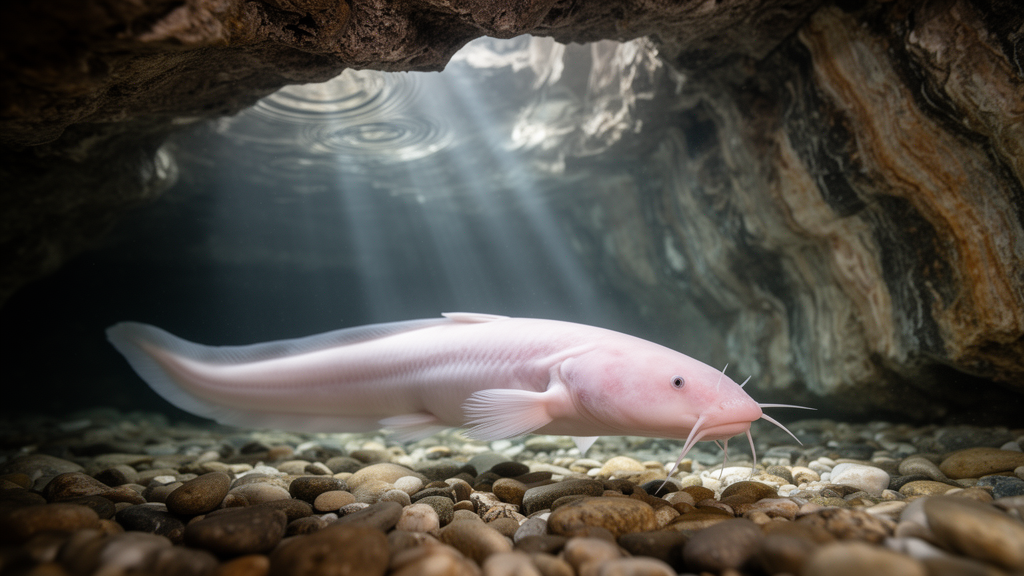
A comparative animal study of four Brazilian Copionodontinae catfish found that eye and barbel measurements varied with both genus and habitat, while brain measurements differed among the three species examined. The cave-restricted Glaphyropoma spinosum had a relatively longer telencephalon than the two Copionodon species studied, but the unbalanced sampling did not allow the researchers to separate effects associated with subterranean habitat from those associated with taxonomy.
Copionodontinae is a subfamily of Trichomycteridae endemic to the Chapada Diamantina karst area of Bahia, Brazil. The four species analyzed were the troglobitic G. spinosum, its epigean congener G. rodriguesi, and the epigean Copionodon pecten and C. lianae. They occur in the upper Rio Paraguaçu basin, where fast-flowing streams run over rocky bottoms and become interrupted into isolated pools during the dry season.
Researchers examined 14 G. spinosum specimens, three G. rodriguesi, 11 C. pecten and 10 C. lianae. An additional C. pecten paratype was examined only for laterosensory canals. Eye diameter, head measurements and the lengths of nasal and maxillary barbels were recorded with a digital caliper, while cleared-and-stained specimens were used to document cephalic laterosensory canals and pores.
Brain morphometry was conducted on five specimens each of G. spinosum, C. pecten and C. lianae. The rare G. rodriguesi specimens were not accessed for this part of the study, so the species was excluded from the brain comparison. Statistical analysis used permutational multivariate analysis of variance based on Euclidean distances, with external measurements standardized by head length and brain measurements standardized by brain length. The models included genus, habitat and their interaction, with significance assessed through 999 permutations; non-metric multidimensional scaling was used to visualize relationships among species.
Eye and barbel traits differed significantly across the sampled groups. The combined genus-by-habitat model was significant (Pseudo-F(2,35) = 20.89, p < 0.0001). When analyzed independently, genus accounted for 54% of the variation (Pseudo-F(1,36) = 42.24, p < 0.001), and habitat accounted for 37% (Pseudo-F(1,36) = 21.55, p < 0.001). The authors stated that this partial overlap was consistent with the correlation between taxonomic identity and habitat specialization in the sampled species.
Both Glaphyropoma species had longer barbels and larger heads than the two examined Copionodon species. The left nasal barbel of G. rodriguesi reached 201.4% of head length, compared with a maximum of 59.6% in C. pecten. Eyes were reduced or asymmetric in both Glaphyropoma species, and some G. rodriguesi specimens lacked one eye. The authors hypothesized that this condition might be a genus-level characteristic that favored the colonization of subterranean habitats by G. spinosum, but the available comparison could not test that interpretation independently of habitat.
All four species showed a tendency toward absence of cephalic laterosensory canals, and pore asymmetry occurred in every specimen examined. Nevertheless, the comparative analysis did not find significant differences among the species in canal presence or pore count per canal. Although canal absence has been described as a troglomorphic condition in subterranean fishes, its occurrence in the epigean species prevented the researchers from attributing it solely to cave habitat.
Brain volumes differed significantly among G. spinosum, C. pecten and C. lianae, with the model explaining approximately 32% of the total variation (Pseudo-F(2,12) = 2.80, p < 0.05). Relative telencephalon length was the principal feature distinguishing G. spinosum from the Copionodon species, and the cave-restricted fish also had greater telencephalon volume. No significant difference was detected in the mesencephalon. Because the brain comparison included no hypogean Copionodon and excluded G. rodriguesi, the researchers could not determine whether these differences reflected habitat specialization, taxonomic identity or both.
Earlier behavioral work provided context but was not part of the present measurement study. Behavioral studies of three species reported that G. spinosum was more photophobic and cryptobiotic than C. pecten and C. orthiocarinatus. A later study described highly aggressive behavior in G. spinosum, including multiple aggressive components, whereas C. pecten was less aggressive, more tolerant of conspecifics and less territorially intolerant. The morphometric study did not directly test whether particular brain dimensions or sensory structures accounted for those behavioral differences. Its central limitation was the partial overlap between habitat and taxonomy: G. spinosum was the only troglobitic species analyzed, no hypogean Copionodon was included, and G. rodriguesi was absent from the brain analysis. The results therefore document associated differences in sensory and brain morphology, without establishing whether they arose primarily from subterranean life, shared taxonomic traits or a combination of the two.
Subject of Research: Comparative morphology of sensory structures and brains in Brazilian cave and surface Copionodontinae catfish
Article Title: The influence of subterranean habitats in the sensorial and brain morphology of hypogean and epigean Copionodontinae catfish ( Siluriformes , Trichomycteridae )
Article References: Rodovanski, T., Bichuette, M. E., Cetra, M., & Mattox, G. M. T. (2026). The influence of subterranean habitats in the sensorial and brain morphology of hypogean and epigean Copionodontinae catfish (Siluriformes, Trichomycteridae). Subterranean Biology, 55, 27-42. https://doi.org/10.3897/subtbiol.55.175751
Image Credits: AI Generated
DOI: 10.3897/subtbiol.55.175751
Keywords: Copionodontinae, cave catfish, troglomorphosis, sensory morphology, brain morphometry, Glaphyropoma, Copionodon, subterranean habitat, comparative study, Brazil, influence, subterranean
Cite Scienmag News
Cassandra Pierce. (October 20, 2026). Comparative animal study links sensory and brain traits of Brazilian cave catfish to genus and habitat. Scienmag. https://scienmag.com/comparative-animal-study-links-sensory-and-brain-traits-of-brazilian-cave-catfish-to-genus-and-habitat/
Cassandra Pierce. "Comparative animal study links sensory and brain traits of Brazilian cave catfish to genus and habitat." Scienmag, 20 October 2026, https://scienmag.com/comparative-animal-study-links-sensory-and-brain-traits-of-brazilian-cave-catfish-to-genus-and-habitat/. Accessed 20 October 2026.
Cassandra Pierce. "Comparative animal study links sensory and brain traits of Brazilian cave catfish to genus and habitat." Scienmag. October 20, 2026. https://scienmag.com/comparative-animal-study-links-sensory-and-brain-traits-of-brazilian-cave-catfish-to-genus-and-habitat/


