


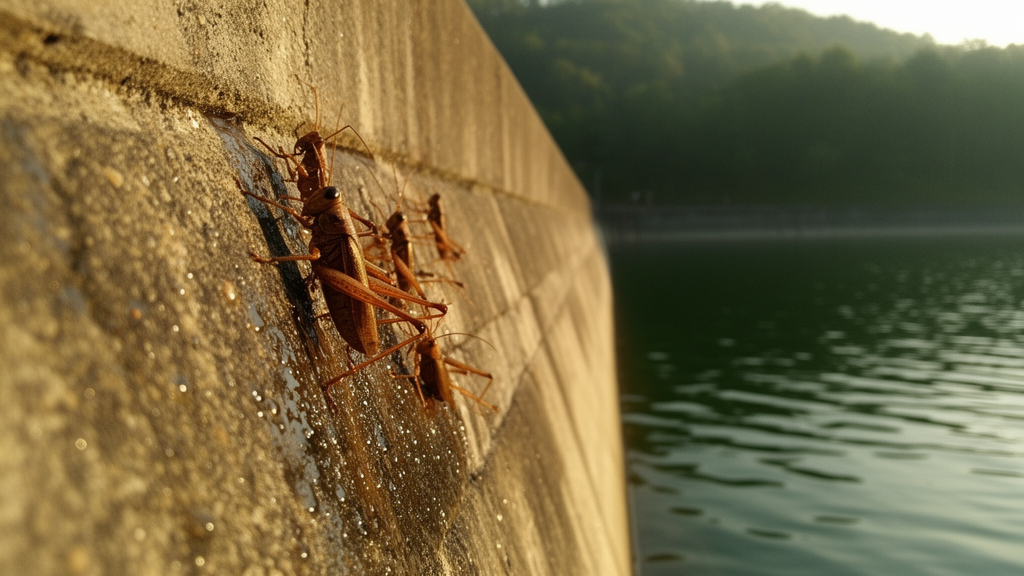
Emma field crickets (Teleogryllus emma) living on the seasonally submerged slopes of the Oishi Dam reservoir in Niigata, Japan, were significantly smaller than those collected from nearby grasslands, according to a field and laboratory study of the insect. The researchers found evidence that environmental conditions, including delayed hatching, daylength, temperature and nymphal crowding, contribute to the size reduction, while differences in development under controlled conditions suggest possible genetic differentiation that the study could not directly confirm.
The reservoir slopes are generally exposed from late June or mid-June to early or mid-October, providing a growing period approximately one month shorter than in surrounding areas. Emma field crickets overwinter as eggs and hatch after the slopes emerge from seasonal submergence. On the exposed slopes, nymphs in early August were at earlier developmental stages than those collected from nearby sites, while adults later collected from the reservoir had a mean head width of 4.8 ± 0.4 mm, compared with 6.1 ± 0.3 mm at Sekikawa, about 7 km away.
The study combined geographic sampling, multi-year collection, laboratory rearing and comparisons of temperature, photoperiod and rearing density. Populations sampled from Saga at 33.2°N to Hirosaki at 40.6°N showed a body-size cline opposite to Bergmann’s rule: head width and hind-femur length were negatively correlated with latitude in both sexes, so adults generally became smaller toward the north. Nymphs from the reservoir slopes and Sekikawa were also reared under photoperiods from 11 hours light to 16 hours light, while separate experiments tested temperatures of 30°C and 35°C and densities ranging from individual rearing to groups of 1,000.
When reservoir-slope nymphs collected in summer 2013 were reared to adulthood at 30°C under a 14-hour light and 10-hour dark cycle, their mean head width was 5.9 ± 0.4 mm, close to the 6.1 ± 0.3 mm recorded for Sekikawa crickets under the same conditions, although the difference remained statistically significant. Their longer laboratory development period, an average of 24.8 days compared with 13.4 days for Sekikawa nymphs collected at later instars, allowed much of the field size difference to narrow. The comparison supports an environmental contribution to size but does not establish that habitat conditions explain all of the difference observed in the field.
Temperature and crowding also affected experimental body size. Reservoir-slope nymphs reared in groups at 35°C had smaller head widths and hind femora than those reared at 30°C, with the head-width difference only marginally significant. Nymphs kept in groups of 100 produced significantly smaller adults than those reared singly or in pairs. Moving nymphs from groups of 100 to groups of 25 after six weeks removed the size reduction, indicating that crowding late in development had a greater effect than early crowding. In a separate Tsukuba experiment, groups of 1,000 produced smaller adults and delayed development compared with groups of 50 or 100.
Photoperiod experiments showed that both reservoir-slope and Sekikawa crickets developed more rapidly under shorter daylengths. Reservoir-slope nymphs generally developed faster than Sekikawa nymphs across the tested photoperiods, with small but sometimes significant differences in adult head width. Across the photoperiod treatments, longer nymphal development was strongly associated with larger adults (r = 0.75, P < 0.0001). Because reservoir-slope crickets hatch about a month later, they encounter a shorter developmental window, a mechanism consistent with reduced adult size.
The possibility of genetic differentiation remains. Prior work found shorter egg periods in reservoir-slope crickets, and the present study observed persistent differences in development speed and some head-width differences under common laboratory conditions. These findings are compatible with heritable population differences, but the researchers did not directly measure genetic variation. The absence of a geographical barrier and the frequent attraction of T. emma adults to light traps also suggest that gene flow from nearby populations may limit or slow divergence. The authors therefore described the reservoir population as showing possible early signs of speciation rather than a confirmed evolutionary split.
Annual measurements added uncertainty to the picture. Reservoir-slope adults were consistently smaller than Sekikawa adults, but their mean size fluctuated among sampling years, whereas Sekikawa body size remained comparatively stable. The study did not formally quantify the relationship between reservoir-slope cricket density and adult size, so density remains a possible contributor rather than a demonstrated explanation. Meteorological conditions also failed to explain the year-to-year pattern: growing-season temperature and sunshine hours did not vary significantly among the relevant reservoir years. In Tsukuba, adult size fluctuated from 2012 to 2024 without a significant relationship to growing-season temperature.
Long-term comparisons showed little change in a separate geographic population. An equation based on samples collected in Tsukuba from 1959 to 1964 estimated female head width at 6.6 mm, compared with a recent mean of 6.5 mm among 506 females collected 53 to 60 years later, despite an estimated 2.5°C increase in annual mean temperature. The authors said stabilizing selection or genetic constraints might buffer this univoltine species against environmental variability, but noted that testing those explanations would require more comprehensive statistical analysis. Overall, the measurements support a combined influence of phenotypic plasticity and possible genetic differentiation, with the relative contribution of each mechanism remaining unresolved.
Subject of Research: Environmental and possible genetic determinants of body size in Emma field crickets at Oishi Dam
Article Title: Geographic cline and body size reduction in the Emma field cricket ( Teleogryllus emma ) living on seasonally submerged reservoir slopes
Article References: Tanaka, S., & Arai, T. (2026). Geographic cline and body size reduction in the Emma field cricket (Teleogryllus emma) living on seasonally submerged reservoir slopes. Journal of Orthoptera Research, 35(1), 9-22. https://doi.org/10.3897/jor.35.150472
Image Credits: AI Generated
Keywords: Emma field cricket, Teleogryllus emma, body size, Oishi Dam, phenotypic plasticity, genetic differentiation, photoperiod, temperature effects, rearing density, nymphal development, Geographic, cline
Cite Scienmag News
Violet Maxwell. (October 20, 2026). Field and laboratory study links Emma field cricket size reduction at Oishi Dam to habitat conditions and possible genetic differentiation. Scienmag. https://scienmag.com/field-and-laboratory-study-links-emma-field-cricket-size-reduction-at-oishi-dam-to-habitat-conditions-and-possible-genetic-differentiation/
Violet Maxwell. "Field and laboratory study links Emma field cricket size reduction at Oishi Dam to habitat conditions and possible genetic differentiation." Scienmag, 20 October 2026, https://scienmag.com/field-and-laboratory-study-links-emma-field-cricket-size-reduction-at-oishi-dam-to-habitat-conditions-and-possible-genetic-differentiation/. Accessed 20 October 2026.
Violet Maxwell. "Field and laboratory study links Emma field cricket size reduction at Oishi Dam to habitat conditions and possible genetic differentiation." Scienmag. October 20, 2026. https://scienmag.com/field-and-laboratory-study-links-emma-field-cricket-size-reduction-at-oishi-dam-to-habitat-conditions-and-possible-genetic-differentiation/


