


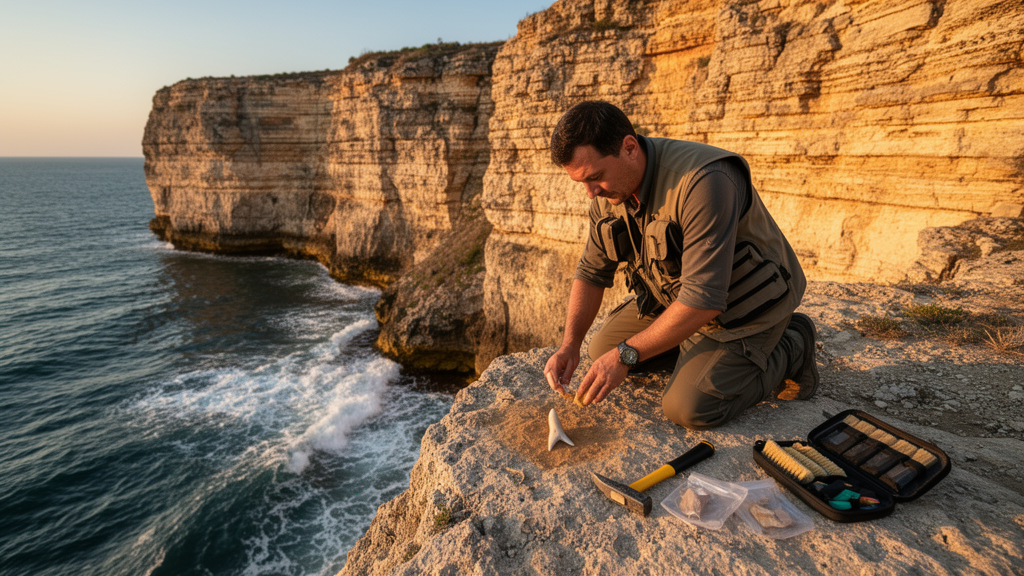
A bulk-sampling paleontology study of the Byala 2b section in Bulgaria documented at least 18 shark genera across the Cretaceous-Paleogene boundary, identifying both extinction survivors and new arrivals in the earliest Paleogene. The assemblage included 535 elasmobranch teeth and 111 dermal denticles recovered from 297 kg of sediment collected during a 2024 field campaign.
Researchers sampled one horizon from the uppermost Maastrichtian, five horizons from the lowermost Danian and the boundary clay. The sampled sediment weighed 52.4 kg in the Maastrichtian horizon, 234.6 kg across the five Danian horizons and 10 kg in the boundary clay. After drying and chemical disaggregation, the material was sieved to 320 μm. This was an observational fossil study based on one continuous marine succession, rather than a global analysis of shark extinction.
The Byala section lies on Bulgaria’s Black Sea coast and contains hemipelagic marls and marly limestones deposited at the continental margin of the northern Neotethys. Paleogeographic reconstructions place the site at approximately 29° N during the transition. Its sedimentary succession records orbital precession and eccentricity cycles, while calcareous nannoplankton biozones provide the biostratigraphic framework. The age model indicates that the sampled post-boundary horizons span no more than about 100,000 years, with the first Danian couplets deposited approximately 21,000 years after the boundary event.
The boundary clay contained elevated iridium, cobalt, nickel and rare earth elements, with iridium reaching 6.1 ppb. Nannofossil evidence places the boundary between the final Cretaceous zone, CC26, and the lowest Paleogene zone, NP1. Although these data help locate the stratigraphic transition, the elasmobranch results are based on teeth and denticles whose preservation is uneven, and the lowest sample of boundary clay was too small to represent a reliable measure of original diversity.
The uppermost Maastrichtian horizon contained eight distinguishable taxa and was dominated numerically by squaliform sharks, including members or morphotypes of the families Centrophoridae, Somniosidae and Etmopteridae. Genera represented in the sample included Deania, Centrodeania, Cretascymnus, Protoxynotus and Incognitorapax. One damaged tooth was tentatively attributed to Hemiscylliidae. Because most teeth were poorly preserved, the researchers did not count every isolated squaliform cusp or indeterminate elasmobranch tooth as an additional taxon.
Diversity varied among the Danian samples rather than changing in a single step. Six taxa occurred in the first sampled Danian horizon, followed by two in Horizon 3 and six in Horizon 4. Hexanchiformes first appeared in Horizon 5, and Horizon 6 contained seven taxa, the highest count among the sampled Danian horizons. The later assemblages added hexanchids, chlamydoselachids, Carcharias, mitsukurinids and the triakid genus Palaeogaleus. Squalus and the dalatiid Angoumeius also appeared above the boundary, while several groups recorded in the Maastrichtian returned in the Danian.
The continuous sequence provided direct evidence that two squaliform genera crossed the boundary. Cretascymnus was represented below the boundary and again in Horizons 4 and 5, including a well-preserved tooth assigned to C. beauryi; the authors therefore regarded the genus as a survivor rather than one confined to the Cretaceous. Incognitorapax occurred in the Maastrichtian, boundary clay and Danian horizons, providing its first continuous record across a K-Pg succession at a single locality. A Danian tooth of Angoumeius extended that genus’ documented first appearance from the Eocene to the earliest Paleocene.
Comparison with intensively sampled sections elsewhere indicated that local environmental conditions influenced the expression of the extinction. At the neritic Waidach section in Austria, the Maastrichtian assemblage was dominated by squaliforms, whereas the earliest Danian assemblage showed a pronounced reorganization associated with shallowing and increasing oxygenation. At the deeper-water Gams section, changes included a shift in the relative abundance of squaliforms and the appearance of deep-water groups such as chlamydoselachids and mitsukurinids. These contrasts indicate that regional turnover cannot be interpreted as a uniform response across marine environments.
Byala yielded no batomorph teeth, which the authors associated with low bottom-water oxygenation. However, they cautioned that quantitative estimates of genus loss were not reliable because numerous teeth were too poorly preserved for firm taxonomic resolution, and the boundary-clay sample comprised only 10 kg. The study therefore provides a high-resolution, locality-level record of survival, first appearances and faunal turnover rather than a precise measure of extinction intensity across the entire elasmobranch fauna.
Subject of Research: Elasmobranch diversity and turnover across the Cretaceous-Paleogene boundary at Byala, Bulgaria
Article Title: Revealing elasmobranch diversity across the Cretaceous-Paleogene boundary in the Central Tethys (Byala, Bulgaria)
Article References: Feichtinger, I., Beaury, B., Guinot, G., Harzhauser, M., Nichterl, T., Stoykova, K., & Pollerspöck, J. (2026). Revealing elasmobranch diversity across the Cretaceous-Paleogene boundary in the Central Tethys (Byala, Bulgaria). Fossil Record, 29(1), 57-70. https://doi.org/10.3897/fr.29.182659
Image Credits: AI Generated
DOI: 10.3897/fr.29.182659
Keywords: elasmobranch fossils, shark diversity, Cretaceous-Paleogene boundary, Byala 2b, Bulgaria, Central Tethys, fossil teeth, faunal turnover, extinction survivors, paleontology, Revealing, elasmobranch
Cite Scienmag News
Violet Maxwell. (October 20, 2026). Bulk sampling of Bulgaria’s Byala section documents shark turnover across the K-Pg boundary. Scienmag. https://scienmag.com/bulk-sampling-of-bulgarias-byala-section-documents-shark-turnover-across-the-k-pg-boundary/
Violet Maxwell. "Bulk sampling of Bulgaria’s Byala section documents shark turnover across the K-Pg boundary." Scienmag, 20 October 2026, https://scienmag.com/bulk-sampling-of-bulgarias-byala-section-documents-shark-turnover-across-the-k-pg-boundary/. Accessed 20 October 2026.
Violet Maxwell. "Bulk sampling of Bulgaria’s Byala section documents shark turnover across the K-Pg boundary." Scienmag. October 20, 2026. https://scienmag.com/bulk-sampling-of-bulgarias-byala-section-documents-shark-turnover-across-the-k-pg-boundary/


