


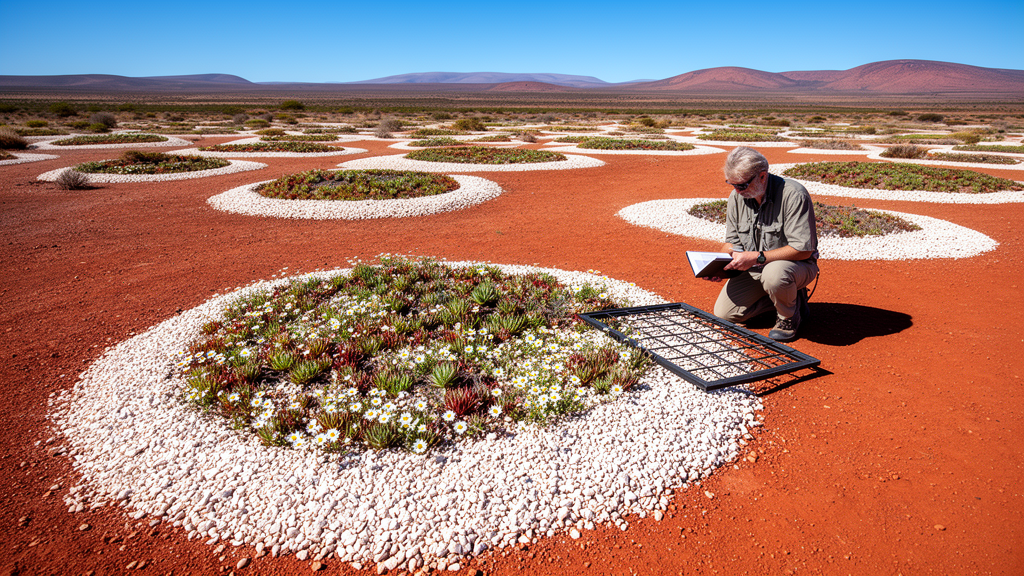
Scattered across the hyper-arid plains near Pofadder in South Africa's Northern Cape Province, white quartz gravel patches stand out sharply from the surrounding semi-desert steppe. These quartz islands, as ecologists call them, are edaphic habitat islands: patches of angular quartz pebble with shallow, acidic soils and near-ground temperatures up to 8 kelvin cooler than adjacent ground, thanks to the high albedo of white quartz. A new study published in Frontiers of Biogeography now provides the first biogeographic assessment of these quartz islands in a summer-rainfall region, and its findings challenge the assumption that different facets of biodiversity respond uniformly to island geography.
The research team conducted floristic surveys on 20 quartz islands between February and March 2024, using systematic walk-through observations to ensure comprehensive species detection. The surveys yielded a complete species list per island and recorded 220 vascular plant species across the archipelago. Roughly one third of the species belonged to just three families: Asteraceae, Aizoaceae, and Poaceae.
Species richness varied dramatically among islands, ranging from 23 to 105 species, a difference of 82 species between the poorest and richest islands. Beyond counting species, the researchers measured functional traits for 134 perennial species, representing more than 80 percent of all perennial species recorded across the islands. Nine traits were quantified following standardized protocols: plant height, specific leaf area, leaf water content, relative leaf phosphorus content, stem succulence, and the presence or absence of epidermal trichomes, prickles, wax coating, and glands.
Each trait captures a different ecological strategy, from drought tolerance to defense against herbivory. From these measurements the team calculated functional dispersion, defined as the mean distance of individual species to the centroid of the community in trait space. This metric is considered robust to outliers and largely independent of species richness, and the authors confirmed that their estimates showed no significant correlation with species counts.
To capture the evolutionary dimension of diversity, the team reconstructed a phylogeny for all recorded species using a megatree backbone and calculated the mean pairwise distance, which measures the average branch distance between all species pairs in a community. This metric is conceptually similar to functional dispersion but reflects deeper lineage history rather than trait values. Island geography was quantified through remote sensing.
The researchers mapped quartz islands by supervised classification of Sentinel-2 multispectral imagery at 10-meter resolution, using a Maximum Entropy Presence Prediction tool and, at two sites, a one-class Support Vector Machine. Model accuracy was evaluated against withheld ground-truth points. From the resulting island polygons and a digital elevation model, the team derived eleven biogeographic parameters grouped into three categories: island shape (area, perimeter, shape index), isolation (nearest neighbour distance, neighbour index, proximity index, and area-based isolation metrics), and habitat diversity (habitat Shannon diversity, habitat richness, and related indices based on slope, aspect, convexity, and surface texture).
Statistical analysis revealed strikingly divergent responses across the three diversity facets. For species richness, the best-supported model contained four parameters and reduced deviance by about 80 percent relative to the null model. Island area emerged as the strongest predictor, exerting a highly significant positive effect consistent with classical island biogeographic theory.
Larger islands offer more resources and space, reduce the risk of population extinction, and enhance the chance of colonization by erratic dispersal. The shape index showed a significant negative effect, indicating that more irregular island outlines flatten the species-area relationship. Partitioning of explained deviance showed that island shape accounted for more than 80 percent of the variation in species richness, while habitat diversity and isolation jointly contributed roughly 15 percent.
Functional dispersion told a different story. The best model explained 70 percent of the variation, but island connectivity, quantified by the neighbour index, was the strongest positive predictor, while nearest neighbour distance and habitat Shannon diversity were significantly negatively related. Variance partitioning revealed that isolation and connectivity metrics accounted for roughly 60 percent of the explained variation, with habitat diversity contributing the remainder.
Notably, island area showed no detectable effect on functional dispersion. The authors attribute this to trait redundancy in species-rich communities: additional species on larger islands likely occupy similar trait combinations rather than expanding the occupied trait space, so functional diversity becomes decoupled from species richness. The narrow range of functional dispersion values across islands, from 0.1187 to 0.1564, further points to strong environmental filtering and broadly similar functional composition among communities.
Phylogenetic diversity responded to yet another parameter. After excluding one highly influential observation identified through diagnostic checks, the best-supported model retained only the area of the nearest neighbour island as a significant positive predictor, explaining about one third of the variance in mean pairwise distance. This suggests that phylogenetic diversity is primarily shaped by the immediate size of the closest potential source area rather than by broader network connectivity.
The absence of stronger isolation signals aligns with studies on other habitat island systems showing weak or random relationships between phylogenetic diversity and insularity. The divergent responses across taxonomic, functional, and phylogenetic facets carry important implications for conservation. Quartz islands occur largely on privately owned land, where threats such as poaching of rare and endemic dwarf succulents persist.
The findings suggest that conservation should safeguard both large islands, given the strong area effect on species richness, and well-connected networks of intact islands, which appear crucial for maintaining functional diversity. Maintaining connectivity is also likely to support dispersal and gene flow among islands, enhancing the adaptive potential of quartz island floras under ongoing global change. More broadly, the study underscores the need for multidimensional biodiversity assessments in habitat islands.
Focusing solely on species richness would have missed the connectivity effects on functional diversity and the area-based isolation effects on phylogenetic diversity. Because quartz islands occur across multiple archipelagos along a wide bioclimatic gradient in South Africa and southern Namibia, they offer an exceptional natural system for comparative habitat island biogeography. Future research extending taxonomic, functional, and phylogenetic analyses across regions at larger scales could identify the main drivers of diversity patterns and determine how climate shapes functional trait space and island-biogeographic relationships in otherwise comparable edaphic environments.
Subject of Research: Biogeographic drivers of taxonomic, functional, and phylogenetic plant diversity on quartz habitat islands in southern Africa
Article Title: Diverging responses of taxonomic, functional, and phylogenetic plant diversity to biogeographic parameters in arid habitat islands of southern Africa
Article References: Bürger, A. M., Meyer, K., Eibes, P. M., Lauel, C., Oldeland, J., Schmiedel, U., & Irl, S. D. H. (2026). Diverging responses of taxonomic, functional, and phylogenetic plant diversity to biogeographic parameters in arid habitat islands of southern Africa. Frontiers of Biogeography, 19, Article e167957. https://doi.org/10.21425/fob.19.167957
Image Credits: AI Generated
Keywords: quartz islands, habitat islands, island biogeography, plant diversity, functional diversity, phylogenetic diversity, species richness, South Africa, Nama-Karoo, environmental filtering, conservation, remote sensing
Cite Scienmag News
Margaret Porter. (October 20, 2026). Quartz islands reveal diverging diversity responses in arid South Africa. Scienmag. https://scienmag.com/quartz-islands-reveal-diverging-diversity-responses-in-arid-south-africa/
Margaret Porter. "Quartz islands reveal diverging diversity responses in arid South Africa." Scienmag, 20 October 2026, https://scienmag.com/quartz-islands-reveal-diverging-diversity-responses-in-arid-south-africa/. Accessed 20 October 2026.
Margaret Porter. "Quartz islands reveal diverging diversity responses in arid South Africa." Scienmag. October 20, 2026. https://scienmag.com/quartz-islands-reveal-diverging-diversity-responses-in-arid-south-africa/


