


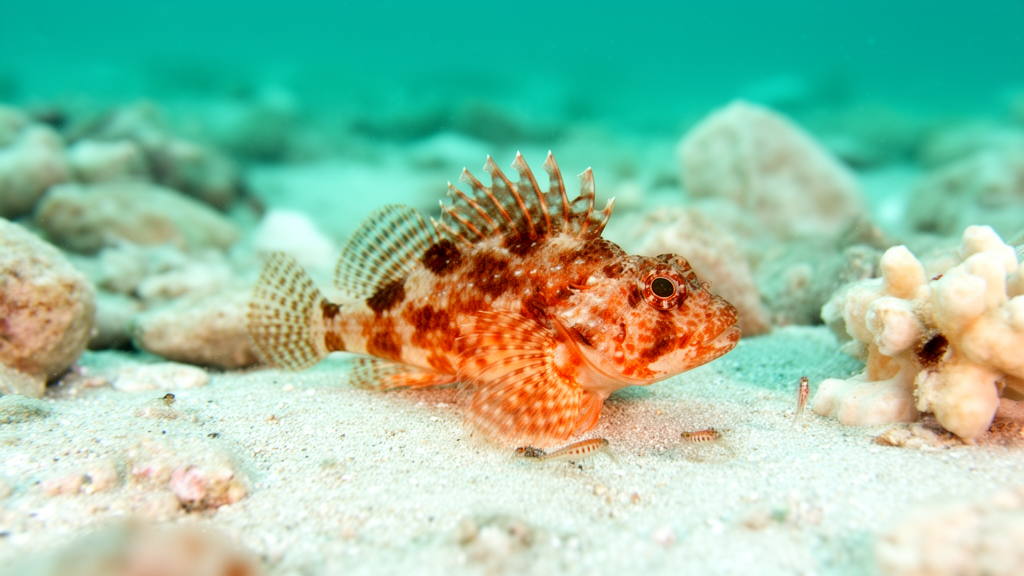
A small, scaleless fish with an armored, thorny head has rewritten the map of its own existence. Researchers report the first record of the Japanese spiny dragonet, Callionymus draconis, from Indian waters, based on a single male specimen pulled from the trawl bycatch off Kanyakumari, Tamil Nadu, at the southernmost tip of India. The find extends the species' known range roughly 5200 kilometers westward, from the western Pacific into the southeastern Arabian Sea, and establishes the westernmost limit ever documented for this elusive bottom-dweller.
The specimen, measuring 71.0 mm in standard length, was collected in August 2025 from the bycatch of multiday trawlers operating off Kanyakumari and landed at Colachel Fishing Harbour, at coordinates 8°10'21"N, 77°15'00"E. It was fixed in 10% formalin and deposited in the marine fish collection of the Fisheries College and Research Institute in Thoothukudi, India, under catalogue number FCRI.CAL.005. The study, published in Acta Ichthyologica et Piscatoria, provides a full morphological description alongside comparisons with type specimens from Japan and Western Australia.
Dragonets belong to the family Callionymidae, a group of benthic marine fishes comprising 201 valid species in 11 genera, distributed from tropical to temperate waters and from shallow coastal zones to depths exceeding 900 m. The genus Callionymus alone contains 121 valid species. The Japanese spiny dragonet sits within the subgenus Callionymus (Spinicapitichthys), a name derived from the Latin spina (thorn) and caput (head), reflecting the elaborate cephalic armature that defines this lineage: a preopercular spine bearing a straight main tip with antrorse serrations dorsally and ventrally, a strong basal spine, and an occipital region often armored with high bony protuberances.
Before this discovery, C. draconis was known only from the eastern Indian Ocean and the western Pacific, with confirmed records from southern Japan, the East China Sea, and off Carnarvon, Western Australia, at depths of approximately 138 to 150 m. The species was originally described by Nakabo in 1977 from a specimen collected off Kochi Prefecture, Japan, at about 150 m. Fricke later reported it from Western Australia under the name Callionymus csiro, which Nakabo and colleagues synonymized with C. draconis in 1992.
The Indian specimen was captured at a depth of roughly 80 to 100 m, making it the shallowest recorded occurrence for the species and indicating a broader bathymetric range than previously documented. Identification rested on a suite of diagnostic characters. The Indian male displays a preopercular spine with 4 to 6 antrorse serrae on its dorsal margin and 4 on its ventral margin, an elongate supraorbital tentacle, meristic counts of dorsal-fin elements IV + vii, 1 and anal-fin elements vii, 1, and a distinctive coloration featuring yellow spots on the upper caudal fin and boldly alternating vertical streaks of dark and pale on the caudal fin.
Within the seven species of the subgenus, these traits separate C. draconis from C. alisae, C. io, C. muscatensis, C. obscurus, C. oxycephalus, and C. spiniceps, which differ in spine formulae, supraorbital tentacle length, anal-fin ray counts, and dorsal-fin spine proportions. Morphometric comparisons with Japanese and Australian specimens reveal only slight intraspecific variation. Head length in the Indian specimen measures 32.4% of standard length, falling near the documented range of 33.5% to 35.5%, while caudal fin length reaches 83.8% of standard length, within the reported span of 53.2% to 94.0%.
Such proportional differences are consistent with phenotypic or ontogenetic variation in widespread cryptobenthic fishes. The specimen's sex was confirmed by the presence of an elongate urogenital papilla measuring 2.8% of standard length, along with the longer caudal fin and yellow caudal spots that Nakabo and colleagues documented as male traits in this species. The fresh specimen presents a striking appearance: the dorsum of the head and body is dark brownish grey, heavily mottled with blackish-grey and pale creamy spots, transitioning sharply to pale creamy-greyish white on the ventral flanks.
The first dorsal fin is dark grey to black, the second dorsal fin mottled dark brown and whitish, and the pectoral fin translucent with faint vertical rows of dark spots. The anal fin is bicolored, with a dark distal half and pale base, while the caudal fin carries bold alternating vertical streaks and conspicuously dark elongated mid-rays. In preservation, the ground color fades and the black blotches and bars become more distinct.
Like all dragonets, C. draconis exhibits a benthic, scaleless, elongate body plan with pronounced sexual dimorphism. Species of the subgenus Spinicapitichthys are cryptobenthic inhabitants of continental shelf soft-bottom substrates across the Indo-west Pacific, using burial in sediment as a primary behavioral adaptation. The biogeographical implications are significant.
The new record establishes a link between the dragonet faunas of the western Pacific and the western Indian Ocean, supporting the concept of a continuous distribution for several cryptobenthic fishes along the soft-bottom habitats of the Indo-Pacific continental shelf. Unrecorded populations may inhabit the intervening regions, awaiting detection. The finding enriches the documented marine fish diversity of India and refines understanding of Indo-Pacific fish biogeography, suggesting that outer continental shelf regions across the species' range may harbor populations at shallower depths than the deeper slopes from which it was previously known.
The discovery also underscores the critical role of bycatch surveys in revealing cryptic marine biodiversity.
Subject of Research: First Indian record of the Japanese spiny dragonet, Callionymus draconis, from Tamil Nadu, extending its range 5200 km westward
Article Title: Westernmost record of the Japanese spiny dragonet, Callionymus draconis ( Actinopterygii , Callionymiformes , Callionymidae ), from Tamil Nadu, southern India
Article References: Ragul, S., Balaganesan, M., Karuppasamy, K. K., Durairaja, R., Jayakumar, N., & Fricke, R. (2026). Westernmost record of the Japanese spiny dragonet, Callionymus draconis (Actinopterygii, Callionymiformes, Callionymidae), from Tamil Nadu, southern India. Acta Ichthyologica et Piscatoria, 56, 111-116. https://doi.org/10.3897/aiep.56.181255
Image Credits: AI Generated
Keywords: Callionymus draconis, dragonet, range extension, marine biogeography, trawl bycatch, India, Arabian Sea, cryptobenthic fishes, Westernmost, record, Japanese, spiny
Cite Scienmag News
Margaret Porter. (October 20, 2026). Japanese spiny dragonet turns up 5200 km west of its known range off southern India. Scienmag. https://scienmag.com/japanese-spiny-dragonet-turns-up-5200-km-west-of-its-known-range-off-southern-india/
Margaret Porter. "Japanese spiny dragonet turns up 5200 km west of its known range off southern India." Scienmag, 20 October 2026, https://scienmag.com/japanese-spiny-dragonet-turns-up-5200-km-west-of-its-known-range-off-southern-india/. Accessed 20 October 2026.
Margaret Porter. "Japanese spiny dragonet turns up 5200 km west of its known range off southern India." Scienmag. October 20, 2026. https://scienmag.com/japanese-spiny-dragonet-turns-up-5200-km-west-of-its-known-range-off-southern-india/


