


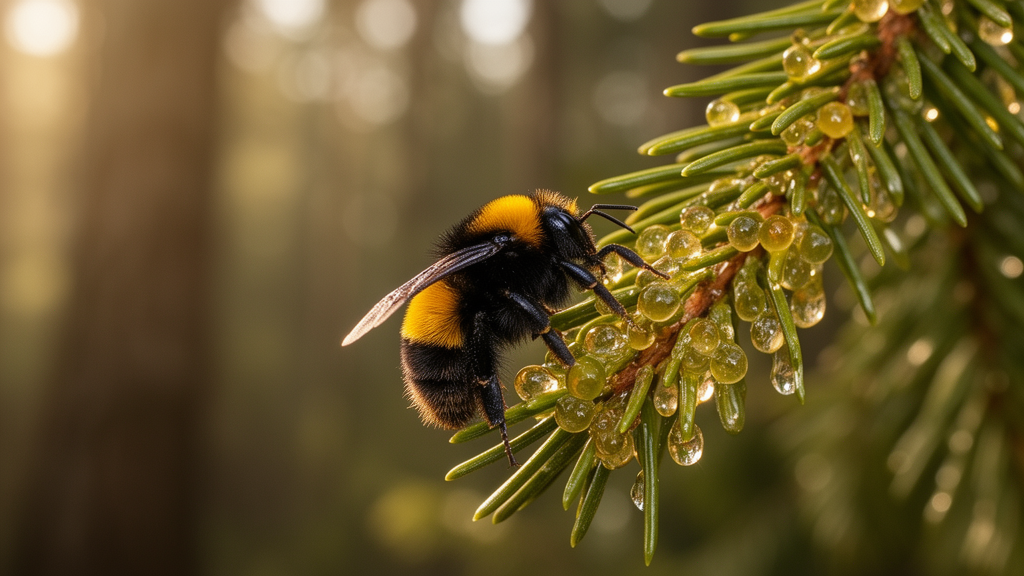
A June 2024 observational study at Hacettepe University in Ankara, Türkiye, recorded approximately 20 buff-tailed bumble bee workers, Bombus terrestris, feeding on honeydew produced by the globose scale insect Sphaerolecanium prunastri on a cherry plum tree, Prunus cerasifera. This field observation and chemical analysis provide evidence that B. terrestris can use scale-insect honeydew as an available food resource, but they do not establish its effects on bee fitness or the ecological relationship between the insects. B. terrestris is a widespread species in the Western Palaearctic, native to temperate Eurasia and widely introduced elsewhere for crop pollination.
The study examined a small sample of wild workers at one campus site rather than comparing managed colonies or testing bee health outcomes. Observations of bumble bees using scale honeydew remain scarce, while earlier accounts have mainly described honeydew produced by aphids. Cameron and colleagues proposed that heat- and drought-related stress could shift B. terrestris toward evaporated aphid honeydew when floral nectar is limited; that account was a proposed mechanism rather than a directly observed result of the current study.
Honeydew is a carbohydrate- and amino-acid-rich excretion produced by sap-feeding insects. Scale insects use piercing mouthparts to reach phloem sap, and their honeydew can coat branches and leaves and facilitate sooty mold growth, potentially reducing photosynthetic capacity. Some animals nevertheless consume honeydew as food.
The best-known example is the association between aphids and ants, in which ants receive honeydew and may protect aphid colonies. Lepidopterans, spiders, neuropterans and various hymenopterans can also consume honeydew, often indirectly, while the relationship between pine scale, Marchalina hellenica, and the honey bee Apis mellifera is documented in Greece and Türkiye. The approximately 10-square-kilometre Hacettepe University campus is bordered by pine plantations and open areas with steppe vegetation.
The surrounding semi-natural landscape, supported by irrigation and landscaping, also contained flowering plants including Daucus carota, Carduus nutans var. nutans, Hypericum perforatum, Stachys annua subsp. annua, Convolvulus lineatus, Centaurea triumfettii, Anchusa azurea var. azurea, Sideritis montana, Salvia absconditiflora, Lamium amplexicaule, Trifolium species and Astragalus species. During the June 2024 observations, the S. prunastri colonies consisted mainly of young females located on the undersides of P. cerasifera branches. Although honeydew droplets were present on both leaves and branches, the approximately 20 B. terrestris workers were observed collecting it exclusively from the colonized branches.
Female scale insects were preserved in 75% ethanol and identified using established criteria, while the bumble bees were identified according to the reference of Rasmont and colleagues. Flowering plants in the area were determined using the Flora of Turkey and the Beytepe Bitkileri reference. For chemical analysis, the researchers placed a 30-by-50-centimetre glass sheet beneath the tree from 11:00 to 14:00.
They retrieved the deposited honeydew by gently scraping it from the glass with a razor blade and stored the samples at minus 20 degrees Celsius. High-performance liquid chromatography was then used to quantify glucose, fructose, sucrose and galactose in triplicate. The samples contained glucose at 13.3 ± 0.1 mg/mL, fructose at 4.7 ± 0.0 mg/mL and sucrose at 3.3 ± 0.0 mg/mL; galactose was not detected.
Glucose was therefore the dominant measured sugar. The authors characterized the overall sugar concentrations as low and considered the profile consistent with the variable and often dilute composition of scale-insect honeydew. Its composition can differ with host-plant chemistry and the metabolic processes of the producing insect.
Previous studies cited by the researchers found substantial variation among scale-insect species and host plants, with many scale insects producing honeydew more dilute than aphid honeydew or most floral nectars. The measured profile therefore represents a modest carbohydrate source with a specific composition rather than evidence of high nutritional value. Two previously described traits may help explain how B. terrestris detects and uses dilute sugars: workers have dense antennal taste receptors, and earlier experiments found that they can shift their sugar preference toward fructose after exposure to fructose-rich resources.
The species is also polylectic, visiting plants across numerous families in Türkiye. The authors regarded hydration as an unlikely primary explanation because the campus was regularly irrigated and included several water sources, such as ornamental ponds, wet soil and irrigation runoff. They therefore considered carbohydrate collection more consistent with supplemental energy foraging, although the observation alone cannot establish the bees’ physiological purpose or quantify their intake and energy gain.
Because honeydew collection occurred despite a rich floral assemblage, this case differs from reports that associate honeydew feeding with nectar scarcity. The authors interpret the observation as evidence of opportunistic use that is not restricted to a food-shortage response, not as proof of a mutualistic relationship between bees and scale insects. The study was limited by its single-campus setting, one June observation period, small observed sample and descriptive design.
It did not compare honeydew-fed with nectar-fed bees, quantify survival or reproduction, test the proposed mold-removal effect, or examine how temperature and relative humidity influence honeydew availability and foraging. The authors recommend more detailed chemical analysis, investigation of interactions with other wild bee species and evaluation of abiotic conditions to clarify honeydew’s ecological role in pollinator foraging.
Subject of Research: Observational evidence of buff-tailed bumble bees foraging on globose scale honeydew in Türkiye
Article Title: Sweet connections: the role of honeydew in supporting wild Bombus terrestris populations ( Hymenoptera , Apidae ) – a case study from Türkiye
Article References: Özenirler, Ç., Kamalak, E., Alkazak, A. D., Daşer Özgişi, B., Çilden, E., Ülgentürk, S., & Aytekin, A. M. (2026). Sweet connections: the role of honeydew in supporting wild Bombus terrestris populations (Hymenoptera, Apidae) – a case study from Türkiye. Journal of Hymenoptera Research, 99, 59-66. https://doi.org/10.3897/jhr.99.172251
Image Credits: AI Generated
Keywords: Bombus terrestris, bumble bees, honeydew, Sphaerolecanium prunastri, scale insects, foraging behavior, Türkiye, Ankara, pollinators, field observation, Sweet, connections
Cite Scienmag News
Gavin Prescott. (October 20, 2026). Observation study records buff-tailed bumble bees feeding on scale-insect honeydew in Ankara. Scienmag. https://scienmag.com/observation-study-records-buff-tailed-bumble-bees-feeding-on-scale-insect-honeydew-in-ankara/
Gavin Prescott. "Observation study records buff-tailed bumble bees feeding on scale-insect honeydew in Ankara." Scienmag, 20 October 2026, https://scienmag.com/observation-study-records-buff-tailed-bumble-bees-feeding-on-scale-insect-honeydew-in-ankara/. Accessed 20 October 2026.
Gavin Prescott. "Observation study records buff-tailed bumble bees feeding on scale-insect honeydew in Ankara." Scienmag. October 20, 2026. https://scienmag.com/observation-study-records-buff-tailed-bumble-bees-feeding-on-scale-insect-honeydew-in-ankara/


